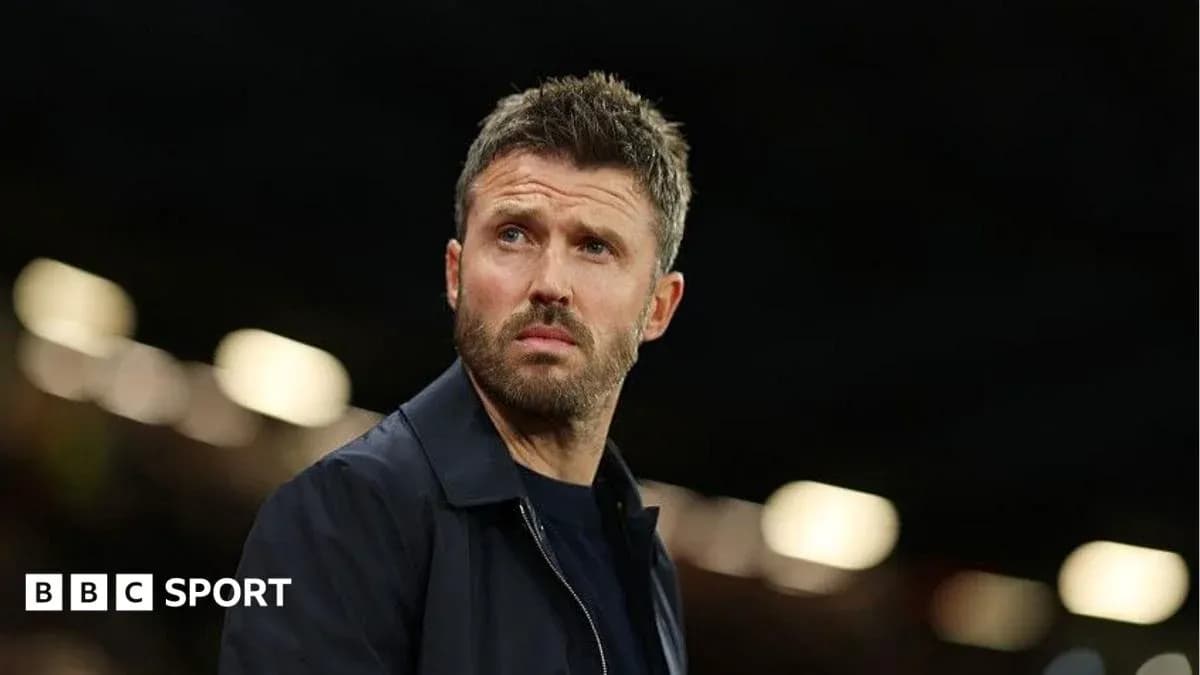
Michael Carrick Defends Position Amid Manchester United Turmoil
Michael Carrick has heard the noise. He has seen the empty seats and felt the boos swirl around Old Trafford. But as the questions grow louder about his future, the Manchester United manager is having none of it.
To him, the idea of counting down his time in the job after a bad week is, in his own word, “ridiculous”.
Under fire after a brutal week
United travel to Fulham on Sunday carrying the weight of a grim few days that have dragged old anxieties back to the surface.
First came the derby defeat: a home loss to Manchester City, who played with 10 men from the 23rd minute and still left Old Trafford with the points and the bragging rights. Then, as if to twist the knife, Brighton arrived in midweek and did something no visiting side had managed in 50 years in the League Cup at this stadium – come back from two goals down to win.
The reaction from the stands was sharp and unforgiving. Boos. Anger. Chants turned against the team. It felt, in the moment, like something was breaking.
Carrick, though, refused to flinch. He insisted in the immediate aftermath that he was “not bothered” by the pressure. Facing the media again before the trip to Craven Cottage, he doubled down.
“I know the club, I know the role, I know what's expected here in terms of playing to a certain standard and achieving certain things on the pitch,” he said. “In terms of future and ownership and how long I've got in the job, that's totally not in my thinking. It's ridiculous to think that way in the position I'm in, that's just not on the radar.”
Two or three bad games? For Carrick, that stings, but it is not a crisis.
“It's two or three games. It's two or three games too many because I really hate losing, but that doesn't mean the world caves in. In some minds it does, it can't for us.”
Board backing and a jarring contrast
Inside the club, the mood is calmer than the outside storm suggests. Senior figures at United are not, at this stage, treating Carrick’s position as under threat. Their gaze is fixed instead on why so many players are underperforming compared to the standards they set under him last season.
That comparison is stark.
Across the second half of last season, Carrick’s United won 12 of 17 matches. They looked organised, purposeful, and on an upward curve. This campaign has started with a far more hesitant stride: two wins from six games, one of them a comeback at newly promoted Ipswich, the other against Sabah FK, the champions of Azerbaijan, in the Champions League.
“It's not a catastrophe or a disaster,” Carrick said. “It's not the end of the world.”
Around Manchester United, though, everything feels bigger. Every wobble becomes a crisis, every misstep an inquest. Carrick knows that. He lived it as a player and now carries it as a manager.
He accepts that problems at Old Trafford are amplified, magnified, sometimes distorted. That does not dull his attachment to the job.
A manager who still wants the fight
For all the turbulence, Carrick’s affection for the club remains obvious. This is where he won titles, where he started his coaching journey, and where he now stands in the firing line.
“There's great feelings, and there's obviously disappointments, and sometimes the smaller disappointments lead to being a little bit bigger,” he said. “It's just part of coping and being at this great football club.
“I wouldn't want to be anywhere else, genuinely.
“It's the best place for me to be, in part because of the times when it's maybe not going to plan. Sometimes they are best times to work your way through, to find out a few things and come out an awful lot stronger.”
That is the version of events Carrick is clinging to: a rough patch, not a breaking point. A test, not a verdict.
Questions over recruitment, answers from within
Outside the dressing room, the post-mortem has already begun. Fingers have been pointed at recruitment – particularly at left-back, where United’s lack of depth has been exposed – and at the club’s finances and debt. Carrick’s own inexperience has been highlighted too, along with that of his backroom staff, with assistant Steve Holland the notable exception.
Carrick refuses to join the blame game.
“We all search for things to look at and point at, or whatever reason it may be and find a blame. Blame me. No problem. I will take the responsibility,” he said.
“But it's not about blaming people. It's about us, it's about us finding solutions and being better. That's as a whole football club.”
There is at least a sliver of positive news on the team sheet. Carrick revealed that Luke Shaw and new signing Carlos Baleba “have a chance” of being fit for the trip to Fulham, a potential boost in an area of the pitch that has drawn so much scrutiny.
United now walk into a crucial stretch of the season with their manager insisting he will not be consumed by speculation or swallowed by the noise. The question is no longer whether Michael Carrick can handle the pressure.
It is whether his players can match his resolve when they walk out at Craven Cottage.