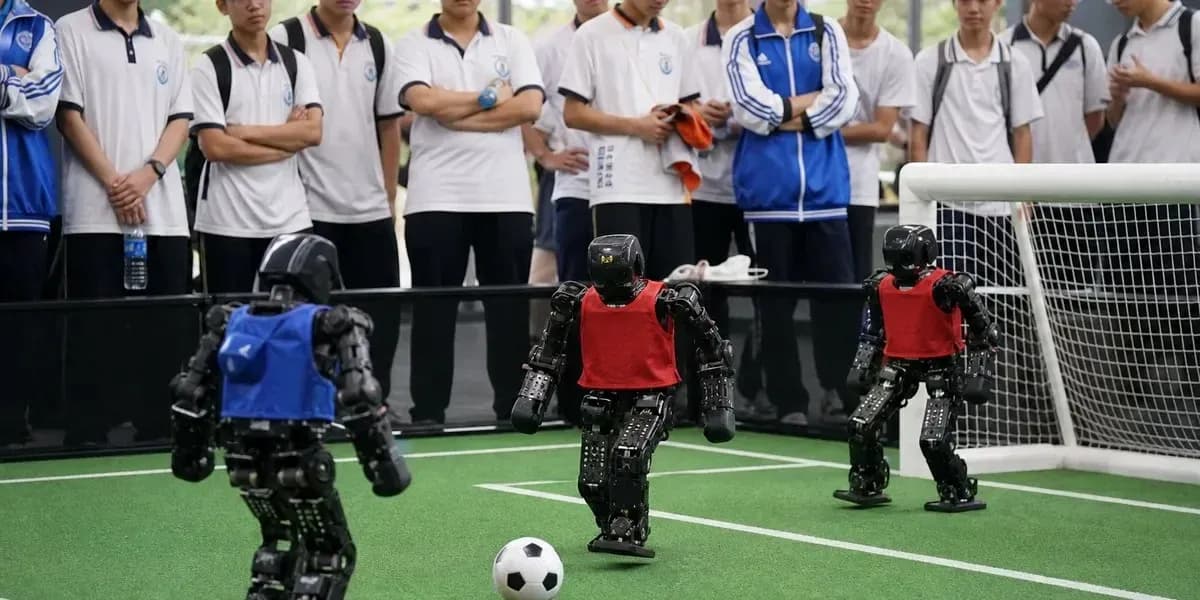
Nanning Hosts China's First Humanoid Robot Football Carnival
The whistle blew in Nanning on Thursday, but the players who shuffled into position were nothing like the ones usually found under stadium floodlights. No shin pads. No nerves. Just steel, sensors, and code.
China’s first humanoid robot football carnival for secondary school students kicked off in the capital of the Guangxi Zhuang Autonomous Region, turning a slice of southern China into a test bed for the future of the sport. More than 40 schoolchildren from 10 educational institutions have traded bibs and boots for laptops and algorithms, ECNS reports.
They are not playing the matches. They are coaching them.
Three-on-three, no joystick in sight
The format is stripped down and sharp: three-on-three football, all robots, no human intervention once the whistle goes. Each team fields Booster K1 humanoid robots, identical in hardware, which means the real battle takes place long before kick-off — in code, not in the penalty area.
Once the game starts, the machines run fully autonomously using artificial intelligence. They scan, decide, and move on their own. No remote controls. No mid-game tinkering. If a robot mistimes a tackle or loses its mark, that mistake belongs to the students’ programming.
For Guangxi, this is a statement event. Organizers describe it as the largest and highest-level humanoid robot football competition ever staged in the region for secondary school students. On the surface, it looks like a carnival. Underneath, it is a classroom with a scoreboard.
Football, science fair, and regional showcase
The timing is no accident. The carnival runs alongside the 23rd China-ASEAN Expo, held in Nanning from September 17 to 21, folding this experimental football into a much bigger story about technology and regional cooperation.
Around the pitch, the program stretches far beyond the three-on-three matches. Scientific events, interactive demonstrations, and China-ASEAN exchanges fill out the schedule. Parents and children drift between hands-on activities and the robot games, where the line between spectator and student blurs quickly.
One of the expo’s three exhibition zones this year is devoted entirely to artificial intelligence and exchanges in that field. Its theme — “CAFTA 3.0 Opportunities, Better Life” — sets the tone: AI is not presented as a distant concept, but as something that will shape everyday experience, from trade to education to, yes, football.
On this stage, each Booster K1 shuffling into a passing lane becomes more than a novelty. It is a moving, kicking example of how coding, engineering, and sport can collide in front of a young audience that will grow up with this technology as a norm rather than an exception.
The scoreboard still tells you who wins. The real question, watching metal strikers and robotic goalkeepers learn the rhythms of the game, is how long it will be before this kind of pitch-side experiment starts to influence the way the sport itself is played and taught.