NBA Draft 2023: Value Guards to Target for Fantasy Success
The NBA’s regular season is a month away, and draft rooms are already heating up. This year, guards are where leagues will be won and lost. Prices are scattered, memories of last spring are still clouding judgment, and the sharp fantasy managers are the ones willing to ignore the noise and trust the numbers.
This is the year you buy the dip in the backcourt.
Garland takes the keys in Los Angeles
Darius Garland arrives in Los Angeles with the ball in his hands and a franchise in transition at his feet.
James Harden and Ivica Zubac are gone after last year’s deadline. Kawhi Leonard is expected to follow. What’s left is a Clippers offense that now belongs to a multi-time All-Star who has already proven he can run a team.
The résumé is rock solid. Across the last five seasons, Garland has put up 20.1 points, 2.8 rebounds, 7.3 assists, 1.2 steals and 2.6 threes in 33 minutes per night, hitting 46% from the field, 39% from deep and 87% at the line. That’s an elite 9-cat line on its own. Now layer in the likely spike in usage.
The glimpse of life without Leonard last season was telling. With Kawhi off the floor, Garland’s production jumped to 27.5 points, 2.2 rebounds, 8.5 assists and 1.2 steals per 75 possessions on a 34% usage rate. That’s lead-engine stuff. In formats like High Score, where assists are worth two points each, that kind of playmaking becomes a weekly cheat code.
The Clippers need a focal point. Garland is built to be exactly that.
Murray’s comeback gathers speed in New Orleans
Dejounte Murray has spent the last two years working his way back from an Achilles tear. The numbers say he’s arrived.
He played just 45 games over that span, but down the stretch last season, the old profile resurfaced. This is a former top-25 fantasy pick for a reason. Since the 2021-22 campaign, Murray has averaged 20.7 points, 6.2 rebounds, 7.1 assists, 1.7 steals and 1.9 threes. That’s a star’s box score.
His age helps the story. He has yet to turn 30, and modern medicine has dramatically changed the Achilles timeline. The final 13 games of last season were the proof of concept: 17 points, 5.6 rebounds, 6.6 assists and 1.7 steals in around 28 minutes a night. Essentially his five-year production, delivered in six fewer minutes.
Now he lands in a New Orleans backcourt with Jeremiah Fears and Jordan Poole, flanked by scorers like Zion Williamson and Trey Murphy III. There’s space for him to run the show and time on the ball to do it. Those 1.7 steals alone are worth more than five points per night in High Score scoring. The rest is upside.
Murray isn’t just back. He’s underpriced.
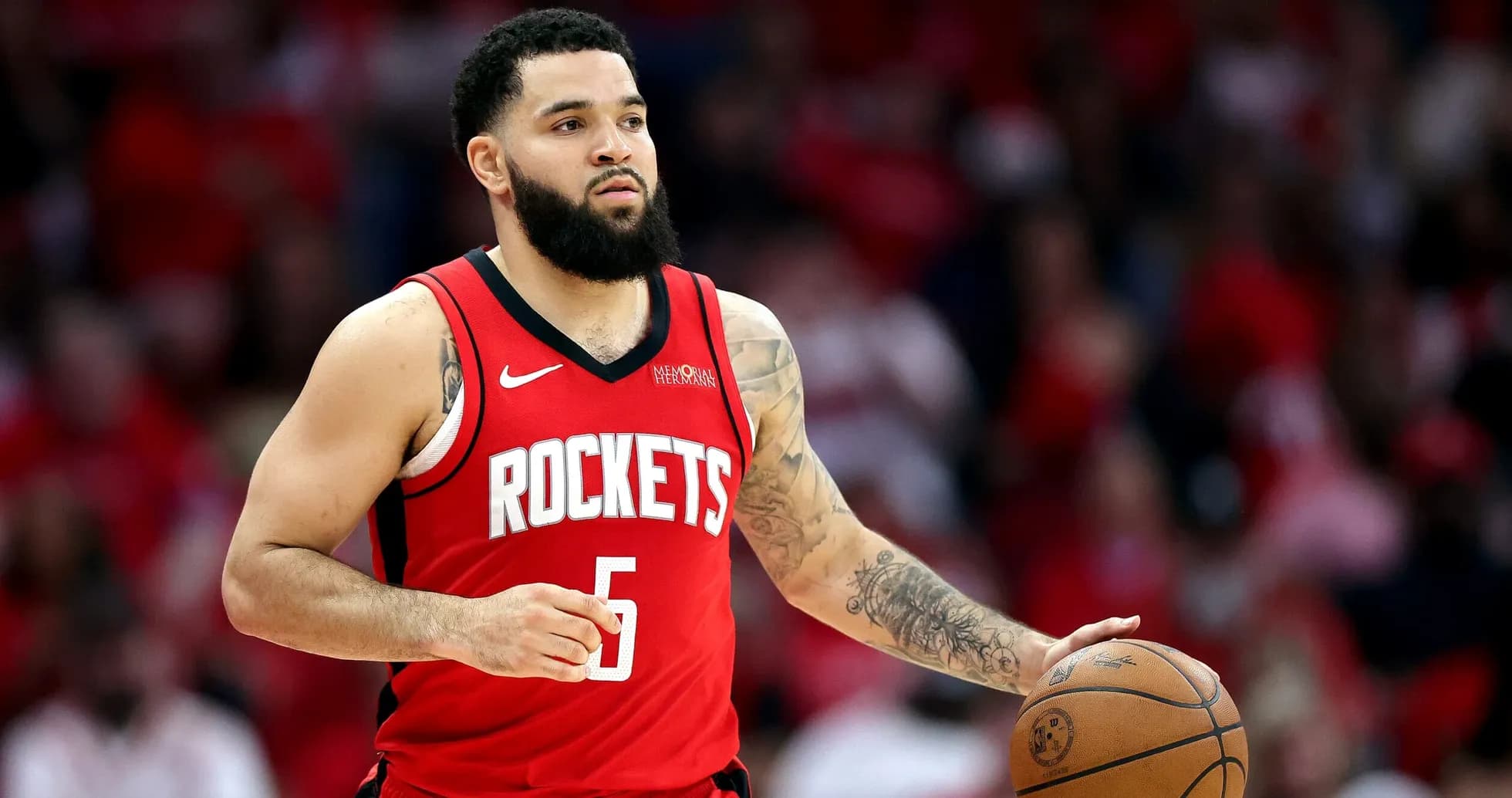
VanVleet’s discount in Houston
Fred VanVleet has lived in the top 50 of fantasy basketball for most of his career. This year, he’s being drafted like an afterthought.
The context: he tore his ACL in September 2025. Reports now say he looks fully healthy. The role is crystal clear — a 35-minute starting point guard job on a Houston team that badly missed his steadiness during its postseason run.
The track record is impossible to ignore. Over the last six seasons, VanVleet has averaged 18.1 points, 4.0 rebounds, 6.8 assists, 1.7 steals, 0.6 blocks and 3.1 threes. That’s a complete guard profile, built for 9-cat formats and point-based leagues alike.
Even if you strip it down to his two-year baseline with the Rockets — 15.9 points, 3.8 rebounds, 6.9 assists, 1.5 steals and 0.6 blocks on solid shooting — his current draft slot looks soft. Houston’s playoff run underscored what his absence cost them in ball-handling and leadership.
The role is there. The history is there. The price is not.
Fox mispriced after a bruising spring
De’Aaron Fox is paying for San Antonio’s spring storylines more than his own production.
Dylan Harper and Stephon Castle exploded in the playoffs. Fox, meanwhile, played through a significant ankle sprain — a brutal combination for a guard whose game is built on burst and change of pace. The narrative cooled. The price dropped.
The numbers didn’t.
Even in what’s framed as a down year, Fox averaged 18.6 points, 3.8 rebounds, 6.2 assists and 1.2 steals. For a player sitting around pick 85, that’s already strong. But it looks more like his floor than his ceiling. His previous six-year baseline sits at 24.3 points, 4.2 rebounds, 6.2 assists and 1.5 steals.
Durability backs it up. Fox has played at least 72 games in three of the last four seasons. In High Score formats, where only one game per week counts, his explosive nights are matchup-breaking. One 35-and-10 outing can flip a week on its own.
San Antonio has new toys. Fox is still the engine.
Quickley’s quiet rise in Toronto
Immanuel Quickley carries a profile that looks a lot like Garland’s. The market, however, has built in a 40-pick gap between them.
That difference comes down to Toronto’s depth chart. The Raptors have a deeper rotation, but they also have Scottie Barnes — a playmaking forward who elevates teammates and thrives alongside a true point guard. That’s where Quickley fits.
Across two full seasons in Toronto, he has averaged 16.6 points, 3.9 rebounds, 5.9 assists, 1.1 steals and 2.6 threes, while shooting nearly 44% from the field, 38% from three and 84% at the line. All of that in just 30.6 minutes a night.
This season, 30 minutes looks like his floor. Behind him are Jamal Shead and Ja’Kobe Walter, capable but not threatening enough to slash his role. Quickley has also appeared in at least 64 games in five of his six NBA seasons, a quiet but crucial edge in long fantasy campaigns.
He doesn’t need more hype. He just needs a fair price. Right now, he’s not getting it.
Pippen Jr. steps into a Memphis vacuum
Memphis has a simple question at point guard after trading Ja Morant: who wants the job?
Scotty Pippen Jr. keeps raising his hand.
Every time the Grizzlies have given him the role, he has produced. Across three seasons in Memphis, he has averaged 10.6 points, 3.2 rebounds, 4.5 assists, 1.4 steals and 1.2 threes in 22 minutes per game. Modest minutes, meaningful impact.
The sample as a starter two years ago is even more revealing. Filling in for Morant, Pippen Jr. put up 14.2 points, 4.5 rebounds and 5.7 assists over 21 games. Last season, he appeared in just 10 games, but he finished the year in the starting lineup.
That’s not a fluke. It’s a pattern.
Factor in a wide-open competition, his fit on a roster that needs a steady hand, and a 155 ADP, and he becomes one of the clearest value plays on the board. If he wins the job outright, that number will look laughable by December.
Ellis lurking in Brooklyn’s chaos
Keon Ellis sits outside the top 200 in most drafts. That might not last long.
Brooklyn’s guard rotation is wide open. The Nets need defense, energy and someone willing to do the dirty work on the perimeter. Ellis has built his fantasy appeal on exactly that.
He has averaged just under 20 minutes per game for his career, yet he’s still delivered 1.2 steals and 0.6 blocks a night. Those are premium defensive numbers for a guard, and they scale beautifully with playing time.
Give him a 30-minute role — which Brooklyn can realistically offer — and the math changes fast. In leagues that pay three points per steal and block like High Score, those categories alone can justify a roster spot.
Ellis doesn’t need to score to matter. He just needs the minutes.
Draft season always tempts managers to chase last year’s headlines. This year, the smarter play might be to lean into opportunity, health and role clarity in the backcourt.
The guards are there. The discounts are real. The only question is who has the nerve to pounce before the rest of the room catches up.