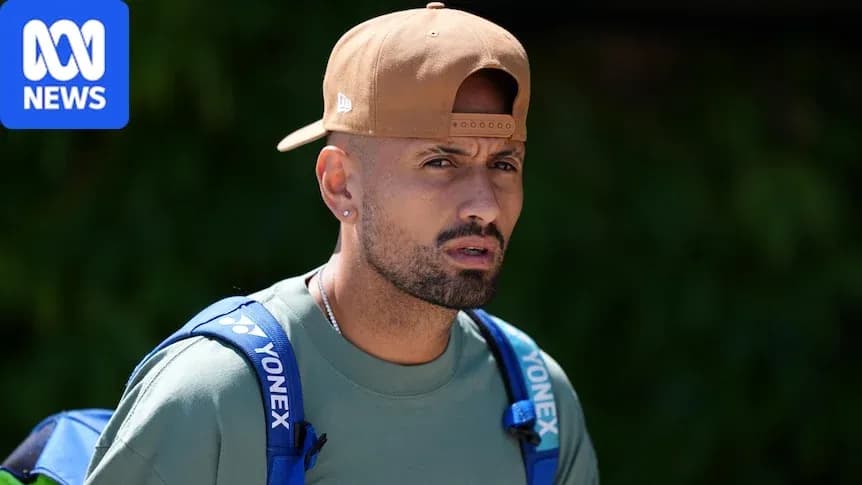
Nick Kyrgios Accepts One-Month Ban After Cocaine Positive
Nick Kyrgios has entered a treatment program and accepted a one‑month ban after testing positive for cocaine, drawing a hard line under one of the most turbulent chapters of his career.
The 2022 Wimbledon finalist, provisionally suspended since August 4, is eligible to return to competition from Friday. That outcome could have been far harsher. Under anti‑doping rules, Kyrgios faced anything from a baseline three‑month sanction to a suspension stretching to four years.
Instead, his admission, cooperation and agreement to seek treatment have dramatically shortened his time out of the sport.
A Night Out, A Positive Test
The failed test dates back to an ATP 250 event in Mallorca, where Kyrgios lost in the first round to fellow Australian Adam Walton and earned 6,570 Euros in prize money. He has now forfeited those earnings.
During an interview with International Tennis Integrity Agency (ITIA) investigators, Kyrgios said his cocaine use had occurred socially during a night out in the days leading up to the tournament, not during competition itself.
The ITIA turned to an independent scientific expert at a World Anti-Doping Agency (WADA)‑accredited laboratory. The expert confirmed that Kyrgios’s account matched the level of cocaine metabolite, benzoylecgonine, found in his sample. On that basis, the ITIA accepted that the use took place out of competition.
Under WADA rules, this type of violation carries a default three‑month suspension. That can be cut to one month if the player commits to an approved treatment program. Kyrgios has done exactly that, triggering the reduction.
The positive result was confirmed by a WADA laboratory on July 17. From that point, the 31‑year‑old was barred from playing, coaching or even attending any tournaments sanctioned by the men’s and women’s tours worldwide, as well as national‑level events in Australia.
He had the right to challenge the provisional suspension. He chose not to.
“I Made a Huge Mistake”
Kyrgios addressed the situation publicly last month in a candid Instagram post.
“I recently failed a drug test in Mallorca after testing positive for cocaine,” he wrote. “I made a huge mistake and I take full responsibility for it.
“I’m sorry to my fans, my family, my sponsors and everyone close to me. Above all, I’m sorry to the kids who follow me. I know the example this sets and I’m deeply disappointed in myself.”
The words carried the weight of a player who has long been a lightning rod for the sport, a showman who has often insisted he never chose tennis, that tennis chose him. Now, facing the prospect of life beyond the game, his off‑court decisions have collided with the strict world of anti‑doping regulation.
A Body Breaking Down, A Career Winding Down
This episode arrives at a time when Kyrgios’s singles career already appears to be fading. He has played only four official singles matches on the ATP Tour this year, his progress stalled by persistent knee and wrist injuries.
“The last couple of years of injuries have taken a huge toll on me, both physically and mentally,” he wrote. “My body hasn’t been able to do what my mind expects it to do, and coming to terms with being near the end of my career has been harder than I ever imagined.”
The Canberra‑born star has spoken openly about feeling close to finished as a singles force. The disconnect between the player he still believes he can be and the body that refuses to cooperate has cut deep.
“I’ve always said I didn’t choose tennis — tennis chose me,” he wrote. “But letting go of something that has been my whole life is one of the hardest things I’ve ever had to face. At times I’ve felt helpless and alone.
“None of that excuses what I did.”
A Wake‑Up Call
For Kyrgios, the sanction is more than a line on a disciplinary record. He has framed it as a turning point.
“The good news is that this has given me a wake up call,” he wrote.
“For the next 28 days, I’ll be stepping away from social media and public life while I focus on getting myself right. I’d ask that people respect my privacy during that time, and most importantly the privacy of my family.
“I’m sorry. I’ll do the work and come back better.”
The ITIA’s decision means he can do that work while knowing exactly where he stands. His world ranking, which once peaked at 13, has already slipped out of the elite. His last appearance came in men’s doubles at Wimbledon on July 2, when he and Alexander Bublik exited in the first round.
Now the punishment is set, the treatment program is under way, and the ban is almost over. The next time Kyrgios walks back into a locker room, the question will not just be how much tennis he has left in him.
It will be whether this jolt, this “wake up call”, is enough to reshape the final act of one of the sport’s most mercurial careers.