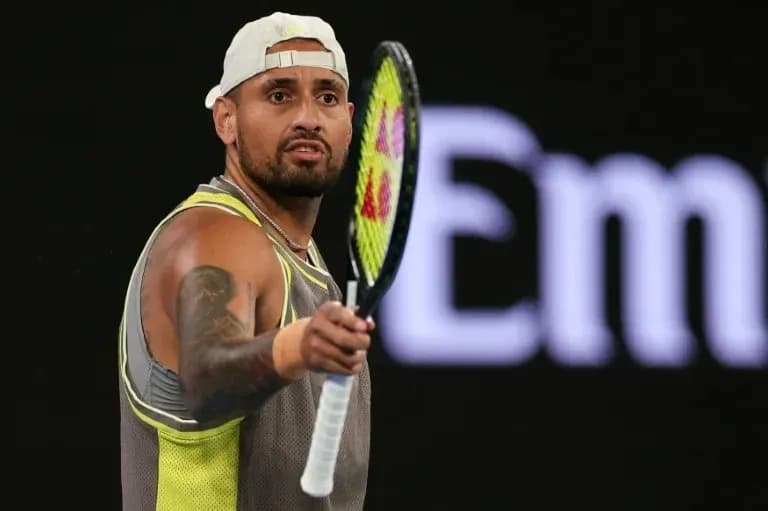
Nick Kyrgios Cleared to Return to Tennis After One-Month Ban
Nick Kyrgios has been cleared to return to tennis after accepting a one‑month ban for cocaine use and enrolling in a treatment programme, the International Tennis Integrity Agency (ITIA) confirmed on Friday.
The 31-year-old Australian, a Wimbledon finalist in 2022, failed a doping test at the ATP event in Mallorca on June 22 and was provisionally suspended on August 4. He admitted at the time he had made “a huge mistake”.
According to the ITIA, Kyrgios explained that he had taken cocaine socially during a night out before his scheduled appearance in Mallorca. An independent scientific expert at a World Anti-Doping Agency (WADA)-accredited laboratory reviewed the case and concluded that his account matched the concentration of the substance detected in his sample.
That detail proved decisive. The ITIA accepted that Kyrgios’ cocaine use occurred out of competition, a crucial distinction under anti-doping regulations.
Under WADA rules, this type of violation normally carries a three-month suspension. The sanction can drop to one month if the athlete commits to a recognised treatment programme. The ITIA confirmed that Kyrgios has entered such a programme, reducing his ban to the minimum term.
His suspension will run until September 3, 2026, contingent on completing the treatment. Prize money and ranking points earned in Mallorca have been stripped.
Kyrgios’ career has long been a collision of raw talent and turbulence. Armed with one of the biggest serves on tour and ferocious groundstrokes, he climbed to a career-high ranking of 13 in 2016 and collected seven ATP singles titles. Today he sits at 918 in the world, his ranking ravaged by long layoffs and repeated surgeries.
His peak came on the lawns of Wimbledon in 2022. That summer he surged to his first Grand Slam final, unsettling Novak Djokovic for stretches before falling in four sets. It felt like a breakthrough. It never quite became a springboard.
Injuries kept arriving. The most serious, a complete reconstruction of his right wrist in 2024, underlined how much punishment his body has absorbed. His most recent appearance came in July at Wimbledon, where he entered the men’s doubles draw as a wildcard alongside Alexander Bublik. They lost in the first round, a brief, subdued outing for a player once synonymous with box-office chaos.
When news of the positive test emerged last month, Kyrgios went public with an uncharacteristically sober message on Instagram.
“I recently failed a drug test in Mallorca after testing positive for cocaine,” he wrote. “I made a huge mistake and I take full responsibility for it. I’m sorry to my fans, my family, my sponsors and everyone close to me. Above all, I’m sorry to the kids who follow me. I know the example this sets and I’m deeply disappointed in myself.”
For a player who has always divided opinion, this episode adds another sharp twist to a career already dense with controversy, brilliance and frustration. Now, with his ban defined and a treatment programme underway, the next question is stark: after injuries, surgery and scandal, how much tennis – and how much of the old electricity – does Nick Kyrgios have left?