Pakistan's Nightmare 200th T20I: Lowest Total Against India
In Dubai, on a night meant for milestones, Pakistan walked into a landmark and straight into a nightmare.
Their 200th T20I, a stage ripe for a statement against their fiercest rivals, instead delivered their lowest total in the format: 55 all out against an Indian attack that never loosened its grip.
A start with promise, an ending in ruins
Pakistan chose to bat, backing themselves to post something substantial and then squeeze India with scoreboard pressure. For a brief spell, that script looked plausible.
Muneeba Ali and Shawaal Zulfiqar began with intent, picking off anything loose and steering Pakistan to 27 without loss. Muneeba, who survived a couple of early alarms, scratched her way to 13 off 15. Shawaal matched her energy with 14 off 14. It wasn’t blistering, but it was steady. It was a platform.
Then the game turned.
Shafali Verma, who had been probing, finally breached Muneeba’s defence. One misjudgement, one stump rattled, and the calm surface of Pakistan’s innings began to crack.
The real damage came in a single, ruthless spell.
Charani and Rawat rip through the middle
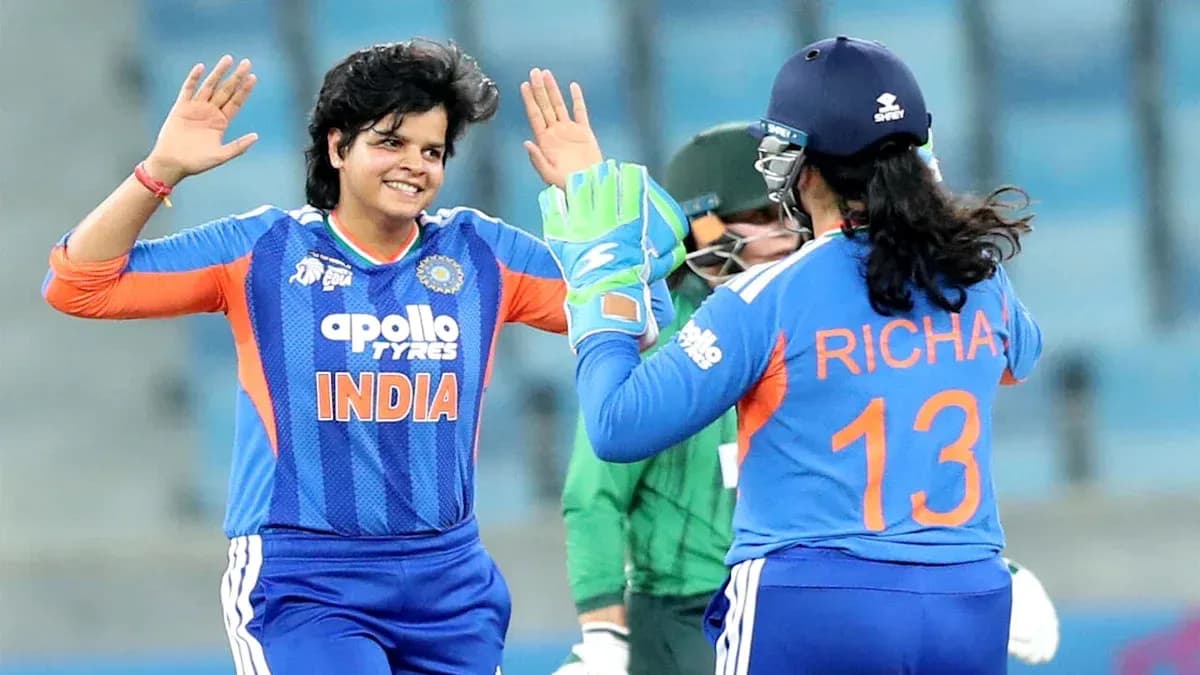
Sree Charani took the ball for the final over of the powerplay and changed the mood of the evening. She struck twice in that over, and Pakistan’s promising 27/0 disintegrated into 35/6 in a blur of poor strokes, tight lines, and mounting panic.
India’s spinners didn’t just keep things quiet; they tore through a line-up that suddenly looked short of answers. Batters groped forward, feet rooted, as the ball dipped, gripped, and slid on.
Charani finished with a scarcely believable 3 for 7, a spell that squeezed the life out of Pakistan’s innings. From the other end, Prema Rawat matched her menace, claiming 3 for 9. Deepti Sharma’s 2 for 5 added to the squeeze, while Shafali’s early strike had already opened the door.
Wickets fell in clusters. After the openers, no one settled, no one rebuilt. Not a single partnership grew into anything that could threaten India or even stall them. The innings never recovered from that collapse out of the powerplay and finally folded for 55 in 18.1 overs.
At the break, Charani summed up her method with disarming simplicity. She spoke of bowling to her strengths, of coaches urging the spinners to give more revs on the ball, of working on a more consistent arm ball and nailing yorkers. It sounded straightforward. Her figures suggested something far more brutal for Pakistan’s batters.
A record Pakistan did not want
The scoreline carried a harsh piece of history. Pakistan’s 55 undercut their previous lowest all-out total in Women’s T20Is — 56 against New Zealand, also in Dubai, in 2024. The desert has not been kind to them.
This new low joins an unwanted list: 60 against England in Taunton in 2009, 63 against India in Guangzhou in 2012, 65 against West Indies in St Andrew’s in 2011. A roll call of bad days, now topped by this one, against their greatest rivals, on a landmark occasion.
The context made it sting even more. This was their 200th T20I, a moment that should have carried pride and nostalgia. Instead, it ended with a collapse that will be remembered for all the wrong reasons.
India’s dominance, and Harmanpreet’s landmark
For India, the script felt far more familiar. They came into the contest already assured of a semi-final spot after wins over Thailand and Hong Kong, and they played like a side that trusted its bowling to decide big days.
The 55 all out now sits as the fifth-lowest total India have ever conceded in Women’s T20Is, another entry in a growing catalogue of dominant bowling performances.
It also extends a lopsided recent record in this rivalry. Before this game, India had won nine of their last ten T20Is against Pakistan, the only blemish in that stretch coming in the 2022 Asia Cup. This display only underlined the gap when India’s attack hits its stride.
There was another milestone in Dubai, one that did deserve celebration. Harmanpreet Kaur captained a T20I side for the 150th time, becoming the first cricketer — male or female — to reach that mark. On a day of records, hers stood in stark contrast to Pakistan’s: a testament to longevity, resilience, and sustained excellence.
India’s bowlers honoured that landmark with a performance of ruthless clarity. Pakistan, on their own historic day, walked away with a statistic they will spend the rest of this Asia Cup trying to erase.