Razaullah's Six-Hitting Heroics Revive Pakistan at Edgbaston
On a day that was supposed to be a procession, Edgbaston got a miracle instead.
England turned up on Saturday expecting to mop up Pakistan, complete a third straight innings win, and stroll to a first three-Test whitewash since 2024 at this very ground. Pakistan, brittle and bewildered all tour, were meant to fold by lunch, mid-afternoon at the latest.
They did anything but.
From 133 all out in the first innings and 320 behind, Pakistan roared back to post 449, snatch a 129-run lead and, almost out of nowhere, drag this third Test into a fourth day. England now need 130 on Sunday. It should be routine. It no longer feels like it.
At the heart of the revolt stood a 21-year-old No. 9 on debut, a player who only got his first passport last week and walked in as if he owned the ground.
Razaullah Khan didn’t just survive. He detonated.
A No. 9 Who Batted Like a Street-Hitter in a Test Arena
By the time he walked in, Pakistan had done the hard yards. Shan Masood’s 95, Babar Azam’s 76 and a composed 59 from Azan Awais had dragged them from embarrassment to respectability. The deficit shrank, then vanished. England’s bowlers, so ruthless at Leeds and Lord’s, suddenly looked ordinary.
Then Razaullah turned a good fightback into a full-blown spectacle.
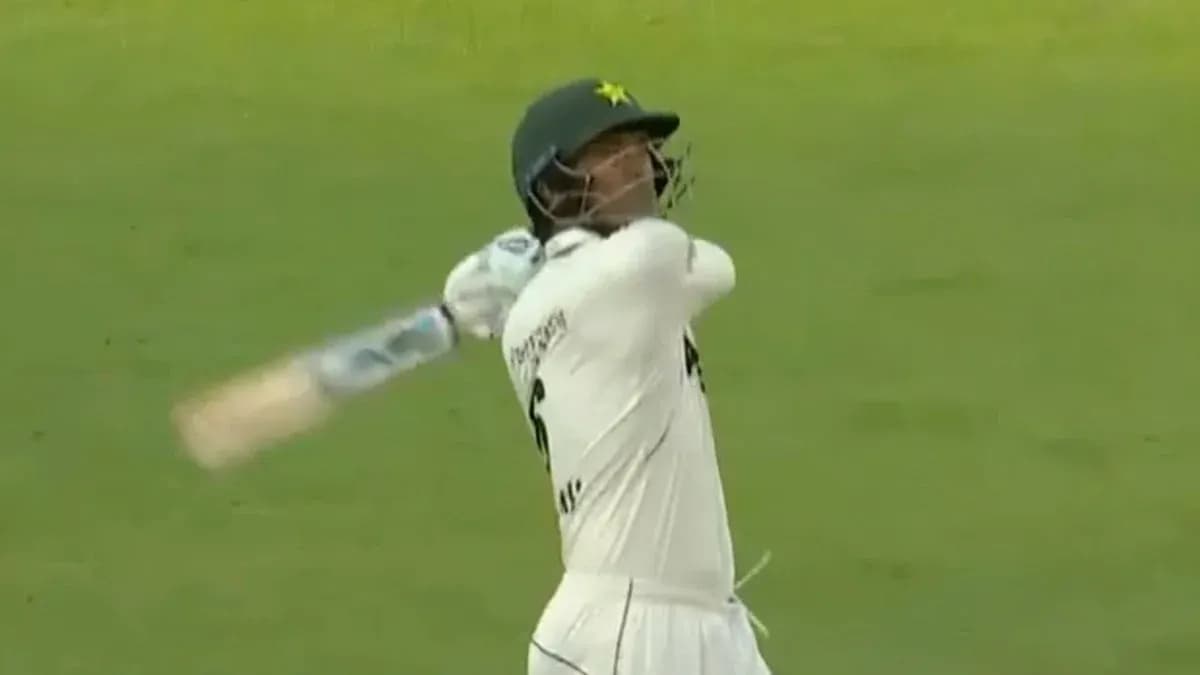
He hammered 81 from 63 balls, laced with nine sixes – equalling the record for the most sixes in a Test innings in England, a mark Ben Stokes set in the 2023 Ashes at Lord’s. Every swing felt like a challenge, every connection a statement that Pakistan were done being pushed around.
His first six took Pakistan into the lead. The next few turned Edgbaston into a hitting exhibition.
Gus Atkinson copped three in one over. Jofra Archer was launched over the ropes for a fifth six that brought Razaullah a 43-ball half-century, then again for Pakistan’s 400. These weren’t edges or mis-hits; they were clean, calculated blows “in the slot,” as he later put it to Sky Sports through a translator. He spoke of wanting to “take it long and deep,” and it showed. There was no sign of fear, only intent.
For a player parachuted into the side amid a selection shake-up, he played like a man who had been waiting his whole life for this chaos.
Masood, Babar and Awais Light the Fuse
This wasn’t a one-man act. The stage had to be built before Razaullah could tear it down.
Pakistan began the day still miles behind at Edgbaston, but for the first time this series, their top order looked like it belonged in a Test match. On pitches at Leeds and Lord’s they never once reached 200 or lasted 50 overs. Here, they peeled off 397 runs in 84 overs on Friday, with two century stands – their first of the tour.
Masood and Awais, both left-handers, stitched together a 125-run partnership that carried Pakistan to 184-3 at lunch. Awais, compact and busy, stroked 10 fours in his 84-ball 59 before a faint edge behind was revealed by England’s review.
Masood was the heartbeat. He moved nimbly, used his feet, and forced England to think. Dropped at point before reaching fifty, he looked destined for a cathartic hundred until Dan Lawrence flung himself low in the slips to grab a superb ankle-high catch. Masood fell for 95, giving Atkinson his first wicket of the match and leaving Pakistan still with work to do.
Babar picked up the baton. The captain, without a Test century in 20 matches, unfurled his familiar range – crisp drives, late cuts, calm control. England tried to rough him up with the short ball. They thought they had him on 69, only for substitute fielder Theo Wylie to brush the boundary rope. Babar’s reprieve didn’t last long. Just before tea, Josh Tongue drew a top edge and Jordan Cox, acrobatic behind the stumps, completed the dismissal. Babar was gone for 76, and with him went Pakistan’s last established star.
When Saud Shakeel, who had just passed 2,000 Test runs and repeatedly dropped the ball into awkward gaps to frustrate England, gloved an Archer bouncer and departed for 29, Pakistan were 306-6. The last recognised batter was gone. The lead was still a long way off. The script said collapse.
The lower order refused to read it.
Abbas and Razaullah Rip Up the Script
Atkinson, quiet all series, suddenly found rhythm. He removed debutant Ghazi Ghori at 312 and Mohammad Imran at 318. Pakistan still trailed by two. England sensed the kill.
Razaullah and Mohammad Abbas had other ideas.
Abbas, a No. 10 known more for his bowling than his strokeplay, produced a career-best 42. He struck two sixes and five fours, and more importantly, stayed in long enough to let Razaullah swing freely. Together they added 121 runs from just 123 balls, the highest ninth-wicket stand against England since 1984.
The partnership wasn’t just productive; it was defiant. England’s lines frayed. Joe Root’s captaincy came under scrutiny as fields scattered and bowlers searched in vain for control on a surface that had flattened out. The gloom in the sky offered nothing; the ball barely moved. For the first time in the series, it was England who toiled.
Abbas walked off to a standing ovation when he finally fell, his 42 a gem in its own right. Moments later, Razaullah followed, stumped for 81 just before the scheduled close, and he too left to a roar from the crowd. From a team in disarray a week ago, Pakistan had found a new cult hero.
“The first time he's been out for Pakistan ever, and absolutely lights up the show,” former captain Ramiz Raja told the BBC, hailing the attitude and self-belief Pakistan had been crying out for. Michael Vaughan, from the other camp, was just as clear: “They've unearthed a gem.”
From Panic to Possibility
None of this felt remotely likely seven days ago. Pakistan had been blown away in Leeds and Lord’s, humiliated by totals that never crossed 200 and innings that rarely threatened 50 overs. The Pakistan Cricket Board hit the panic button, sending seven players home and sacking the head coach. Three debutants walked into a shell-shocked dressing room and watched their side crawl to 133 in the first innings.
England’s response – 453, a lead of 320 – looked terminal. When Pakistan slipped to 0-2 on Thursday evening, the series appeared over in all but name.
Yet they breached 200 after lunch, 300 after tea, and 320 within about 40 minutes. The pitch eased, the ball stopped talking, and for once it was England who ran out of ideas. Root’s fields spread, the bowlers lost their lengths, and Pakistan’s batters, one after another, seized their moment.
By the time the last wicket fell at 449, the mood had flipped. The whitewash is still in England’s hands, but they will have to earn it now. A target of 130 should be a formality for a side that piled up 453 in the first innings.
After Razaullah’s debut storm and Pakistan’s refusal to lie down, nothing about this final day feels routine anymore.