Rory Gaffney Retires: A Look Back at His Glorious Career
Rory Gaffney’s last act in domestic football for Shamrock Rovers was to win them a double. His next has been to walk away from the game altogether.
The 36-year-old striker has announced his retirement after an injury-ravaged 2026 campaign in which he did not play a single minute for the Hoops. For a player who so often dragged Rovers over the line, it is a brutally quiet ending to a loud, influential career.
From cup final hero to enforced spectator
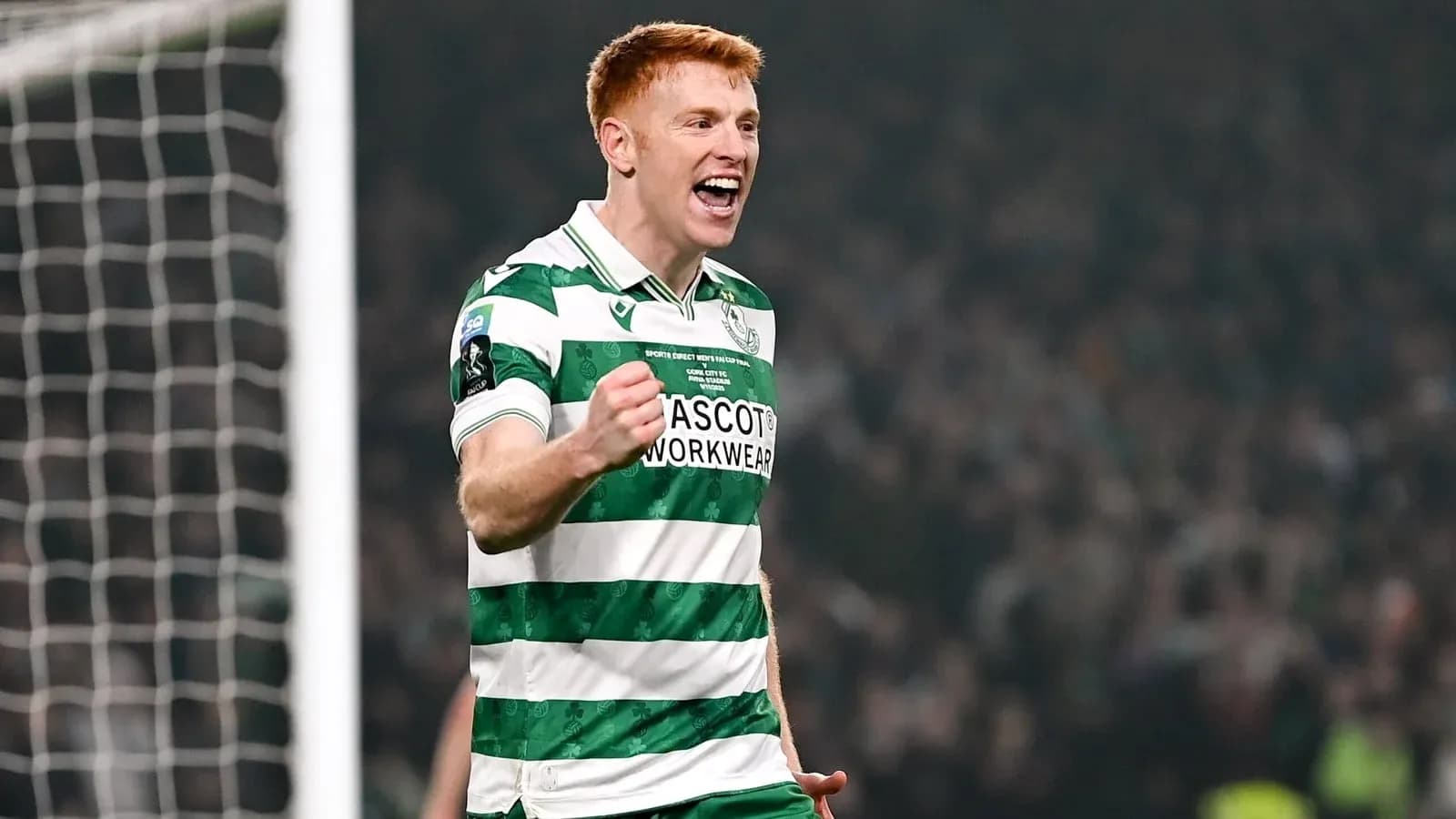
If his farewell season never really started, his previous one ended in the most fitting way possible. Gaffney’s final domestic outing came in last year’s FAI Cup final, where he produced a match-winning brace to secure the trophy and complete Rovers’ first league-and-cup double since 1987.
That performance was a snapshot of his Tallaght years: decisive, ruthless, and utterly reliable when the pressure bit hardest. It also capped a fifth league title in his six seasons at the club, a period of sustained dominance with Gaffney at its heart.
His last appearance in green and white arrived a month later, in December’s 3-1 win over Hamrun Spartans that closed out their UEFA Conference League campaign. No fan in Tallaght that night knew they were watching his European farewell. He probably didn’t either.
Injury, surgery, and a battle lost
Gaffney’s body, which had absorbed the knocks and scrapes of a long career, finally pushed back over the winter. He underwent an Achilles procedure in Sweden during the off season, a calculated gamble to extend his time at the top. An infection then derailed everything, stalling his recovery and stripping away any realistic chance of returning to match fitness in 2026.
For a player who built his reputation on work-rate and physical presence, the Achilles is the cruelest of weak points. Once it went, so did the prospect of one last surge in front of the South Stand.
A journey from Tuam to Tallaght
The Tuam native’s path to becoming a modern Shamrock Rovers great was anything but straightforward. Gaffney started out in the League of Ireland with Mervue United, then earned a move to Limerick, where his form opened the door to England.
He crossed the water and pulled on the shirts of Cambridge United, Bristol Rovers (on loan), Salford City and Walsall (on loan). It was a classic journeyman’s circuit: lower-league graft, tight dressing rooms, and the constant need to prove yourself every August.
When he returned to Ireland in 2020 to join Rovers, it felt like a homecoming with a point to prove. It turned into a trophy-laden final chapter.
Across six seasons in Tallaght, Gaffney scored 50 goals for Stephen Bradley’s side and became one of the pillars of a team that set the domestic standard. He hit 37 league goals in 143 games; only five players have scored more league goals for Rovers in the Tallaght era – Graham Burke, Gary Twigg, Aaron Greene, Ronan Finn and Gary McCabe. That is elite company in a golden period for the club.
European nights and a place in history
If the league titles and the double defined Rovers’ dominance at home, the European nights under the floodlights defined their ambition. Gaffney embraced those stages.
He struck eight times in Europe for the Hoops, a tally that places him fifth on the all-time list of League of Ireland goalscorers in European competition. For a club and a league fighting every year for respect and recognition beyond their borders, those goals carry weight.
Gaffney himself pointed to those nights as a highlight of his time in green and white, speaking of the privilege of wearing the jersey and the bond inside the dressing room since 2020. Now, he says, he will support “the lads from the stands” – a line that underlines the finality of the decision, but also his refusal to drift away from the club he helped shape.
Legacy of a modern Rovers great
Strip it back and the numbers are clear: 50 goals, multiple league titles, a historic double, and a European scoring record that puts him in national company, not just club folklore. But Gaffney’s legacy at Shamrock Rovers runs deeper than statistics.
He arrived as an experienced forward and left as one of the defining figures of the Bradley era – a striker trusted in big moments, a presence in the dressing room, and a link between Rovers’ domestic dominance and their growing European profile.
The Achilles ended his career earlier than he would have wanted. The infection robbed him of a proper send-off on the pitch. Yet his last meaningful act in domestic competition was to win a cup final and seal a double, and his last European outing ended in victory.
For a striker, there are worse ways to be remembered.