Sonal Dinusha's Remarkable Spin Mastery Against India
Sonal Dinusha walked in four times against India and never once from a place of comfort. Early crises, wobbling scoreboards, high-class spin in home conditions that suddenly felt alien. Three Tests into his career, this was supposed to be his soft launch. It turned into a trial by fire.
He didn’t flinch. He built something.
Across those four innings, Dinusha peeled off 420 runs, three of them converted into centuries. Sri Lanka still lost the series, but the numbers told a different story about one player: here was a young batter who not only survived pressure, he seemed to enjoy rearranging it.
Owning the length that breaks others
On these pitches, the contest lives in a narrow strip: that 3-5m good-length zone for spinners, where indecision gets you. Hang back and you’re trapped. Lunge forward and you’re in two minds. For most Sri Lankan batters, it was a graveyard.
Dinusha turned it into a scoring area.
He took 182 runs off good-length spin, averaging 91 at a strike rate of 58.89. The series as a whole plodded along at 26.42 and 45.36 in that same band. No one on either side scored more runs there. Only Niroshan Dickwella, in a much smaller sample, scored quicker.
Even Player of the Series Devdutt Padikkal, the standard-bearer for India’s batting, sat behind him in this zone: 69.50 at 49.82. Dinusha wasn’t just hanging in. He was dictating.
The secret was not what he played, but where he met the ball. His average interception point against good-length spin was 2.64m from the stumps – the furthest of any batter in the series. Padikkal, who preferred to wait and play late, operated at 2.02m. Two contrasting methods, one clear outlier.
Only 43.4% of good-length balls to Dinusha entered the “danger zone” – that 1.5m to 3.5m gap between pitch and contact where batters so often misjudge. Among Sri Lankans, no one bettered that. Across both teams, only Padikkal, Rishabh Pant and Ravindra Jadeja forced that danger percentage even lower.
Short in stature, big in intent
There was another twist. Dinusha is listed at just five foot six. Shubman Gill, India’s captain and the only player to use his front foot more often than Dinusha against spin, can lean on height and reach. Dinusha had to find other ways.
So he did. He came at the ball.
Among batters who faced at least ten overs of spin, Dinusha went forward 73.6% of the time, including when he charged. Only Gill, at 77.3%, pushed that front-foot percentage higher.
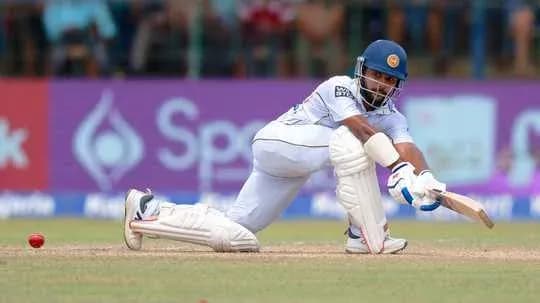
Dinusha stepped down the pitch to 12% of the balls he faced, second only to Pant’s 13.3%. That alone would have been a bold statement. He layered something even more audacious on top of it: the sweep.
He swept 21.6% of the time – the highest rate in the series.
A sweep shot turned into a weapon
The scale of his commitment to the sweep bordered on obsessive. Dinusha attempted 120 sweeps, including reverse and slog-sweeps, and harvested 173 runs from them. Both marks are the highest ever recorded in a series of any length, surpassing Joe Root’s prolific sweep-fest in Sri Lanka in 2021.
He scored at better than a run a ball with that stroke against all four of India’s frontline spinners. Every time he went down, there was intent. Every time he went across, there was calculation.
The 4-5m band, traditionally the spinner’s killing zone, underlined his clarity. Across the series it produced 27 wickets at 21.14. For most batters, it was the length that forced mistakes. Dinusha faced 212 balls there and gave his wicket away once. He made 125 runs.
He didn’t respond by shutting shop. He doubled down on variety. He swept 53 times in that band for 87 runs. He advanced down the track to 32 balls. The message was simple: this length might trouble others, but you don’t get to bowl here on repeat to me.
Doing that against Ravindra Jadeja, with his relentless pace through the air and skidding trajectory, stood out. Dinusha tried 34 sweeps against Jadeja – the most any batter has attempted against him in a subcontinental series. He also came down the track to Jadeja 36 times, just two fewer than Michael Clarke managed across five innings in India in 2013.
Not just boundaries, but control
This wasn’t slogging dressed up as bravery. It was discipline with teeth.
Of Dinusha’s 30 boundaries against spin, 18 came via sweeps or their variations, usually front of square on the leg side. He mixed in paddles, reverse sweeps, and on four separate occasions he opened a new session by slog-sweeping to the mid-wicket boundary. Not for show, but to redraw the field and force a rethink in length.
Once he shifted those lengths and spread those fields, the innings changed gear. Singles appeared. Twos followed. He nudged, pushed, swept and worked the ball around, keeping the scoreboard alive without needing constant fireworks.
The numbers back that up. Only 4.98% of the balls he faced went to the boundary – the second-lowest rate among specialist batters who played a substantial volume in the series, with only Jadeja ahead of him. This was accumulation, not a highlights reel.
Perhaps the most revealing detail of all lies in what he simply refused to do. Across pace and spin, Dinusha did not hit a single boundary through the front-of-square off-side. The drive – the pretty, high-risk, ego-stroking drive – stayed in the locker.
A young batter, three Tests into his career, walked into a series against a superior spin attack and built his game around restraint, clarity and a ruthlessly honed scoring plan. Sri Lanka did not win. Dinusha did something else: he left India’s spinners with questions they are not used to asking themselves.