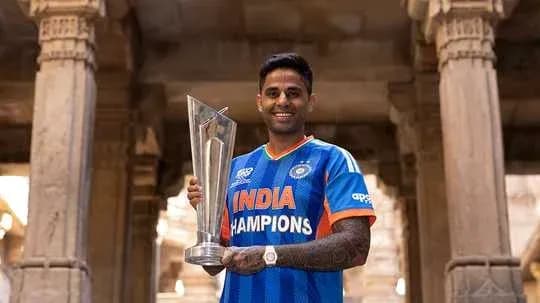
Suryakumar Yadav's Surprising Ouster: From Captain to Spectator
Suryakumar Yadav did not see it coming. Not now. Not like this.
Barely months after lifting the T20 World Cup trophy on home soil as India’s captain, the 35-year-old found his name missing from the T20I squads for the Ireland and England tours. The call came a couple of days before the announcement. The message from the selectors was blunt.
“I think it’s time to move on.”
On Aakash Chopra’s Baith and Bol show, Suryakumar recalled the moment with a calm that almost jars with the scale of the decision. He spoke of smiling when he realised his name wasn’t there, of using that smile as a shield whenever pressure and uncertainty closed in.
“I smiled after spotting that my name isn't there,” he said. “Whenever I have been in pressure situations or when things aren't going in my favour, I've always smiled, relaxed. I have looked back at the moments and been grateful.”
The smile, though, hid a genuine jolt. Suryakumar had mapped out the next phase of his India career. He thought he knew the road ahead.
From planning for 2028 to out in 2026
By his own admission, he believed he was building towards something far bigger than just the next series. He had his eyes on the 2028 Los Angeles Olympics and the T20 World Cup later that same year. He thought he would be the man to lead India into both.
“I didn't think this would happen in 2026,” he said. “I was under the impression that I am preparing to take this team forward for another two years – Olympics, another T20 World Cup and then another challenge going forward.”
That vision evaporated in a short phone call.
The selectors, led by Ajit Agarkar, chose a hard reset. They informed him of the decision, Suryakumar listened, and then, as he put it, chose not to react.
“They called me two-three days before the team was announced. They said, ‘I think it's time to move on.’ I didn't react because it's not my forte. Whatever call was taken, the person must have felt it was in the best interest of the team. You took the call, informed me, no harm done.”
Cold logic from the panel. A quiet acceptance from the captain who had just delivered the biggest prize in the format.
A dominant reign cut short
The numbers behind his tenure make the timing feel even more ruthless.
Once he rose to No. 1 in the ICC T20I batting rankings in November 2022, Suryakumar became the face of India’s ultra-aggressive T20 batting. After Rohit Sharma’s T20I retirement following the 2024 T20 World Cup, he took over the captaincy full-time.
Under his leadership, India won 42 of 50 completed T20Is. They defended the men’s T20 World Cup title, a first for any side, and did it at home, another historic first. For two years, India did not lose a T20I series. They added the Asia Cup to that run. They looked settled, confident, and relentless.
Then it ended with a single match: the World Cup final against New Zealand. A high, and his last outing in India colours.
After that triumph, the baton passed to Shreyas Iyer. The unbeaten series streak, the trophies, the aura – none of it was enough to shield Suryakumar from the realities of succession planning.
“The guy they've picked, I have played a lot of cricket with him,” he said of Iyer. “I know he's a good player, good human being, good captain also. So, I didn't resent the decision but was disappointed because we didn't lose a series for two years, won Asia Cup, T20 World Cup – you want the same thing to go forward. When everything is going well, then why the change?”
That final question will echo with many Indian fans. When everything is going well, why now?
Form, cycles and a brutal call
The selectors had their answer ready. Agarkar framed the move as part of a broader cycle reset that often follows a World Cup.
“Obviously, it's a tough one... having just won the World Cup,” he said at the time. “But as it happens after most World Cups, we try and reassess what the best way forward is.
“Partly his own form, but also looking at the next two-year cycle or a little bit more than two years now till the next World Cup, we thought this was the best way forward.”
Form did give them an opening. Suryakumar’s returns with the bat had dipped in the lead-up to the World Cup. On the global stage he still produced – 242 runs, the third-highest for India, including a crucial unbeaten 84 against USA – but the warning lights were flashing in the IPL.
After a superb 717-run season in IPL 2025, his 2026 campaign for Mumbai Indians slumped to 270 runs. For a player whose game thrives on rhythm and audacity, that drop-off was stark. It gave the selectors both a cricketing argument and a convenient justification.
The decision, however, still cut deep.
Wrestling with the shock
Suryakumar admitted it took him weeks to process what had happened. The smile in public gave way to questions in private.
“For one-and-a-half months I kept thinking, how can this happen? How is it possible? We just won the World Cup. Yes, IPL wasn't as good as how I wanted,” he said.
Friends and family rallied around him. They told him this is how sport works, how life works. Players come in, players go out. Even captains.
“Friends and family consoled me that this is part of life. But once they leave, you are alone with your family. We were thinking, how is it possible?”
That line reveals the reality behind the calm exterior. For all the talk of cycles and long-term plans, this was a man who had just delivered everything asked of him, then found the door closing as he turned around.
No farewell, no retirement – just a wait
What stands out is what he has not done. There is no retirement announcement. No grand farewell statement. No hint that he is ready to walk away.
He is, quite simply, waiting.
“I am ready, I am still playing, will continue to do so,” he said. “Whenever you feel the time is right, things are right, call me.”
There is defiance in that patience. No public fight, no bitterness, but a clear message: he believes there is more cricket left in him, more runs, perhaps even another chapter in India colours.
India have already moved on in official terms. A new captain, a new cycle, a fresh roadmap to the next T20 World Cup and beyond. But cycles in sport have a habit of looping back to familiar faces.
If form returns and opportunities open up, will the selectors make that call he is waiting for? Or will one of India’s most influential T20 captains see his international story end not with a farewell lap, but with a phone call that simply said: “It’s time to move on”?