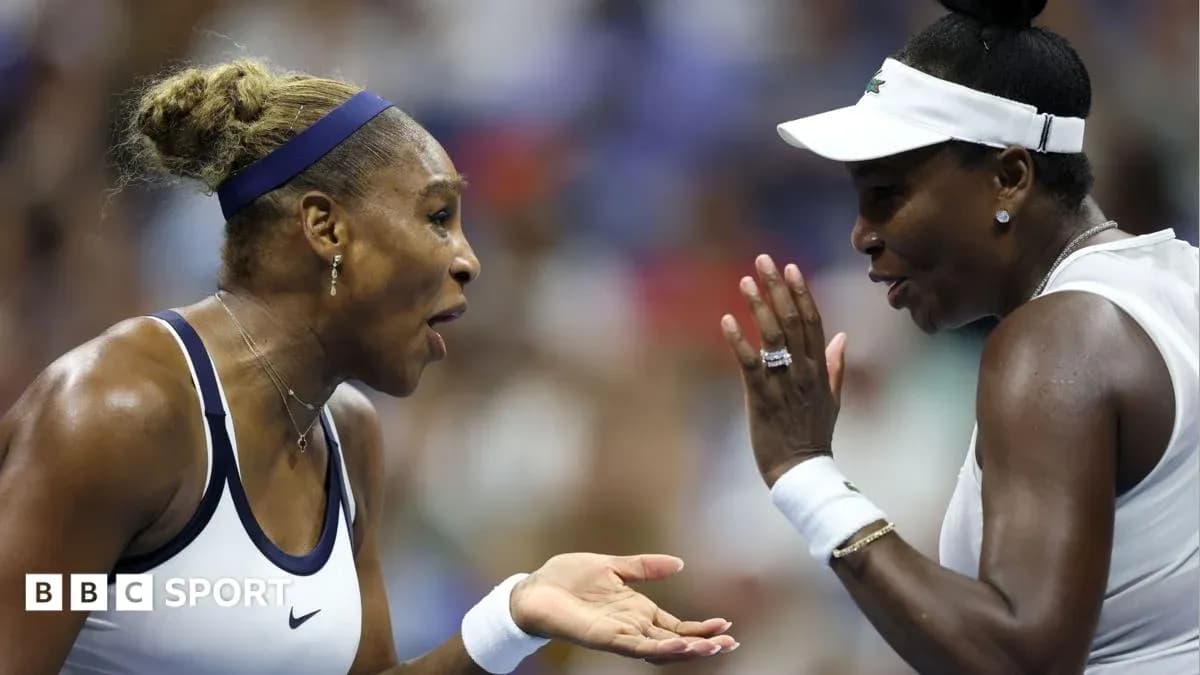
Williams Sisters Captivate US Open Crowd Despite First Round Loss
On most nights at the US Open, a first‑round women’s doubles match does not own Arthur Ashe Stadium. The Williams sisters are not most nights.
Serena and Venus walked back into the New York spotlight with a combined age of 90 and the kind of aura that still makes 20,000 people hold their breath. The result, on paper, was a defeat: a 6-3 6-7 (6-8) 7-6 (10-7) loss to 14th seeds Hao-Ching Chan and Maya Joint. The spectacle was something else entirely.
Ashe under their spell again
Four years after their last appearance together on this court, the sisters emerged to a rapturous reception. This is the arena where they have collected eight singles titles between them and two doubles crowns as a pair, a place that has grown up with them, grown loud with them, grown old with them.
The first set didn’t match the noise. Chan and Joint were cleaner, sharper, quicker to the punch. The Americans looked rusty, their timing off, their movement just a half-step behind. The decibel level dropped with each lost point, the opening set slipping away 6-3 with little resistance.
For a moment, you wondered if this was how it would end on Ashe: quietly, tamely, with a whimper rather than a roar.
Then the match caught fire.
Finding the old rhythm
Serena’s level rose. Venus, already the steadier of the two early on, kept hammering her groundstrokes, carving out angles that dragged their opponents wide. The fifth and seventh games of the second set became mini-battles. Four break points came and went for Chan and Joint as the Americans dug in, refused to give away the night.
The crowd sensed it. The murmurs turned to shouts, then to that familiar New York roar that has so often ridden in behind a Williams surge.
“The atmosphere was surreal,” Joint said later. “It was something we've never experienced before, and to play against such legends of the game was super special.”
The pressure finally told in the tie-break. Serena and Venus, locked in, fed off the noise and the occasion, clawed their way through 8-6 to level the match. Suddenly, it felt like 20 years had rolled back.
From a subdued first set to a pulsating second, Arthur Ashe had its show.
One last fight?
The decider threatened to spoil the script. Chan and Joint jumped out to a 4-1 lead, picking at the spaces, dragging the veterans into the corners, making them feel every year and every mile in their legs. The stadium, so loud minutes earlier, fell into an uneasy hush.
But the Williams sisters have built entire careers on refusing the obvious outcome. They rallied again, tightening up their returns, sharpening at the net, forcing the contest into a match tie-break.
Then came the surge that felt like destiny. They raced ahead 5-0 in the breaker, the crowd on its feet, the second round within touching distance. Every point won was a jolt of electricity; every changeover, a chance for 20,000 people to believe they were watching another improbable chapter.
It didn’t hold.
Chan and Joint steadied. The younger pair blocked out the noise, the names, the history, and went back to basics. They chipped away, point by point, helped by a double fault from each sister at crucial moments. The 5-0 lead dissolved, the scoreboard turned, and suddenly it was the seeds who held match point.
When the final point was lost and the 10-7 scoreline flashed up, there was no angry silence. Just a long, warm farewell.
Legends under the lights
The match itself was more than respectable from two players in their mid-40s. Their groundstrokes stayed solid, their movement—while no longer explosive—remained sharp enough to trouble a high-level team. The competitive edge never dulled. Chan and Joint had to earn it, holding their nerve in a partisan cauldron that could easily have overwhelmed them.
“After the first set you wondered if Serena and Venus would be able to find their mojo – but, boy, they did,” said former player and commentator Chanda Rubin, who once faced them in the 1999 US Open doubles final.
For once, the famously chatty Ashe crowd stayed locked in during the points, almost reverential. The sight of the Williams sisters sharing the court here again, possibly for the last time, demanded that kind of respect.
Three decades after they exploded onto the scene as teenagers, they still command the sport’s full attention. Between them: 30 Grand Slam singles titles, 14 doubles majors as a team, and a legacy that stretches far beyond the lines of any court.
Serena’s decision to come out of retirement this summer lit a fresh spark. A 23-time Grand Slam singles champion hinting on Good Morning America that she wants to play singles again is not a throwaway line; it’s a tremor that runs through the entire game.
Venus, a seven-time major winner, has never walked away. She has kept going, sustained by wildcards and her own stubborn love of competition. Some have questioned those invitations. Not many questioned the wisdom of bringing the sisters back to Flushing Meadows together.
Their planned reunion at Wimbledon fell apart when Serena injured her knee in a singles loss to the 20-year-old Joint—an irony not lost on anyone watching her across the net on Ashe. They eventually rejoined forces in Cincinnati, only to fall in another match tie-break to Marta Kostyuk and Peyton Stearns. New York delivered the same cruel ending.
What comes next?
This time, there were no answers from the sisters. US Open organisers said Serena and Venus were “not available” for media after the match. The speculation about what follows will have to wait.
Earlier in the week, Serena had teased the idea of more singles. Venus, speaking after her singles exit on Monday, insisted she should not “have to” think about life beyond doubles just yet.
On Friday night, under the Ashe lights, they didn’t need to say anything. The tennis, the ovation, the lingering stares from fans who know they may never see this again—those told the story.
The scoreboard says the Williams sisters lost in the first round of the US Open doubles. The sport, still captivated after 30 years, knows that’s not the point.
The real question now is whether this was a final encore, or just another pause before two of the game’s greats find one more way to surprise everyone again.