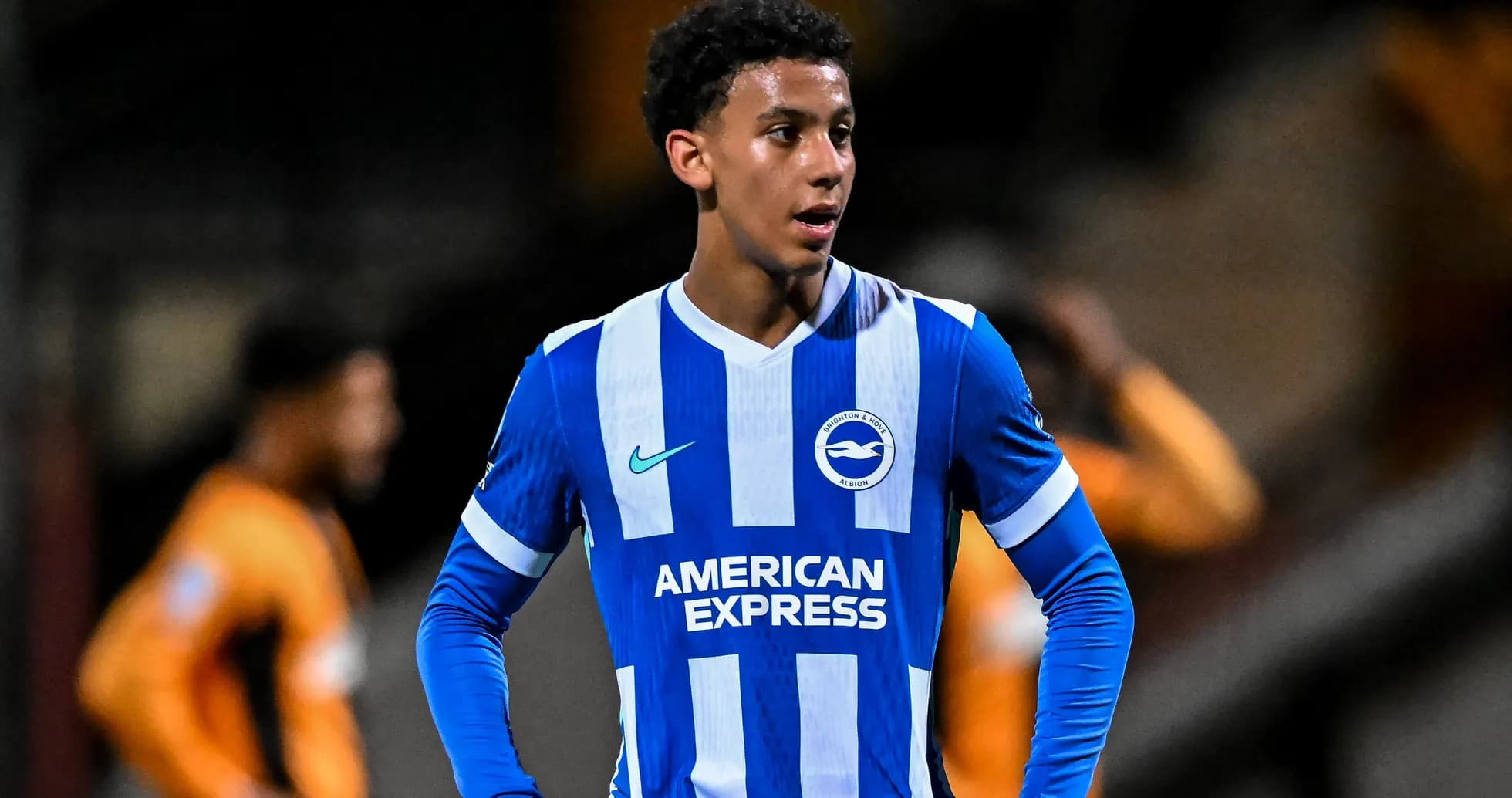
Younes Ibrahim: Rising Star in Brighton's Football Academy
Last Sunday did not feel like academy football.
Forty-eight hours earlier, Younes Ibrahim had been just another standout in Brighton’s under-21 side, his superb goal lighting up the club’s youth channels and sending the usual ripple through the academy crowd. Then the phone rang.
You’re with the first team tomorrow.
For some clubs, that kind of call can be a pat on the back, a gesture, a taste of the big time with no real consequence. Brighton are not one of those clubs. Fabian Hürzeler and his staff have built a reputation on conviction, not sentiment. This is the club that turned Moisés Caicedo, Alexis Mac Allister and Marc Cucurella into elite assets and sold them for enormous fees because they knew exactly when potential had hardened into certainty.
So when Ibrahim’s name appeared on the first-team teamsheet, even as a substitute, it carried weight. He did not play a minute against Coventry. He did not need to. His presence on that bench was a message.
We see you. And we see you soon.
A season that forced the door open
The numbers behind that decision are modest at first glance, but they point to a player accelerating at the right time. This 2026–27 campaign, Ibrahim has appeared three times across Brighton’s youth sides in different competitions, scoring once and supplying another goal. A neat return, but not the full story.
The real surge came last season. Nine goals, five assists, and a growing influence that stretched beyond the penalty area. Coaches began to trust him not just as a finisher but as a problem-solver between the lines, someone who could drift wide, attack from the wing or operate as a false nine. He did not just score. He connected moves, disrupted defensive shapes, and read space like a player older than his years.
Nothing about this rise has been overnight. No viral clip. No sudden explosion from nowhere. Ibrahim’s path has been built the old-fashioned way: step by step, academy to academy, level to level.
From Luton to London, and then a “step back” that wasn’t
His story starts far from the glamour of the Premier League. Luton Town’s academy gave him his first grounding in English football, a place where discipline is drilled in early and the margins for error are thin. From there, he jumped into the deep end: Chelsea’s academy, one of Europe’s most competitive proving grounds.
At Cobham, he met different tactical ideas, different cultures, different speeds of play. Training sessions felt like trials. Every touch mattered. Every decision carried pressure. For a teenager, it can be overwhelming. For Ibrahim, it became an education.
The real turning point, though, came when he walked away from that prestige. He chose Brighton and their under-15 side. On paper, it looked like a step down. In reality, it was a calculated move.
Brighton offer something rare in English football: a visible, believable pathway from academy to first team. The route is not just a slogan on a wall. It is stamped into the careers of players who have made that same climb.
Under-15. Under-18. Under-21. Ibrahim moved through each age group without fanfare, but with constant progress. He grew physically, sharpened mentally, and kept adding layers to his game. Coaches saw a player who did not just survive each jump, but adapted to it.
The contract and the creed
Last July, the club made their belief official. Ibrahim signed his first professional contract, a landmark moment for any young player and a clear signal of Brighton’s intent.
Academy director Ian Buckman framed it in simple terms that fit the club’s ethos: “It is an exciting moment for the players and their families alike.” Then came the line that really matters inside a system like Brighton’s: this is recognition of effort, and a challenge to keep pushing.
“It is a recognition of the great efforts they have made during their time at the academy so far, and now they must seize the opportunities available to them to ensure that their development and learning continue, as they have proven their ability to do up to this moment.”
That is the Brighton deal. The contract is not a reward. It is a doorway. What you do next decides whether you walk through it.
For Ibrahim, the next step arrived quicker than most expected: a place on the bench for a senior match, the crest on his chest the same as the one worn by Premier League regulars, the warm-up in front of a crowd that suddenly feels a lot bigger than academy parents and scouts.
Four shirts, one decision
What makes his story stretch beyond the south coast is not just his club trajectory, but the international tug-of-war already forming in the background.
Ibrahim was born in Australia. That alone puts him firmly on the radar of the Socceroos, a national team constantly searching for its next leading striker. Eight years in England have made him eligible for the Three Lions, a setup that rarely lets a Premier League prospect slip by unnoticed.
Then there is bloodline. Egyptian and Moroccan roots open doors to two of Africa’s most ambitious federations. Egypt and Morocco have turned the recruitment of dual-nationality players into a deliberate, strategic project. They scour European academies, track progress, build relationships early.
Four national teams. Four distinct football cultures. One teenager whose name is already underlined in more than one federation office.
He has not chosen yet. At eighteen, he does not need to. He should not. Right now, the only jersey that truly matters is Brighton’s.
The bench that meant more
This is where the story loops back to that Sunday against Coventry.
On the surface, it was a simple thing: a young player listed among the substitutes, waiting for a debut that did not come. For Ibrahim, and for those who track these moments closely, it was much more than that.
It was the first visible sign that the club’s long-term plan for him is no longer theoretical. The under-21 goal two days earlier had not just gone viral among academy followers; it had accelerated his timeline. The call-up confirmed it.
The task now is clear. Turn that first taste of the matchday squad into actual minutes. Turn those minutes into impact. Turn impact into a first Premier League goal. Once that happens, the dynamic shifts. The question will not be which national team he chases, but which one can convince him they have the clearest vision for his future.
From Sydney to Luton, from Chelsea’s conveyor belt to Brighton’s carefully drawn pathway, Ibrahim’s journey has already spanned continents and philosophies. Now it stands on the edge of the Premier League stage, with four national anthems potentially in his future.
The project is no longer hidden in youth fixtures and training pitches. It has stepped into the light on England’s south coast and started knocking, loudly, on the door that leads to the game’s highest level.