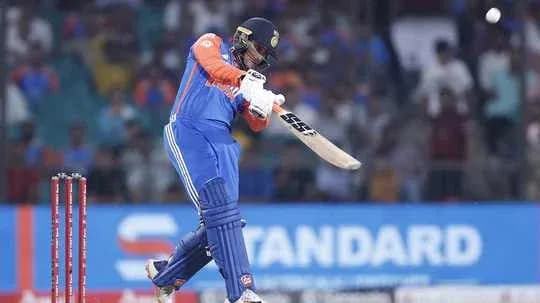
Abhishek's 32-Ball Masterclass Decimates Afghanistan
Abhishek’s first scoring shot told the whole story. An inside‑out six over cover off Fazalhaq Farooqi, struck so cleanly it sounded like a statement. The last blow of his 32-ball assault carried the same authority. By then, the chase of 156 in Delhi’s flat, unforgiving conditions was a formality, the contest reduced to a showcase of one man’s hitting range.
India’s bowlers had done their job, keeping Afghanistan to a par-at-best 156 in the opener of the three-match T20I series. On this pitch, it never looked enough. Once Abhishek settled in, it looked hopeless.
He truly took charge after losing his opening partner at the start of the third over. The wicket didn’t slow him; it sharpened him. Azmatullah Omarzai walked in with the field still feeling its way into the game and was immediately dragged into the storm. Abhishek lofted him straight and long, deep into the long-off stands, then rocked back to pull a short ball through square leg in the same over. Any thought of a watchful rebuild disappeared right there.
Farooqi, Afghanistan’s spearhead, bore the brunt next. The fifth over turned into a demolition. Abhishek marched onto the front foot and muscled a slower short ball over the on-side for six, then followed it almost instantly with a flat-batted four scythed to the off-side fence. Twenty-six runs came off the over. The chase, and with it Afghanistan’s plans, lay in pieces.
Afghanistan’s pace attack had no shock, no sting, nothing to push him back. Abhishek sensed it and refused to let them breathe. By the time Ibrahim Zadran, Afghanistan’s new captain, turned to spin, the damage was already severe. The change of pace brought no relief.
Mohammad Nabi, the veteran problem-solver, was clipped and carved for back-to-back fours to close the Powerplay at a crushing 82 for 1. Abhishek had 41 of those, off just 15 balls. It felt like a private duel between bat and field, everyone else reduced to bystanders.
Rashid Khan entered, as he so often does, as Afghanistan’s last resort. Abhishek greeted him with another inside‑out boundary over cover, a shot that carried the arrogance of a man in complete control of his options.
Only Noor Ahmad briefly forced him into orthodoxy. A couple of sharp deliveries drew from Abhishek something almost extinct in T20 cricket: a neat, forward defensive. It lasted only for a moment. His fifty arrived with a simple tuck to the leg side off Rashid, and the switch flicked back instantly.
He skipped down the track to Rashid, lifting him over midwicket for six, then swatted another blow to deep cover to rip 15 from Afghanistan’s most experienced bowler in a single over. The hierarchy of reputations meant nothing; only the length and line did.
There was nowhere left to hide. Noor, who had looked the most likely to hold him, was dragged into the same chaos. A short ball disappeared over deep midwicket. The fuller one that followed was launched high over deep extra cover, a towering 83-metre hit that underlined the full spectrum of Abhishek’s power hitting.
By the time it ended, the numbers were as stark as the visuals. Eighty-two runs off 32 balls. Seven fours. Seven sixes. He became the second-fastest batter to reach 6000 T20 runs and logged his 14th fifty scored in fewer than 25 balls. No one else comes close; the next best is Suryakumar Yadav with nine.
Yet this was not blind slogging. Abhishek dismantled Afghanistan’s plans one by one. Pace first, then spin, then whatever mix they tried in desperation. He showed just enough restraint to underline that this was calculation, not chaos. Off pace, he plundered 28 from nine balls at a strike-rate of 311.1. Against the spin attack that usually forms Afghanistan’s spine, he hammered 54 from 23 at 234.78.
He read length early. He used his feet. Anything even slightly off target disappeared.
For Abhishek, the weight of the innings ran deeper than the scorecard. He walked into this series under pressure, his lean run made more glaring by the quality waiting behind him. Sanju Samson’s experience and Vaibhav Sooryavanshi’s fearless strokeplay both pressed hard at the top of the order. India, unusually, had the luxury to make a change if they wanted it.
Memories of his home T20 World Cup still lingered. Three ducks in his first three innings of that campaign had threatened to swallow his tournament before he steadied himself in the second half of India’s title defence. The aftermath had been patchy. Across his previous six T20I innings, he had managed only two scores in double figures, with a highest of 16. Across 10 T20Is in this World Cup cycle, he had scraped together just 191 runs.
India kept faith. The management trusted the method behind the aggression, the ceiling behind the numbers. Even with three of India’s most dangerous T20 openers jostling for two spots, Abhishek’s place in the XI felt the most secure. Nights like this show why.
From the balcony, Varun Chakaravarthy, who has suffered similar punishment from Abhishek in domestic cricket, could only watch and relate. “I have personally bowled against them, I know how hard it is. I feel for their spinners,” he said later, capturing in a single line what Afghanistan’s attack had just endured.
On a flat Delhi night, Abhishek didn’t just find form. He reminded everyone why India were willing to wait for it.