Ajit Agarkar's Absence Sparks Speculation in BCCI Meeting
In Mumbai, a high-powered review meeting unfolded on Thursday under the glare of television cameras and speculation. One man’s absence dominated the chatter.
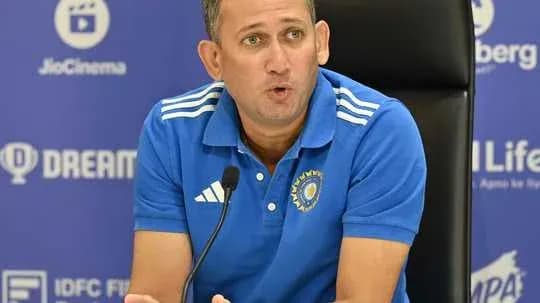
Ajit Agarkar, chairman of the senior selection committee, stayed firmly out of frame in his own hometown.
The Board of Control for Cricket in India moved quickly to calm the noise. This was not a snub, not a signal, not a power play, they insisted. Just logistics.
“Today, he was out of station, so he could not be a part of the meeting. The meeting was called at very short notice, and our chairman of the selection committee, Ajit, was not in town. So he could not join the meeting, and he was in an area where he could not join online either, despite our best efforts,” BCCI secretary Devajit Saikia said, choosing his words carefully.
It sounded straightforward. Yet the timing, and the context, made it anything but.
Only a few days earlier, Agarkar had chaired an online selection meeting to pick the T20I squad for the three-match series against Afghanistan. He had logged in, presided, and signed off on a squad that instantly fed into the debate around India’s white-ball transition.
On Thursday, when the BCCI’s top brass gathered for a review, he could not even be reached virtually.
Saikia stressed that the meeting was not about team selection at all. “Today, we did not have any selection meeting. There was no such discussion in today’s meeting,” he said, attempting to draw a clear line between the review and the selectors’ remit.
The statement did little to slow the online storm. Social media timelines filled with theories about Agarkar’s future. Some accounts went further, suggesting he was on his way out, treating his absence as the first sign of a deeper churn inside Indian cricket’s decision-making structure.
Officially, nothing of the sort is on the table. When the BCCI secretary offers “absolute clarity”, as he did, the establishment expects the matter to rest there. Yet the questions refuse to go away, in part because of the recent Rohit Sharma episode that dragged the selection panel into an uncomfortable spotlight.
Reports had suggested that the selectors told the former captain to retire from T20Is, only for the BCCI to step in and reverse course. That saga left a lingering sense that the balance of power between the board and its selectors had been tested, if not strained.
In that light, Agarkar’s no-show at a crucial review was always going to be dissected.
For now, the official line is that he is overseas. Multiple sources maintain that no changes are expected to the selection committee and that Agarkar will see out his term, which runs until next July. There is even talk that he could be extended through to the 2027 World Cup, scheduled for October-November, though that possibility has not been independently confirmed.
Saikia, aware of how every phrase might be parsed, drew a hard boundary. “I do not want to give any fodder to the speculators,” he said, pushing back at the narrative spiralling around the chairman.
The next visible checkpoint in this story comes soon enough. Agarkar is expected at the Duleep Trophy final, starting September 6 in Chennai. He is likely to be there for the full five-day red-ball contest, accompanied by a couple of his fellow selectors. Two others from the panel are set to be in Delhi at the same time, keeping an eye on the T20I series against Afghanistan.
Those assignments are routine, the sort of quiet, methodical work that usually defines a selector’s life. Yet routine has not been the word around Agarkar lately.
During the just-concluded Test series in Sri Lanka, he was everywhere. Cameras cut to him repeatedly in the stands, his reactions tracked almost as closely as those of the players. His presence became part of the broadcast, a visual reminder of the new selection regime.
On Thursday, he was just as central to the narrative—only this time, because he was nowhere to be seen.
The next time the cameras find him, in Chennai or beyond, the real question will not be where he is sitting, but how firmly he still sits at the heart of India’s selection future.