Ajit Agarkar's Empty Chair at BCCI Meeting Sparks Speculation
In a room full of power brokers at the BCCI headquarters in Mumbai, the loudest presence on Thursday was an empty chair.
The board convened a high-profile review meeting in Agarkar’s hometown, a gathering important enough to spark instant intrigue. Yet the chairman of selectors, one of the most crucial figures in Indian cricket’s current structure, was nowhere to be seen.
The BCCI moved quickly to douse the flames.
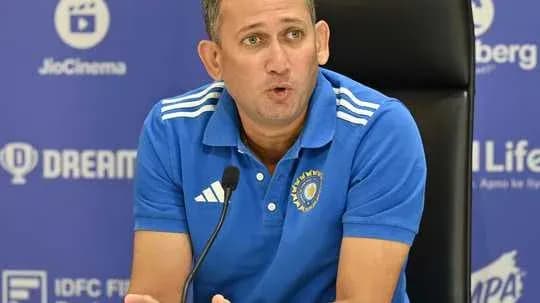
“Today, he was out of station, so he could not be a part of the meeting. The meeting was called at very short notice, and our chairman of the selection committee, Ajit, was not in town. So he could not join the meeting, and he was in an area where he could not join online either, despite our best efforts,” BCCI secretary Devajit Saikia said.
On paper, it sounded straightforward. In practice, it only deepened the curiosity.
A Missing Man, a Growing Narrative
Only a few days earlier, Agarkar had chaired an online selection committee meeting to pick the T20I squad for the three-match series against Afghanistan. He was available then, presiding virtually over a key selection. On Thursday, though, he could not even be patched in via video call.
Saikia underlined that the gathering in Mumbai was not about team selection at all.
“Today, we did not have any selection meeting. There was no such discussion in today’s meeting,” he stated.
That line should have settled things. It did the opposite.
Social media erupted. Timelines filled with speculation about Agarkar’s future, some accounts going as far as to declare that he was on his way out as chief selector. No official indication, no statement, just a vacuum — and the usual frenzy rushed in to fill it.
Saikia tried to slam the door on that narrative. “I do not want to give any fodder to the speculators,” he said. His words were clear. The noise outside the BCCI office was louder.
Rohit, Retirement and a Question of Power
Agarkar’s absence would not have attracted such attention without the context of the past few months. His position has been under the microscope since the Rohit Sharma episode, when the selectors reportedly told the former captain to retire from one format, only for the BCCI to step in.
That incident raised a sharper question: who really holds the final say in Indian cricket’s selection calls?
In that light, the missing chairman at a “high-powered” review meeting felt like more than just a travel clash. Even if the board insists otherwise.
Contracted to Stay, Whispers of an Extension
For now, the official line is steady. Agarkar is said to be overseas, and multiple sources maintain there are no changes expected to the selection committee. His current term runs until next July, and the expectation within the system, as of now, is that he will complete it.
There is even talk that he could be given an extension through to the 2027 World Cup, scheduled for October-November that year. That possibility, though, has not been independently verified and remains just that — a possibility, not a decision.
So the speculation rolls on, feeding off every appearance, every absence, every carefully worded statement.
From Sri Lanka’s Cameras to Chennai’s Stands
On the field, Agarkar has been anything but invisible. During the recently concluded Test series in Sri Lanka, television cameras repeatedly picked him out in the stands, tracking his reactions as closely as some of the players’. His presence became a visual subplot to the series.
The contrast on Thursday was striking. This time, he was again hard to miss — but only because he was not there at all.
The next sighting is expected soon. Agarkar is likely to be in Chennai for the Duleep Trophy final, starting September 6, a five-day red-ball fixture where he is set to be joined by a couple of his fellow selectors. Two other members of the panel are expected to be in Delhi for the T20I series against Afghanistan.
The machinery, on the surface, remains in motion. Selectors assigned. Schedules drawn. Chairs filled.
Yet one empty seat at one meeting has turned into a talking point across Indian cricket. For a man whose job is to quietly shape squads from behind the scenes, Ajit Agarkar now finds himself at the centre of a very public question: is this just an unfortunate clash of logistics, or the first sign of a deeper shift in how Indian cricket is being run?