Bali International Oval: Indonesia's Ambitious Cricket Project
In the lush north of Bali, far from the island’s usual tourist trail, Indonesia is quietly building the most ambitious cricket project in its history.
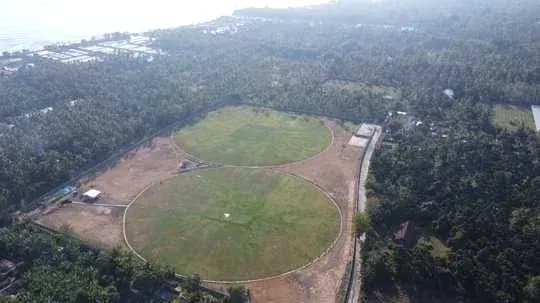
The Bali International Oval – BIO for short – is taking shape as a two-oval complex designed not just to host matches, but to drag Indonesian cricket into the global high-performance conversation. This is not a pop-up tournament ground. It is being built to live and breathe cricket all year.
At the heart of the project sits the Garuda National Cricket Academy, which will operate as the high-performance engine of the complex. Indonesia’s senior and age-group teams are expected to use it as their training base, while the doors will also be open to visiting international teams, academies, coaches and curators. The vision is clear: local talent sharpening skills alongside global expertise, on home soil.
On the ground, the work is already past the drawing-board stage. Both oval footprints have been cut into the landscape, and the centre-wicket blocks are emerging. The heavy lifting of construction is giving way to the more delicate work that defines elite cricket venues: wicket maturation, fine-tuning of playing surfaces, and the laying of drainage and irrigation systems that can cope with Bali’s tropical moods. Specialist ground machinery is set to follow, along with purpose-built high-performance spaces, team areas and broadcast facilities to bring the venue to a wider audience.
Cricket Indonesia is not thinking small. The federation sees BIO as a potential high-performance hub for the entire Asia-Pacific region, a place where training, sports science, coach education, athlete recovery and tournament operations can sit under one roof. For a country still in the early chapters of its cricket story, it is a bold attempt to fast-track its development by becoming a destination rather than a footnote.
The spark for this push came in January 2024, when Bali hosted the Asian Cricket Council Annual General Meeting and Indonesia was formally welcomed into the ACC fold. Jay Shah, then ACC President, played a central role in those proceedings, but what lingered longest in Indonesia was not just the membership certificate.
“When the ACC came to Bali in 2024, the message I took away was bigger than membership. Inclusive leadership had opened a pathway for Indonesia. I felt our responsibility was to build the infrastructure that would allow our players to use that opportunity for generations,” says Abhiram Singh Yadav, chairman of Cricket Indonesia.
That sense of responsibility now sits alongside a global shift. Cricket is returning to the Olympic Games, and Indonesia wants to be ready. BIO is being developed with that horizon in mind, as the country looks to ride the sport’s wider expansion rather than watch it pass by.
“The Olympic return changes the imagination of cricket. A young Indonesian should be able to dream not only of international cricket, but of an Olympic pathway. Our infrastructure must be ready for that era,” Yadav says.
If BIO delivers on that promise, a new generation of Indonesian cricketers could grow up not just watching the game on screens, but chasing Olympic dreams on world-class turf in North Bali.