Emma Raducanu's Comeback Journey Inspired by Andre Agassi
Emma Raducanu’s comeback has taken an unexpected turn – into the pages of Andre Agassi’s life.
Five years on from her astonishing US Open title run, the Briton is rebuilding not just her body, but her relationship with the sport. And as she pieces things together, she has been studying a man who once lost his way entirely, then climbed back higher than before.
A Grand Slam champion looking for a new map
Raducanu’s story is already etched into tennis history. In 2021, at 18, she became the first qualifier in the Open era to win a Grand Slam, tearing through the US Open without dropping a set. By July 2022 she had risen to world number 10, the kind of ascent that usually takes years, not months.
The fall has been far more familiar.
Now 23 and ranked 98th, Raducanu has spent the past two seasons fighting her own body as much as any opponent. A foot injury disrupted her pre-season. A post-viral illness then kept her off the court for two and a half months. A stress fracture in her lower right leg ruled her out of this year’s US Open entirely.
Yet in between those setbacks, there was a flicker – a reminder of what she can still be. At Queen’s Club in June, she put together one of the most convincing weeks of her career, reaching her biggest final since that night in New York. For the first time in a long time, her tennis did the talking.
Agassi’s words, Raducanu’s reality
Raducanu has been reading Agassi’s 2009 autobiography, a book that stripped away the glamour of a global star and revealed the turmoil underneath. For a player who went from anonymity to a Grand Slam title and worldwide scrutiny in three weeks, the parallels are not hard to spot.
“I was especially intrigued by the passage where he got out of his slump in the late 1990s by creating his own training regimen and finding his way back to the top,” Raducanu told Uniqlo.
“It speaks in depth about his early successes and the lows he reached, perhaps as a result of them. A lot of it was so relatable.”
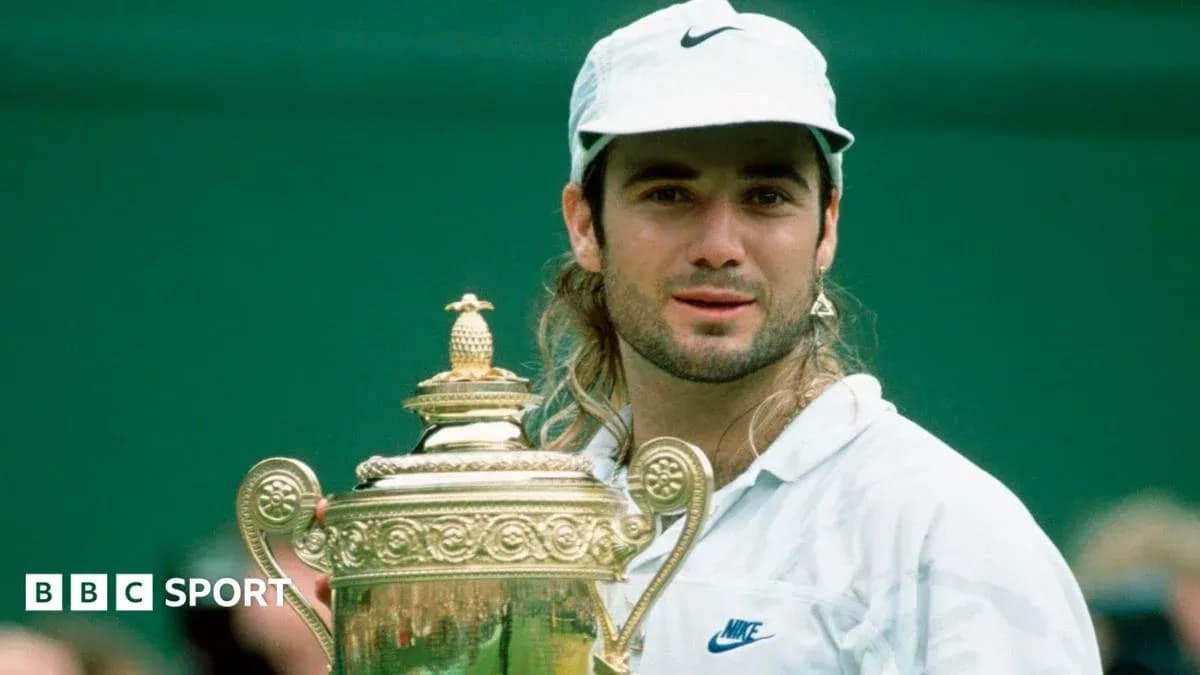
Agassi’s own career never followed a straight line. A teenage prodigy, he claimed the first of his eight major singles titles at Wimbledon in 1992 at the age of 22. Then came the crash. He went four years without a major, his ranking tumbling to 141 in the world.
From that low, he rebuilt – on his own terms.
That journey, he has always said, was the point of the book. The trophies mattered. The scars mattered more.
“If one person read it…”
Agassi, now 54 and still a sharp observer of the game, has been genuinely moved to hear his words resonate with a new generation.
“It’s wonderful to hear that anybody can relate,” he told BBC Breakfast. “It was literally the hope that if one person read it and it gave them hope, some tools to understand that they’re not alone, they can figure it out and get to a healthier place without having to direct their frustrations at the game of tennis, then it was a success for me.
“So, hearing that 17 years later it can still impact somebody, especially in this game, it does make me feel good.”
He knows better than most how quickly adulation can turn to expectation, and how suffocating that can be when you are still trying to work out who you are.
Asked what he would say directly to Raducanu, his answer went straight to the heart of that tension between result and identity.
“I would encourage her to focus on being the best of herself on a daily basis, but don’t judge that by results or thinking that somehow you have to be 100%,” he said.
“You have to learn to be 100% of whatever percent you’re at [and] be comfortable in your own identity inside of that – not what people say.”
Then came the line that underlines how much the landscape has changed.
“Back in my day, I could just put down the paper and not read it. Now it seems like it’s harder for these youngsters to avoid.”
Fear, freedom and a second career
Agassi’s own relationship with tennis was fraught from the start. His father, obsessed with producing a champion, introduced his son to strangers as a future world number one. The label stuck long before the boy had any say in the matter.
That pressure, Agassi admits, drove him to play with “fear”. Only when he plummeted from world number one to 141 did he find space to reconnect with the game on his own terms.
During that period he set up a foundation focused on education for under-served children. Stepping outside tennis, he says, changed how he stepped back into it.
“I had more success from that point forward than I did playing out of fear,” he reflected.
His message to parents in sport is blunt.
“The first thing I would advise a parent to think about is that it’s not their life, it’s their child. You raise a child in their way and they’ll never depart from it. You just have to find out what their way is.”
For Raducanu, whose life was rewritten in a fortnight in New York, that idea of “her way” may be the most important lesson of all.
A new role for Agassi, a new chapter for Raducanu
Agassi remains firmly woven into the sport’s present. Later this week he will captain Team USA at the Laver Cup at The O2 in London, from 25-27 September. Another stage, another pressure cooker, another chance for young players to feel the weight of expectation and the thrill of performance.
“Tennis is a hamster wheel of sorts – the fact that these guys make room in their schedule to play this incredible event tells you how great this event is,” Agassi said.
“We’re obviously playing Team Europe, in Europe, so I don’t know where the crowd is going to have their heart. But I know one thing – they’re going to see some spectacular tennis.”
Raducanu will be watching from the outside this time, still managing her recovery, still trying to put together a full, healthy season. Her ranking says she is a long way from the summit. Her game, when her body allows, still hints at rare altitude.
Agassi once rebuilt a career from 141 in the world to all four majors and Olympic gold. Raducanu has one Slam, a shelf of medical reports, and a book that tells her reinvention is possible.
The question now is simple, and brutally compelling: what does her second act look like?