George Chuvalo: Legendary Canadian Heavyweight Champion Dies at 89
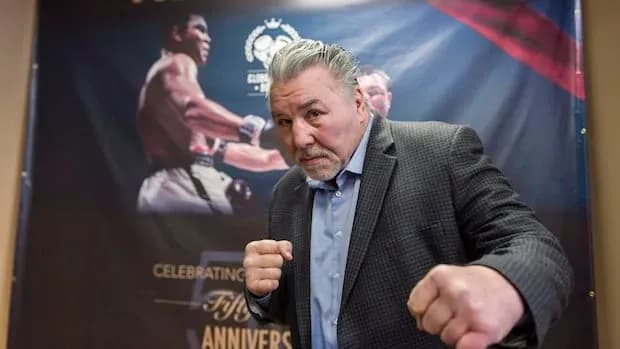
George Chuvalo, the granite-jawed Canadian heavyweight who stood up to the biggest punchers of boxing’s golden era without ever being knocked off his feet, has died at 89.
The former contender, long revered as one of the sport’s toughest men, had been living with dementia in a long-term care facility in Toronto. His death on Saturday was confirmed in multiple online posts from family and friends. Ontario Premier Doug Ford, who described Chuvalo as a family friend, offered condolences, saying his thoughts were with all of Chuvalo’s loved ones.
For a generation of Canadian sports fans, Chuvalo was the man who wouldn’t fall.
He went the distance with Muhammad Ali twice, in Toronto and Vancouver. He soaked up the full force of Joe Frazier and George Foreman, two of the most destructive heavyweights in history, and stayed upright. His “never knocked down” tag wasn’t a marketing slogan; it was his calling card.
The punishment he took in the ring, though, never matched what life threw at him later.
“If you added up every punch I took and multiplied the total by 10,000, it wouldn't begin to equal the pain of losing three sons and a wife to drugs and suicide,” he wrote in his 2013 autobiography, Chuvalo: A Fighter's Life, co-written with Murray Greig. It was a line that cut through the mythology and laid bare the man behind the chin.
From Toronto’s Junction to the world stage
The son of Croatian immigrants, George Chuvalo was born on Sept. 12, 1937, in Toronto’s tough Junction neighbourhood. Boxing found him early. A copy of The Ring magazine on a newsstand caught his eye, and by age 10 he was climbing through the ropes for the first time.
A growth spurt and a fascination with weightlifting turned him into a formidable physical presence: six feet tall, 210 pounds, thick through the neck and shoulders. After a short amateur stint, he turned professional in 1956 and quickly made noise at the Jack Dempsey Tournament at Maple Leaf Gardens.
Then the momentum stalled. By the early 1960s, poor management had his career drifting. The raw material was obvious; the direction was not.
That changed when Toronto poultry magnate Irv Ungerman took over his career. Under Ungerman, Chuvalo’s path sharpened. He strung together wins, then seized his chance in 1964 at Madison Square Garden, stopping respected contender Doug Jones in the 11th round. A year later he was back at the Garden, losing a narrow decision to former heavyweight champion Floyd Patterson in a brutal, see-saw fight that The Ring named its 1965 Fight of the Year.
“He just keeps coming and coming”
That was Chuvalo in a sentence. His style was relentless without being reckless. He trudged forward behind a high guard, slamming heavy shots to head and body, grinding opponents down. Eighty-eight per cent of his victories came by stoppage.
“You can't believe his strength,” Canadian fighter Bill Drover once said. “There's no way to stop him. He just keeps coming and coming. The only way you can stop him is with a stick of dynamite.”
Chuvalo always argued his defence was better than critics claimed, but what separated him from almost everyone else was his durability. He credited a 17.5-inch neck, built through years of specific exercises, for allowing him to absorb punches that would have finished other men.
Ali, the title shot, and a reputation forged
In 1966, he found himself in the biggest spotlight of all. Ali, shunned in parts of the United States for his association with the Nation of Islam and his stance on the Vietnam War, needed an opponent. Chuvalo stepped in as a replacement challenger for the heavyweight title.
The New York Times summed up the betting view with a brutal headline: “Bettor's-Eye View of Chuvalo: A Big Bum With a Lot of Heart.”
He didn’t leave the ring with the belt, or with Canada’s first heavyweight title since Tommy Burns in the early 1900s. What he did leave with was respect. Ali, who would face every great heavyweight of his era, famously called Chuvalo the toughest man he had met to that point.
For many Canadians, that 15-round war in Toronto became the defining image of Chuvalo. He admitted it took time to embrace that.
“In a crazy way, that fight is what defines me for a lot of my fellow Canadians but it took a long time before I came to appreciate how good it made me feel,” he said later.
The Ali performance opened doors. With his wife Lynne and five children at home, Chuvalo understood what those paydays meant. He beat contenders Jerry Quarry and Manuel Ramos, dropped close decisions to rugged rivals Oscar Bonavena and Jimmy Ellis, and remained a fixture in the upper tier of the division.
He was finally stopped in 1967 by Frazier, his eye so damaged he needed a silicone implant to keep it from drooping. Three years later, Foreman bludgeoned him to a fourth-round stoppage, the referee stepping in before Chuvalo’s legendary “never knocked down” streak could be broken.
He met Ali again in Vancouver in 1972, but the rematch never caught fire in the same way. The fight was more one-sided, the drama muted. Chuvalo boxed on and walked away on his own terms in 1978, retiring after a win with a record of 73-18-2, including 64 knockouts.
A fighter outside the ring
Unlike some of his contemporaries, Chuvalo did not show obvious signs of damage in retirement. He spoke quickly, sharply, with a steady stream of wisecracks and self-deprecating lines. The words came easily. The adjustment did not.
He wrestled with what he once called the “humdrum” nature of life after boxing. He tried on different roles: nightclub owner, real estate agent, fight promoter, television host. He even turned up on the big screen, suffering what has been described as cinema’s worst arm-wrestling defeat in a cameo in David Cronenberg’s The Fly.
One thing he was clear about, even in 1968, was that he didn’t want his four sons to box for a living. The danger, he understood. What he couldn’t foresee was the threat he couldn’t slip or block.
Jesse, the youngest, became addicted to heroin after a prescription painkiller ran out. In 1985, at just 19, he shot himself. By then, older brothers George Jr. and Steven were also using heroin, drifting into petty crime to feed their habits.
“My dad spent quite a few years chasing us around the city, Georgie and I in particular, and dragging us out of drug houses and heroin houses and basically just trying to keep us alive,” Steven told CBC’s the fifth estate in 1995.
The nightmare deepened. George Jr., only three days out of jail in Kingston, Ont., died of an overdose on Halloween 1993. Four days later, Lynne Chuvalo swallowed pills, left a suicide note, and ended her life at 49. Chuvalo later told the New York Times he never thought she would do it, but wasn’t surprised, saying she never recovered from burying their first child.
Steven, who had spoken on the fifth estate about wanting to make his father proud, overdosed and died eight months after the program aired.
The man who never went down kept getting up.
He remarried. He poured himself into time with his eldest son Mitch, his daughter Vanessa, and his grandchildren. He turned his family’s devastation into a blunt, unsparing anti-drug message, travelling across Canada to speak to students. In a 1998 CBC Radio report, he laid out his mission in stark terms:
“I'd like to think if you're ever tempted with the idea of doing drugs, or you ever flirt with doing drugs, I hope you think of me, George Chuvalo, and what drugs did to my family.”
Legacy and final years
The final chapters were not without turmoil. In 2017, reports emerged of bitter disputes between his surviving children and his second wife, Joanne, as the couple went through a divorce. At the heart of some of those battles was Chuvalo’s cognitive decline and questions over his care.
On a podcast five years later, Mitch Chuvalo said his father no longer recognized him when he visited.
By then, the city that once watched the kid from the Junction grow into a world-class heavyweight had put his name on the wall. In 2019, Toronto officially opened the 7,000-square-foot George Chuvalo Community Centre in the neighbourhood where his story began.
For all the nights under the lights, all the rounds with Ali, Frazier, and Foreman, it is that image—his name on a building in the Junction, a space for the next generation—that may prove the most enduring measure of a man who refused to fall, even when life hit harder than any champion.