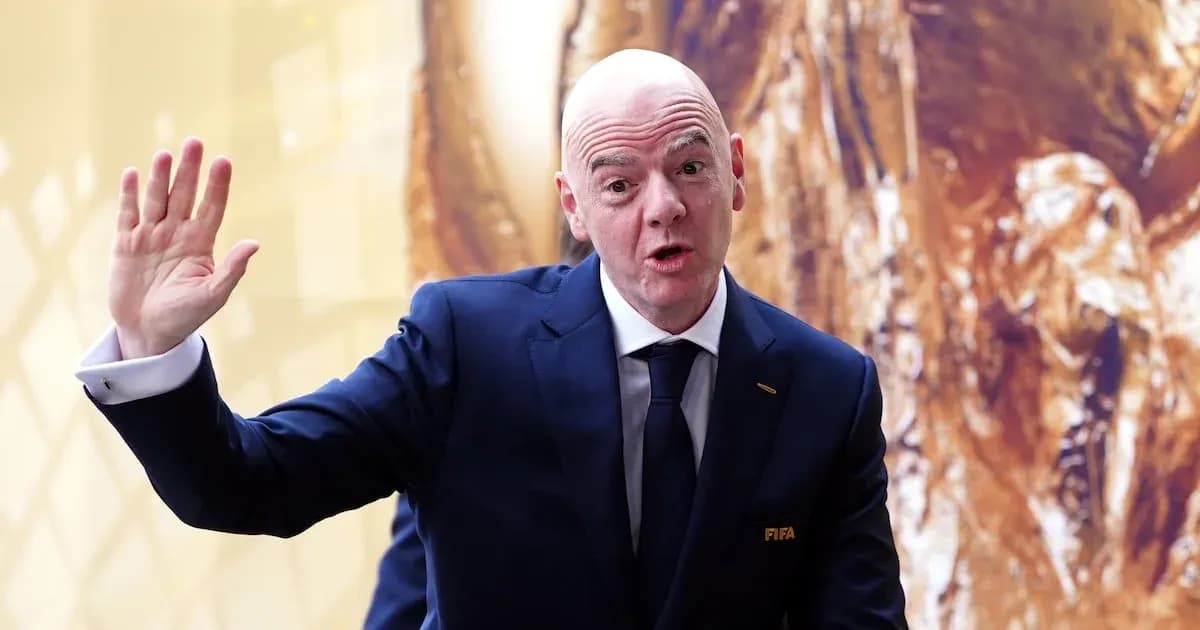
Gianni Infantino Agrees to Independent Governance Review
Gianni Infantino has finally blinked.
Under growing fire over Fifa’s handling of a controversial World Cup commercial deal and the Folarin Balogun eligibility storm, the Fifa president has agreed to commission an independent governance review – the first time in his tenure he has opened the door to external scrutiny.
Infantino yields to pressure – but only so far
For weeks, discontent has been building inside Fifa’s own corridors. Several members of the Fifa Council had been privately and then publicly pushing for an outside investigation into two flashpoints: the proposed sell-off linked to Fifa Forward Enterprise and the way the Balogun case was managed.
The pressure sharpened when English FA chair Debbie Hewitt wrote directly to Infantino, demanding the release of all documents relating to both matters. Infantino did not engage with those complaints in public or in council, leaving tensions to simmer.
Now he has moved, but on his terms.
In a letter sent to all 211 Fifa member associations, Infantino said he would ask the Fifa Council to consider commissioning an “independent external review” of Fifa’s governance framework for major strategic initiatives. He also called for a broader look at how decisions are made at the top of the organisation.
The proposal is due to be discussed at the next Fifa Council meeting in Zurich on 15 October.
Governance under the microscope
Infantino’s letter sets out a two-pronged plan.
“First, I will ask the council whether it wishes to commission an independent external review of Fifa’s current governance framework for major strategic initiatives and recommend potential improvements,” he wrote.
“Second, I will propose that the council establish a direct, structured and time-limited consultation with confederations, member associations and relevant stakeholders on how Fifa’s decision-making can be further strengthened.”
That consultation, he said, would seek concrete ideas on earlier involvement of key bodies, the precise roles of the president, the bureau, the council and the congress, and on “practical ways to strengthen transparency, participation and accountability” around big-ticket decisions.
On paper, it is a significant step. The Fifa Council – made up of 28 representatives from the six confederations, eight vice-presidents and Infantino himself – is widely expected to approve the commissioning of an external review. The real battle will be over the terms of reference.
A wide, genuinely independent mandate could open the door to meaningful reform at the world governing body. A narrow brief could instead serve as cover, allowing Infantino to claim openness while tightening his grip ahead of the presidential election in March next year.
Flashpoints left untouched
For all the talk of transparency, one detail in Infantino’s letter stands out. He does not specifically commit to reviewing Fifa Forward Enterprise or the Balogun affair.
That omission means he has not met Hewitt’s demand head-on. The controversies that triggered the revolt remain unaddressed, at least formally, and questions over how those decisions were taken – and by whom – still hang in the air.
The independent review may yet stray into that territory, depending on how it is framed. Right now, though, Infantino has kept those flashpoints at arm’s length.
Money on the table
Governance is not the only fault line.
Infantino is also facing heavy pressure over Fifa’s finances. With cash reserves of around $6bn (£4.5bn), Fifa sits on a vast pile of money at a time when many national associations are battling economic strain.
Last week, Uefa president Aleksander Ceferin and Concacaf president Victor Montagliani formally requested a payout of at least $10m for every national association. That is a huge ask, and a very public one.
On Monday, Asian Football Confederation president Sheikh Salman bin Ibrahim Al Khalifa joined the chorus, sending a similar letter and ensuring the issue of funding will sit prominently on the agenda in Zurich next month.
So Infantino heads into that council meeting with two storms converging: demands for structural reform and demands for cash. How he shapes this “independent” review – and how generous he is prepared to be with those reserves – will tell the game far more about the balance of power in Fifa than any carefully worded letter.