Heavyweight Crown Changes Hands at O2 Arena: Dramatic Fights Unfold
The heavyweight crown changed hands in dramatic fashion at the O2 Arena, but the undercard had already done its job long before Moses Itauma and Filip Hrgovic touched gloves. Blood, controversy, a brutal one-punch finish and a statement from a rising lightweight contender – this was a card that never really eased off.
Below is how the chaos unfolded before the main event.
Guido Vianello vs Moses Jolly – A Brutal, Breathless Draw
The night opened with two big men trying to steal the show before it had even started.
Moses Jolly, unbeaten and brimming with ambition, walked in as the naturally bigger heavyweight. Guido Vianello, the former Olympian with scars on his record and something to prove, met him head-on. From the first bell, it was clear neither man had come to box within his limits.
Jolly dug to the body early, thudding in shots that sounded heavy even from distance. Vianello answered with the cleaner, more eye-catching punches upstairs. They didn’t so much feel each other out as crash straight into the fight they both wanted.
By the second round, the tone had changed from competitive to chaotic. Both were bloodied, both swinging in wild, ugly exchanges that looked one punch away from a finish. Technique frayed, but the drama didn’t.
Jolly’s confidence surged when he crashed home two savage overhand rights that Vianello somehow absorbed amid the clinching and wrestling. The Welshman blew a kiss to the crowd, bounced to the music in his corner at the bell – a man enjoying his moment on the big stage.
That early work to the body began to tell by the middle of the fourth. Vianello was visibly labouring, sucking in air, yet still sharp enough to find counters and clever shots on the inside to keep himself alive in the contest. Jolly seemed to be bossing the tempo, but the Italian refused to wilt.
The sixth brought a shift. Jolly’s output dipped to single jabs, his earlier ferocity fading. Vianello seized the opening, timing his counters and clawing his way back into a fight that had threatened to run away from him. Both men grew sloppier as fatigue set in, yet neither stopped trying to land the punch that would settle it.
They didn’t get it. The final round played out like the rest – heavy breathing, heavy leather, and a sense that one clean shot might still turn everything. It never came. The referee, acting as sole scorer, returned a 76-76 card.
A draw.
Jolly, who had dominated long stretches of the first half, could feel aggrieved. Vianello, who rallied late, had his own case. What they shared was a brutal, messy, compelling fight that left more questions than answers.
Constantin Ursu vs Ben Vaughan – Blood, Grit and a Doctor’s Call
The British welterweight title defence for Constantin Ursu was supposed to be a showcase. Ben Vaughan refused to play that role.
Vaughan started fast, determined to rough up the champion and turn the ring into a small, uncomfortable place. Across the opening two rounds, the challenger did the better work, crowding Ursu, smothering his attempts to find space for the rear uppercut he clearly wanted to land.
Ursu’s jab, though, began to tell. It sliced through Vaughan’s guard, bloodied his nose and gradually imposed some order on the chaos. Technically, Ursu looked the sharper boxer, but he kept getting caught with avoidable shots, his defence as loose as his ambition was high.
Vaughan’s plan was obvious and effective: hammer the body, take the legs away, drag the champion into deep water. The body shots thudded home and, for a while, Ursu looked uncomfortable.
Then the tide turned.
In the fifth, Ursu found his rhythm and his accuracy. He opened a nasty cut above Vaughan’s left eye, blood streaming down and into the challenger’s vision. The sight seemed to energise the champion. Suddenly he was landing at will in the closing seconds of the round, driving Vaughan backwards and turning a hard fight into a crisis for the Englishman.
The sixth turned savage. Ursu picked up a cut of his own over the right eye, and the ring quickly became a crimson blur. Neither man backed off. They stood in the pocket, trading, Ursu’s shots carrying more venom, Vaughan answering with stubborn resistance.
By the start of the eighth, both fighters were coated in each other’s blood. They rose for the round, ready to continue, but the referee and ringside doctor had seen enough. Vaughan’s cut, pouring and dangerous, brought the fight to a halt.
Ursu retained his British and Commonwealth welterweight titles via eighth-round TKO, his hand raised but his aura dented slightly. Vaughan had dragged him into a war and exposed a defence that still looks far too generous at this level. The champion leaves with belts and momentum, but also with a clear warning about what happens when he lets his guard slip.
Nelson Hysa vs Thomas Narmo – One Punch, One Statement
Heavyweight power doesn’t always need long build-up. Sometimes it just needs a target.
Nelson Hysa, unbeaten and carrying the WBO Global strap, stepped in with Thomas “The Last Viking” Narmo, a man who arrived boasting 14 fights, 14 knockouts and a reputation as a destroyer. On paper, it was a collision. In reality, it was brief.
They opened tentatively, two huge men prodding with range-finding jabs. Narmo, though, showed an early flaw – exiting range upright, chin high, straight back. Hysa spotted it and smiled, a quiet, knowing grin that said the mistake would not go unpunished.
He didn’t need long.
In the second round, before the atmosphere had settled from the ring walks, Hysa detonated a looping overhand right. It crashed through Narmo’s fragile exit route and dumped “The Last Viking” heavily to the canvas.
Narmo hauled himself up, but his legs and eyes told the truth. He was upright but not present. The referee stepped in, correctly, before the situation turned ugly.
Hysa walked away with a first-round knockout, his record stretching to 25-0 and his WBO Global title still strapped around his waist. On a night stacked with heavyweights, he delivered the cleanest, most ruthless finish.
Sam Noakes vs Denys Berinchyk – Pressure, Patience and a World-Level Statement
The chief support had the feel of a crossroads fight.
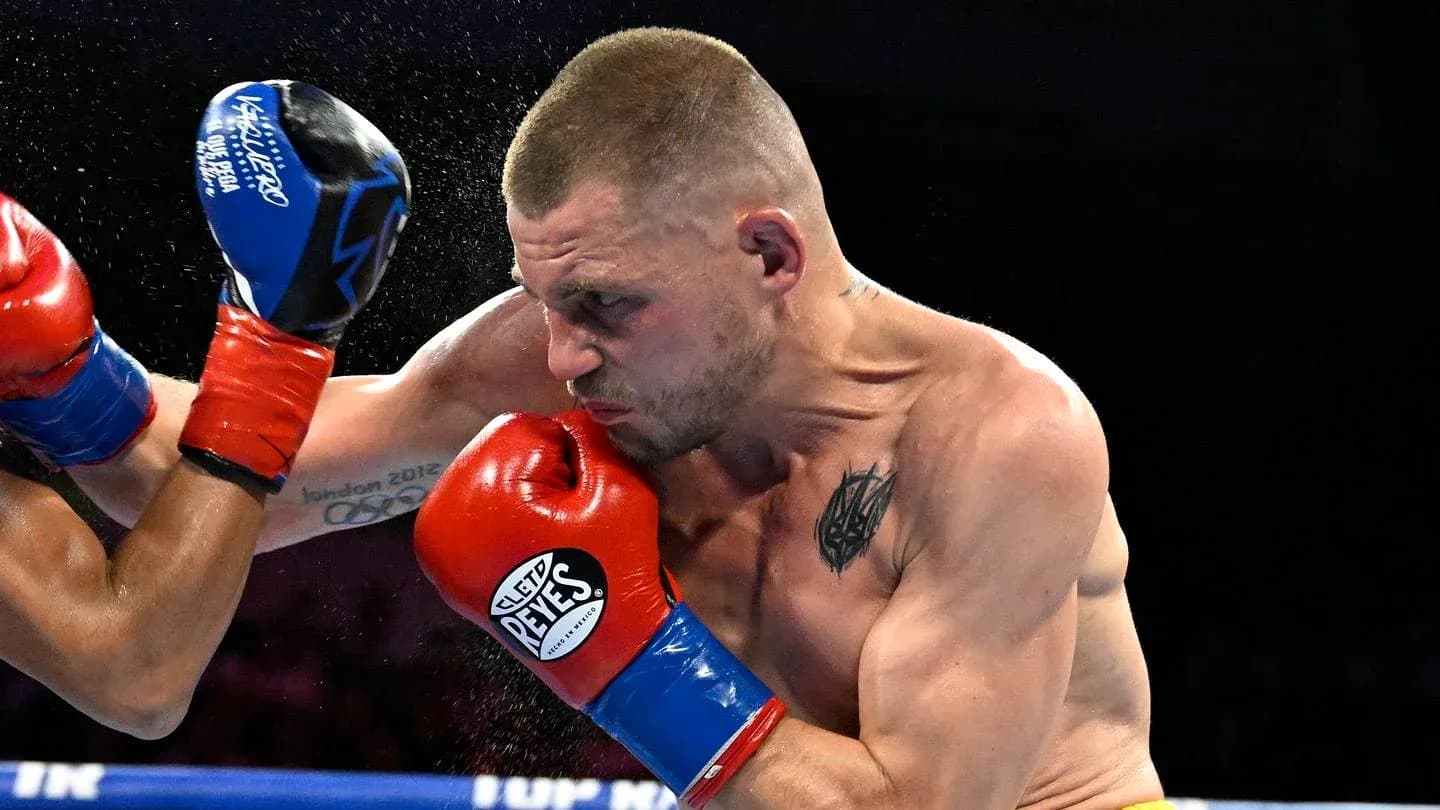
Denys Berinchyk, once the WBO lightweight champion, arrived trying to rebuild after being knocked out by Keyshawn Davis and losing his belt. Sam Noakes came in as the hungry contender, still smarting from a punishing defeat to Abdullah Mason but fresh off a quick-fire win at York Hall.
From the opening bell, Berinchyk refused to stand still. He circled, darted, dipped and slid away, using every inch of a generous ring. His jab, sharp and educated, flicked out to disrupt Noakes’ rhythm. The Ukrainian had no interest in trading early; he was boxing to survive and then to score.
Noakes, by contrast, loaded up. Every shot carried bad intentions, but for the first few rounds he struggled to find anything clean. Berinchyk’s movement and angles made him a difficult, slippery target, and the Englishman was often made to swing at shadows.
In the fourth, Berinchyk switched to southpaw and snapped in a couple of stinging left hands, reminders of the class that took him to an Olympic silver medal and a world title. Noakes kept trying to drag him into a war, edging closer, digging to the body whenever he could reach it. He knew he had to slow those spring-loaded legs.
The shift came in the middle rounds. In the fifth, Noakes started cutting the ring off with more intelligence, not just chasing but corralling. He jabbed Berinchyk into corners, then followed with combinations to head and body. It wasn’t domination, but the momentum had tilted.
Gradually, the ring shrank for Berinchyk. Noakes made the space feel smaller and smaller, forcing exchanges the Ukrainian clearly wanted to avoid. As Berinchyk’s face reddened and his feet lost a fraction of their early bounce, the fight began to slide away from him.
Berinchyk’s fast hands never disappeared. Noakes had to accept he would take one to land one, walking through sharp counters to invest in the body and sap what remained of his opponent’s movement. The size and power difference told; each Noakes shot seemed to weigh more heavily than what came back.
Heading into the final round, it still felt close enough to be tense, but Noakes had the stronger argument. He had outlanded Berinchyk over the bulk of the contest, especially in the second half. Even then, the former champion found pockets of success, staying closer and whipping in uppercuts and lead hooks in a last attempt to turn the tide.
It wasn’t enough.
All three judges sided with Noakes, handing him a unanimous decision that does more than just repair his record. It places him back in the queue for another shot at world honours, this time with the experience of having gone rounds with a wily former champion who forced him to think as well as fight.
On a night when heavyweights chased history at the top of the bill, it was Noakes who quietly underlined his own ambitions. The next time he steps onto a world stage, it may not be as the supporting act.