India's Balancing Act Amid US Tariffs and Russian Oil
The Indian government is poring over the fine print of fresh US tariffs targeting buyers of Russian oil, Commerce Minister Piyush Goyal said on Monday, as New Delhi braces for another test of its uneasy economic ties with Washington.
The new law, passed in Washington days ago, hands US President Donald Trump sweeping authority to slap tariffs of up to 100% on India, China and other countries that continue to rely on Russian energy. For India, which has deepened its energy partnership with Moscow since the war in Ukraine, the message from the US is blunt: curb Russian oil or pay a steep price.
India’s tightrope between Moscow and Washington
India’s relationship with Russia has only grown more entrenched since the Ukraine war began, anchored by a steady stream of discounted Russian crude that has helped cushion the Indian economy from global price shocks. That same lifeline has become a major irritant in New Delhi’s dealings with Washington.
Under Prime Minister Narendra Modi, India-US relations have repeatedly run into friction over Russian oil purchases. In August last year, Trump hit Indian imports with an extra 25% tariff, explicitly linked to those purchases. That penalty landed on top of an existing 25% reciprocal tariff, sharply raising the cost of Indian goods heading to the US.
The pressure eased briefly. In February 2026, Washington rolled back the additional Russia-related tariff and trimmed the reciprocal duty to 18% as part of a broader US-India trade framework. That agreement was hailed at the time as a breakthrough, a potential reset for two major economies trying to find common ground.
Yet the deal now hangs in the balance. There has been no decisive progress since, and trade analysts argue the new tariff powers will sit on the table as a negotiating weapon. The threat is clear: cooperate on energy and trade terms, or face another wave of punishing duties.
For India, which has turned into a crucial outlet for Russian exports shut out of Western markets, the stakes are enormous. Russian oil has become a cornerstone of its energy security and a key factor in keeping domestic inflation under control. Any move to sharply reduce those imports would ripple through the economy and the political landscape.
Campus tragedy and a rare apology
Far from the trade corridors, another story gripped India on Monday — a campus death that has sparked protests and forced one of the country’s premier institutes into an unusual public climbdown.
The Indian Institute of Technology Bombay issued an apology for its earlier communication on the reported suicide of a second-year student from the Department of Energy Science and Engineering. The student died on September 18.
In its first statement, posted on social media a day after the death, IIT Bombay said the 20-year-old had died by suicide after being caught using a mobile phone in an examination hall, allegedly to seek answers from ChatGPT. He was later found dead in his hostel room that evening.
That version of events triggered outrage.
On Monday, the institute walked back its initial framing. In a post on X, IIT Bombay said that “the details and circumstances leading up to the incident remain subject to investigation by the appropriate authorities” and admitted it had been “inappropriate to have set out or characterized details” while the probe was still underway.
Students have staged protests on campus, demanding a thorough investigation and action against the professor who supervised the exam. The student’s family has reportedly named the same professor in the police complaint, accusing him of harassment and caste discrimination.
Under pressure, IIT Bombay Director Professor Shireesh Kedare met the protesters on September 20. Indian media reported that the professor in question has since been suspended pending investigation. For a campus long seen as a symbol of elite opportunity, the case has reopened raw debates about mental health, caste bias and accountability in India’s top institutions.
Viral video, public fury
Another disturbing story unfolded online.
Videos from Jamui district in the eastern state of Bihar, showing a mob harassing two minors — a boy and a girl — spread rapidly on social media on Monday. The first clip, apparently shot at night, shows a group confronting the teenagers for being alone together. One man grabs the girl from below, lifts her off the ground and carries her away from her friend.
Later footage shows the pair surrounded by a crowd, visibly distressed. The scenes sparked a wave of anger across India.
“Deeply disturbing,” wrote opposition leader Rahul Gandhi on social media, describing how the Class 10 students were “stopped on a road. Harassed. Humiliated. Molested.” He highlighted the image of the girl, hands folded, pleading to be released while men groped and dragged her away.
Gandhi demanded that every person seen in the video be identified and prosecuted under the Protection of Children from Sexual Offenses (POCSO) Act, questioning why the suspects were still free if the incident took place on September 19.
Public pressure mounted quickly, with users tagging police accounts and calling for swift arrests.
Jamui Police confirmed that both victims were minors who had gone to the area to take photographs. A First Information Report has been registered. “The accused will be identified and arrests ensured at the earliest,” the district police said on social media.
Jamui Superintendent of Police Vishwajeet Dayal told reporters that the video reached the police on Monday morning. Investigators then traced the victims and recorded their statements, establishing that the assault took place around 7 p.m. on September 19 after the teenagers left their coaching classes.
Dayal said the accused had been identified and that legal action was underway, with arrests expected soon. The case adds to a grim catalogue of gender-based violence in India, raising again the question: how many viral videos will it take before deterrence truly sets in?
Delhi’s voter rolls under the scanner
In the capital, the battle is over names on paper — and who gets to keep their vote.
Delhi’s ongoing revision of electoral rolls has come under sharp scrutiny after a string of high-profile figures received notices over “discrepancies” in their voter information. Among those flagged, according to Indian media reports, are Foreign Minister Subrahmanyam Jaishankar, Election Commissioner Sukhbir Singh Sandhu, Foreign Secretary Vikram Misri and several former leaders from both the ruling Bharatiya Janata Party (BJP) and the opposition.
Even Delhi Chief Minister Rekha Gupta has reportedly been served a notice over an age mismatch.
The exercise, known as Special Intensive Revision (SIR), is run by the Election Commission of India to clean up voter lists — removing duplicate entries, dead voters and incorrect records. Discrepancies typically involve errors in names, family details or age, and can be corrected by submitting approved documents to local officials.
On paper, it is routine. In practice, it has become a political flashpoint.
The latest round of SIR, announced in October 2025, has already swept through several states. Opposition parties and civil society critics allege that the process has disproportionately affected minority communities and accuse the BJP of using it as a tool to tilt future elections.
The BJP rejects that charge, insisting that those removed are largely deceased individuals or “illegal infiltrators,” and arguing that the clean-up strengthens Indian democracy rather than undermines it.
A recent investigation by The Reporter’s Collective added fuel to the fire, estimating that about 54.6% of Delhi’s existing voters had either been struck off the rolls or served notices, forcing them to prove their eligibility. With such a high share of the electorate under question, the battle over who gets to vote in the capital is set to intensify.
Flash flood tragedy in Kerala
Far to the south, in the lush hills of Kerala, a sudden surge of water turned a quiet Sunday evening into disaster.
Search and rescue teams in Nilambur recovered three more bodies on Monday morning, pushing the death toll from a flash flood to at least five. Six people were swept away on Sunday when the Kottapuzha River swelled after heavy rainfall upstream, local media reported. The search for the sixth missing person continues.
Kerala knows these scenes too well. Floods and rain-triggered landslides are a grim feature of the monsoon months between June and November, as rivers and hillsides buckle under intense downpours.
Chief Minister VD Satheesan is expected to arrive in Nilambur shortly to review the situation and meet affected families.
The India Meteorological Department has issued orange alerts — the second-highest warning level in its four-tier system — for six districts in the state, signalling the likelihood of heavy to very heavy rainfall and urging authorities and residents to stay prepared. With the monsoon still in play, the question for Kerala is not whether the skies will open again, but how much more the ground can bear.
A nation juggling crises and ambition
Back in New Delhi, a slight nip in the air signals late September, but the news cycle offers no hint of a slowdown. From trade brinkmanship with Washington and a campus in mourning, to a viral video demanding justice, contested voter rolls and a state bracing for more rain, India is juggling crises on multiple fronts.
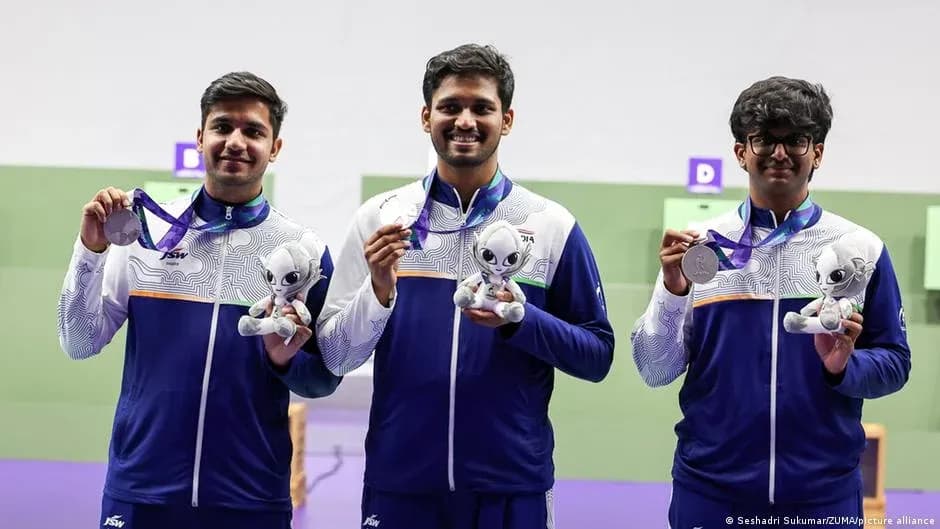
On the global stage, its athletes are quietly stacking up medals on day two of the Asian Games in Aichi-Nagoya, taking the country’s tally to six with fresh podium finishes in shooting and mixed martial arts.
In the boardrooms, a power struggle at Tata Sons over the reappointment of its chairman and a possible public listing is unfolding, with one of India’s biggest private conglomerates locked in a tug-of-war with its own controlling charitable trust.
Tariffs, tragedies, elections, floods, medals, corporate battles — all playing out at once. The bigger question now is not whether India can keep up with this pace, but how it chooses which fires to fight first.