Lewis Hamilton’s Ferrari F40 Dream: A Time Capsule Resurrected
Lewis Hamilton’s Ferrari dream has always had a very specific shape: low, red, and brutally honest. The Ferrari F40 was the poster on the wall long before the world titles, long before the move to Maranello, long before the idea of actually driving for the Scuderia stopped being fantasy and started becoming a contract.
“There are cars that you admire, and then there are cars that make you feel something.” For Hamilton, the F40 has always belonged firmly in the second category.
A time capsule on four wheels
The car that finally became his is no ordinary example. It’s a 1991 Ferrari F40 with the kind of backstory collectors dream about and mechanics almost don’t believe.
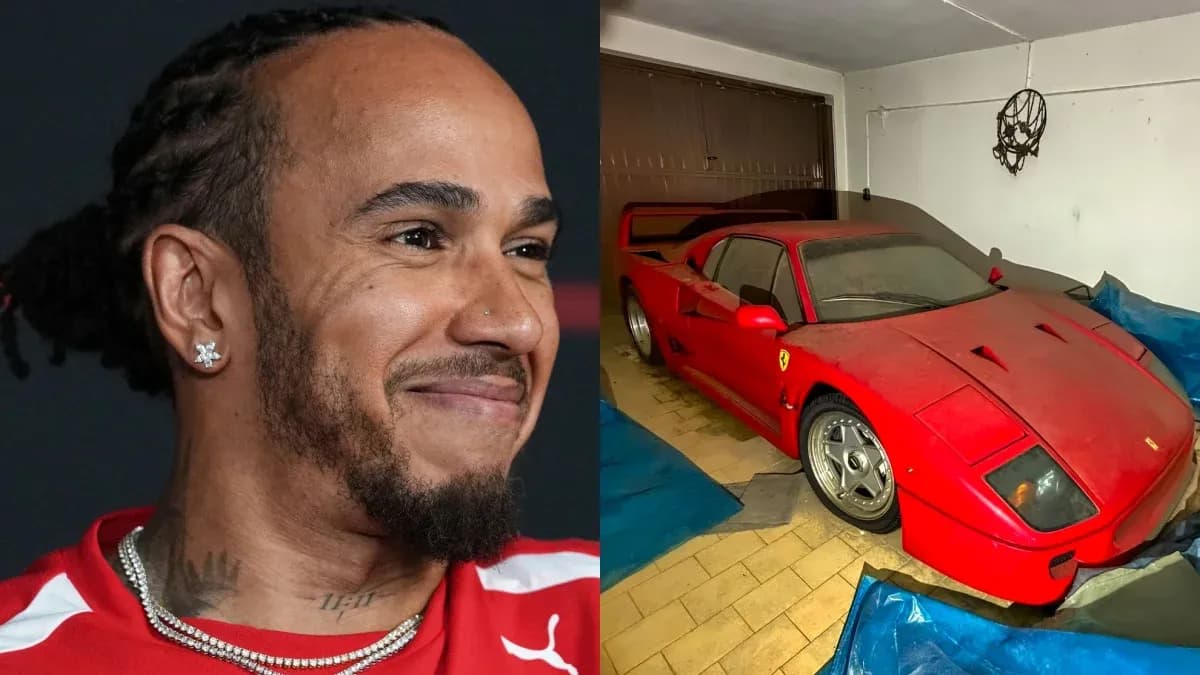
Tracked down in late 2025 by Azimut Automobile Heritage Enhancement, an investment fund specializing in historically significant cars, the F40 had lived an almost mythical existence. Delivered new, rolled into a private garage within days, and then effectively sealed away for around 35 years.
It showed delivery mileage. The panels had never been stripped. No restoration, no modifications, no upgrades, no tinkering. According to Azimut AHE, not even a single screw had been turned. The car had simply been left to sleep.
Dust, dirt and dead insects built up across the body and grille over the decades, but the conditions were kind. Sheltered from light, moisture and temperature extremes, the original Rosso Corsa paint survived in astonishing condition. Underneath the grime, the F40 looked almost as it had when it left the factory.
The one car he wouldn’t let go
By the time Hamilton walked through the doors at Maranello for his first official day as a Ferrari driver in January 2025, the story had already begun to loop back on itself.
He made sure an F40 was there beside him for the photo that would announce his Ferrari era to the world. It wasn’t just a prop. It was a statement: this is the car that made the boy fall in love with the badge now stitched on his race suit.
Months later, Hamilton revealed that he had sold his entire multimillion-dollar car collection. The superstar who once filled garages with hypercars and exotics had pivoted, he said, toward art. Cars no longer held the same pull.
Except one.
The F40, he admitted, was the exception. That wasn’t a car to him. It was a piece of art in its own right.
By then, Azimut AHE had already acquired the remarkably preserved example that would become his. The investment fund secured the car in its untouched state, then Hamilton stepped in and wrote the next chapter.
Back to Maranello, back to life
Owning a time capsule is one thing. Driving it is another.
Hamilton sent the F40 back to Maranello, returning it to the place where it had first been imagined and engineered. Ferrari’s own specialists took over from there. Engineers and mechanics carefully removed major components, including the engine, and began the slow, meticulous work of waking the car without erasing its history.
This wasn’t a restoration. It was resuscitation.
Weeks of effort went into making the car safe and usable while preserving the originality that made it so rare. Every decision balanced mechanical necessity against historical purity. Replace what you must, disturb as little as possible.
When the work ended, the F40 was no longer a static relic. It was alive again.
A red flash through Maranello
The car has now been seen where it belongs: on the road, in the hands of the driver who once dreamed of it.
Hamilton has been spotted at the wheel on the streets of Maranello, easing the F40 along a narrow two-way road. This isn’t a racetrack shakedown or a staged high-speed run. It’s something more intimate — a champion quietly learning the rhythms of a car that defined an era.
A motorcyclist draws alongside, offers a brief greeting. Hamilton answers, then rolls on through the traffic as heads begin to turn. Phones go up. People stop. The red wedge of the F40, with Hamilton behind the wheel, pulls the town’s attention as surely as a Formula 1 car firing down the main straight.
He can’t unleash its full fury there. No 201 mph blasts, no long pulls through the gears to the red line. But the car doesn’t need speed to dominate the scene. The silhouette is unmistakable. The sound — that raw, mechanical bark from its twin-turbo V8 — cuts through the everyday noise.
On these ordinary roads, the F40 looks anything but ordinary.
The last Ferrari of an era
Introduced in 1987 to mark Ferrari’s 40th anniversary, the F40 carried more than just a name. It became the final road car signed off during Enzo Ferrari’s lifetime, the last word from the man who built the legend.
Under its lightweight bodywork sits a 2.9‑liter twin‑turbocharged V8, sending 478 horsepower through a five‑speed manual gearbox. No driver aids, no soft edges, just a claimed 201 mph top speed and a demand that the person in the driver’s seat knows exactly what they’re doing.
For years, Hamilton admired that car from a distance. Now he threads one through the streets of Maranello, a modern superstar at the controls of a machine born from a very different Ferrari.
The boyhood poster has become his most treasured possession — and, fittingly, it now lives and breathes just a few miles from the factory that built both the car and the dream.