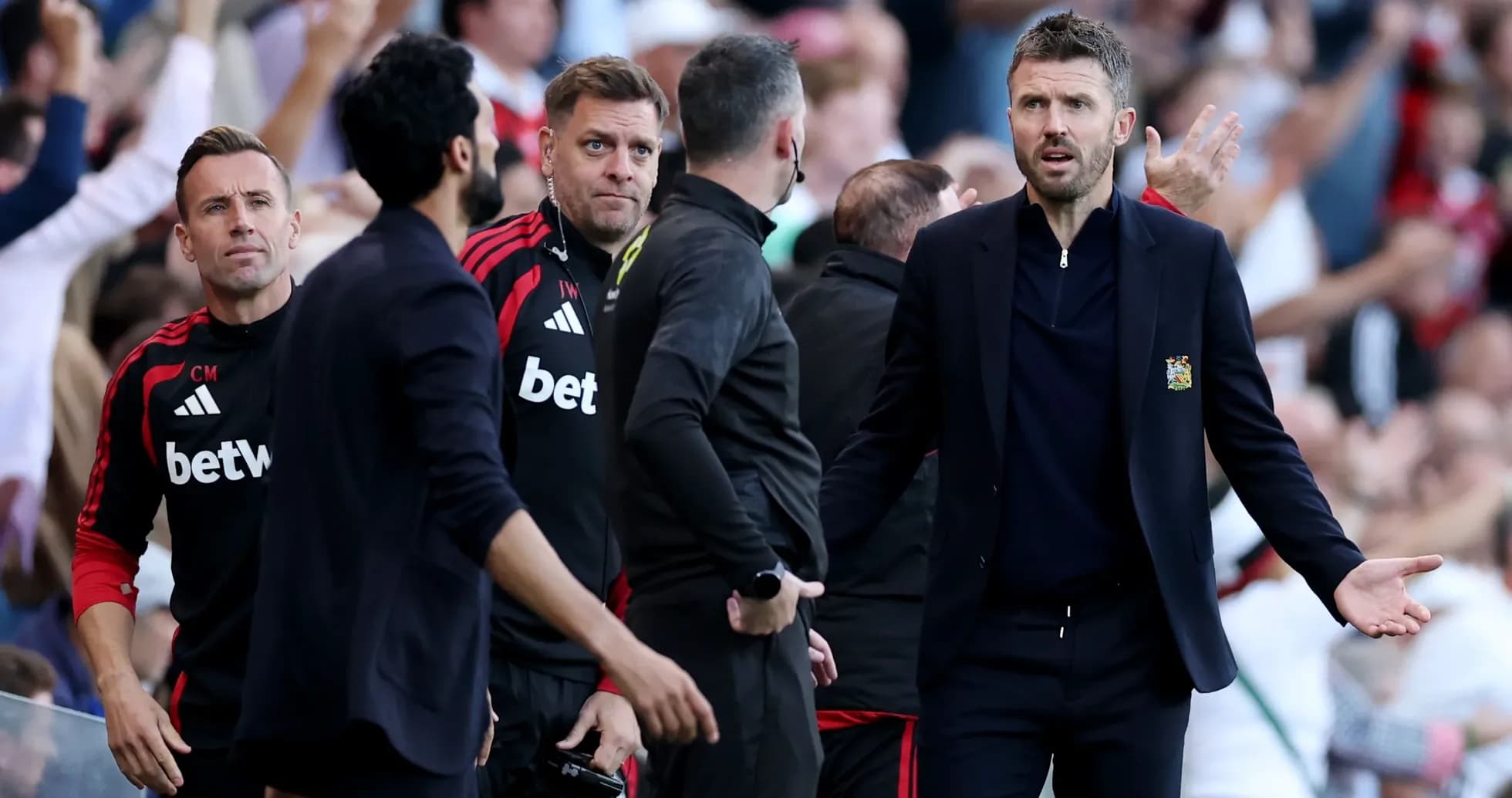
Manchester United's Struggles Under Michael Carrick
The boos told their own story. As Kobbie Mainoo’s number went up in the 90th minute against Fulham, the sound around Old Trafford turned from frustration to fury. Thirty days into the season, Michael Carrick’s homecoming has curdled into something far darker.
Manchester United have already dropped as many points as they did in the whole of last season. Two wins in seven games is the headline. The detail is even more damning. According to “The Sun”, Carrick has stacked up a catalogue of glaring misjudgements that have stripped United of identity, structure and belief, leaving him teetering on the brink.
A Line-up That Tore Up United’s Attacking Blueprint
It started with the teamsheets. Carrick has not so much tweaked his side as torn at the seams of what worked.
The decision to start Ayden Heaven at Hull City was the kind of roll of the dice that gets managers sacked. Nineteen years old, no Premier League start since the opening day on 22 August, suddenly thrown into the back line simply because he is left-footed and Lisandro Martinez is out. Heaven was pitched straight into a duel with Oli McBurnie, a striker who thrives on bullying defenders. With Noussair Mazraoui and Diogo Dalot both available and ignored, the risk bordered on reckless.
On the left wing, the logic was just as baffling. Carrick had three natural options and chose Patrick Dorgu, the weakest of the trio, for a full start after a complete preparation period. He lasted 45 minutes. The damage, though, stretched beyond one poor half.
That single selection call knocked United’s entire attack out of shape. Matheus Cunha, electric and prolific from the left last season under Carrick, was shifted inside to centre forward and lost his edge. Bryan Mbeumo, who had been scoring freely as a central striker, was shunted out to the right. Two of United’s most dangerous players were dragged away from their best zones. The result: a blunted, confused front line.
Carrick then doubled down. Against Ipswich, Everton and Fulham – three games, three different outcomes, a win, a draw and a defeat – he persisted with the same starting XI. The most alarming constant was the back four: Dalot, Harry Maguire, Martinez and Luke Shaw. It is the very same unit that capitulated 4-0 at Brentford in August 2022, widely regarded as United’s worst Premier League performance. That defence has already leaked five goals in four games this season. The warning signs were not subtle.
Tactical Gambles That Turned Into Self-Inflicted Wounds
If the line-ups raised eyebrows, the in-game management shredded nerves.
United were 1-0 up against Everton when Carrick took off Marcus Rashford, explaining that the forward “felt something”, and sent on Dorgu. The substitution sucked the air out of United’s threat. It also sent a message. Everton smelled weakness. They responded by introducing Jack Grealish, who promptly dragged them level.
Then came the collapse. Shaw, excellent all afternoon, delivered for Benjamin Sesko to score in the 88th minute. United had the game in their hands. Carrick’s response was to withdraw both full-backs, Shaw and Dalot, and bring on Leny Yoro and Mazraoui. The reshuffle backfired instantly. Yoro’s positioning narrowed the pitch and opened up the channel Grealish craved. Mazraoui, caught in two minds, failed to close down Ainsley Maitland-Niles, who rifled in a 95th-minute equaliser. A win turned into a gut punch.
The pattern repeated itself in the derby against City. When Phil Foden was sent off in the 23rd minute, Carrick had a full 22 minutes before half-time to reset, to be bold. Sesko was already warming up, his name rolling around the Stretford End. Yet the striker stayed on the touchline until 19 minutes into the second half. By then, Erling Haaland had struck what proved to be the winner.
The reshuffle that followed only deepened the sense of tactical chaos. Sesko’s arrival pushed Cunha deeper, while Bruno Fernandes dropped even further into midfield. United’s most inventive playmaker, the man who should have been probing around City’s box, was dragged away from the danger zone at the very moment his team needed a spark. United did not create a single clear chance until stoppage time in the 95th minute. By then, the game – and the opportunity – had gone.
Brighton, the Cup, and a Night of Naivety
Old Trafford has become a happy hunting ground for Brighton. Four straight wins there told Carrick everything he needed to know about the danger they pose. The cup tie was not the night to experiment. He did it anyway.
Eight changes. A 15-year-old on the bench. A makeshift core in front of a goalkeeper, Karl Darlow, making his first appearance for the club. Yoro and Heaven were stationed ahead of him, a raw, untested triangle in the most exposed area of the pitch.
Brighton did not need a second invitation. The three of them – Darlow, Yoro, Heaven – were involved in all three goals conceded as United surrendered a 2-0 lead. The visitors became the first team to come from two down and win at Old Trafford since Tottenham in 1976. Nearly half a century of history overturned in one chaotic night.
Sticking With Strugglers While Form Slips Away
The selection puzzles do not end at the back.
Joshua Zirkzee offered a glimpse of promise when he scored twice in Ruben Amorim’s first win in December 2024. That was supposed to be a starting point. It never really became one. Since that brace, the forward has managed only two league goals. The club were open to selling him in the summer after Everton made contact.
Yet as this season has unravelled, Zirkzee has continued to feature, starting in three consecutive defeats without leaving a mark. At a time when United needed fresh ideas and brave solutions, Carrick turned instead to a player whose form had already convinced the hierarchy to consider cashing in.
That, more than anything, captures the mood around Old Trafford right now. A manager once seen as the calm, modern heir to the United bench is suddenly trapped in a cycle of bad calls and missed chances. The crowd has started to voice its verdict. The question now is whether the board will ignore the noise, or whether those boos in the 90th minute against Fulham will be remembered as the moment the Carrick era began to slip beyond saving.