Matt Hauser: Australia’s Triathlon Star Aiming for Olympic Glory
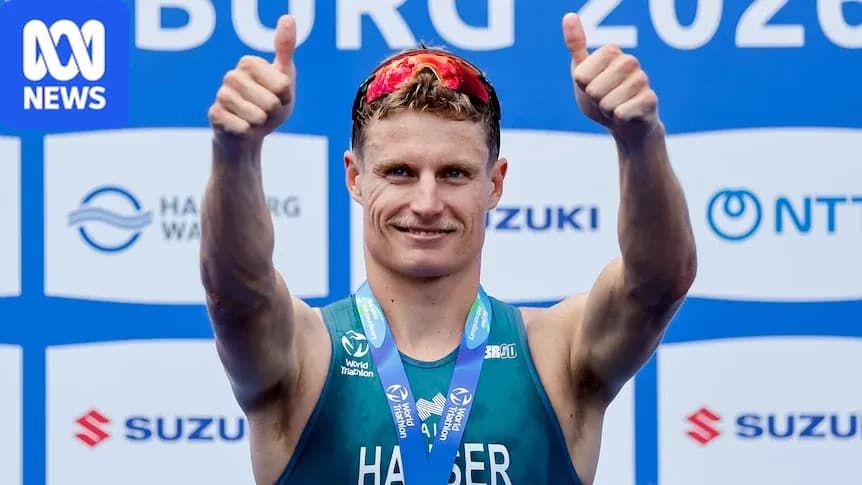
Matt Hauser is dragging Australia back to the summit of world triathlon, one ruthless performance at a time.
On a crisp day in Wollongong, he snapped a 15-year title drought for his country and planted a flag on home soil. It was more than a win. It was a statement that the green and gold is back in a sport it once dominated.
Yet in Hauser’s mind, that finish line was only a checkpoint.
The race that really matters is still two years away, on the streets of Los Angeles at the 2028 Olympic Games.
From contender to hunted man
Heading into the next leg of the World Triathlon Championship Series in Weihai on August 29, Hauser sits third in the overall standings. On paper, he is chasing: Brazil’s Miguel Hidalgo and Portugal’s Vasco Vilaça are ahead of him, each with four races under their belt to Hauser’s three.
But the numbers hide the real story.
Hauser has started three times this season. He has won three times — Yokohama, Hamburg, London. A perfect record. The form line of a man everyone else now has circled in red.
His status has shifted from hopeful to hunted, a reality he is still absorbing.
“It’s a bit of a pinch me moment, honestly,” he told ABC Sport at the AusTriathlon Performance Hub in Miami on Queensland’s Gold Coast. He spoke about the surreal feeling of being at the top of his game, of having to remind himself that, right now, he is one of the best — if not the best — in the world at what he does, and that this window will not stay open forever.
That sort of dominance never arrives overnight in a sport as unforgiving as triathlon. The climb is long, the margins fine, the setbacks constant.
“It doesn’t feel like a big sudden jump,” Hauser said. Instead, he described a steady accumulation of “smaller goals and processes” that have built into what he calls a “world champion persona”.
At the heart of it is a decade-long partnership with coach Dan Atkins. Ten years of work, of trial and error, of building what Hauser calls “daily performance environments” on the Gold Coast. The kind of grind the public never sees, but which sharpens an athlete for days like Wollongong.
The new standard for Australian triathlon
Hauser’s surge has come in the immediate aftermath of the Paris Olympics, a period when some of his biggest rivals have stepped away to explore other challenges.
Gold medallist Alex Yee has been chasing marathon history, clocking 2:06:38 — the second-fastest time ever by a British man behind Mo Farah. Silver medallist Hayden Wilde has dipped his toes into longer-distance triathlons in the T100 series.
On the women’s side, Olympic champion Cassandre Beaugrand has been tearing up the track and road, setting French records over 3,000m, 5,000m and 10km, and racing in the Diamond League.
Hauser watches all of that with admiration. He calls it inspiring, and he knows it lifts the profile of triathlon as a whole, proving its stars can live with the best in each discipline.
But while others have branched out, he has doubled down.
For him, the job right now is simple: perfect the craft of triathlon itself. The sport, he says, has evolved even in the two years since Paris, and he has chosen to live inside that evolution, not outside it.
His form has had a ripple effect at home. On the Gold Coast, the next generation is watching closely.
“Looking back at Australia’s history in triathlon, it’s so rich, and now we’re definitely stepping up our game,” 19-year-old Aspen Anderson told ABC Sport. She called Hauser the one who has “led the way” and said seeing him succeed makes the dream tangible: if he can do it, why can’t they?
For a nation that once produced Olympic medallists with regularity, Hauser’s run has arrived at exactly the right time.
Redrawing the race map
Modern triathlon is a delicate equation. Train too heavily in the pool and the extra upper-body mass can drag on the bike and run. Build too much run strength and you risk losing precious seconds in the water. Every choice has a cost.
From junior level, triathletes are told the same thing: you can’t win the race in the swim, but you can lose it there. The trick is balance — a blend of three disciplines that allows you to shape the race, not chase it.
For a spell, the sport drifted towards the runners. Races would bunch through the swim and bike, then explode on the final leg as the pure runners tore clear. The script felt familiar.
Hauser has helped tear that script up.
He has gone back to an older, more aggressive blueprint: attack from the gun, rip the field apart in the water, keep the hammer down on the bike, and strip the late-running specialists of their advantage before they ever lace up for the final 10 kilometres.
It is a style that would look familiar to Alistair and Jonathan Brownlee at their peak. The British brothers built their legend on savage swim-bike breakaways, then backed it up with brutal runs.
“The dynamics change from year to year,” Hauser said. He pointed to the Brownlees’ era of front-pack fireworks, then the rise of runners like Mario Mola and Australia’s Jake Birtwhistle, when races became larger, condensed packs and late charges from behind.
Now, the pendulum is swinging again. Front packs are back. Breakaways are biting. Hauser is at the front of that wave, driving the tempo, “limiting the strengths” of the runners behind and proving you no longer need to be the best pure runner to win.
There is belief now, he says. Belief that if you can hurt the race early, you can control it late.
Chasing history in Los Angeles
For all the world series points and podiums, one target sits quietly in the background.
The Olympics.
Australia’s triathlon history at the Games is rich, but also incomplete. Emma Snowsill remains the country’s only Olympic gold medallist in the sport, her triumph in Beijing etched into triathlon folklore. Michellie Jones, Loretta Harrop, Emma Moffatt and Erin Densham have all climbed the Olympic podium.
No Australian man has ever done the same.
Hauser carries that fact with him. He admits the Games are “always in the back” of his mind — in training, in world championship races, in the grind of day-to-day work. The plan is clear: use these years to harden himself so that peaking in 2028 is not a leap, but a natural extension of what he has been doing.
Only a few years ago, he could mix it with the best, but not often enough to call himself a genuine front-runner. Now he is there, week after week, at the sharp end of races. The next step is to make that his normal.
If he does, Los Angeles becomes less of a dream and more of an appointment.
The World Triathlon Championship Series rolls into Weihai, China, on August 29, before the series finale in Pontevedra, Spain, on September 23. Another two chances for Hauser to test his template, to bank experience, to add a few more notches to the belt.
Australia has waited a long time for a male triathlete to stand on an Olympic podium.
Hauser is racing like a man intent on ending that wait.