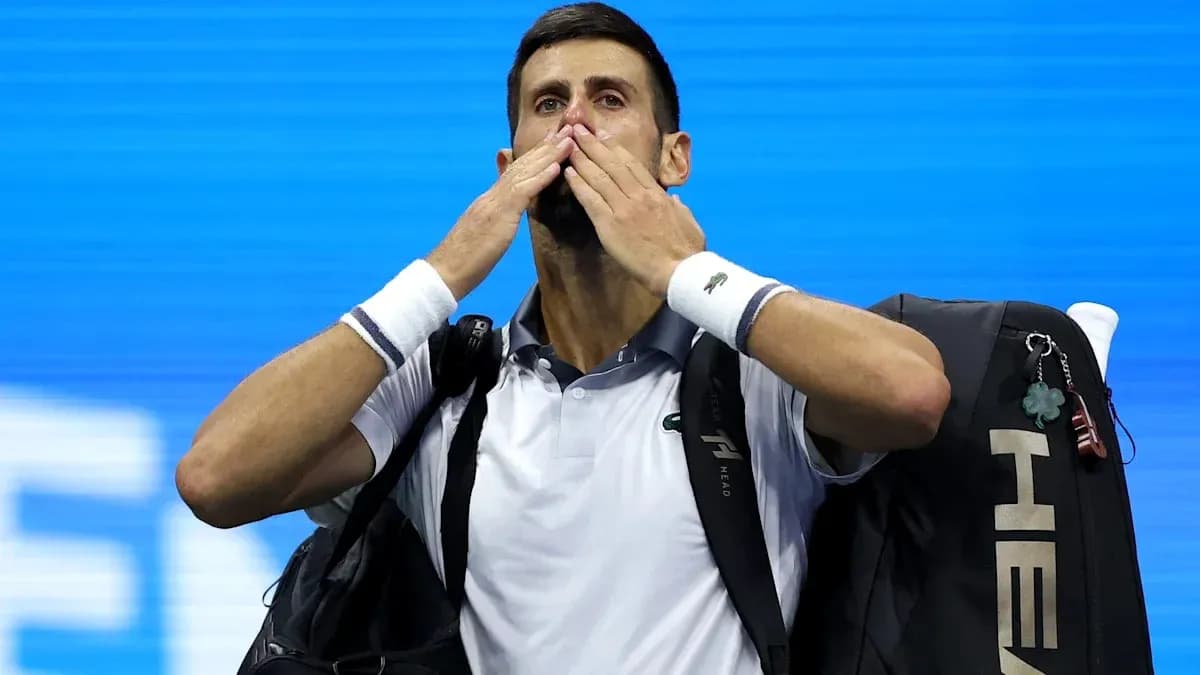
Novak Djokovic: The Relentless Champion Helping Rivals
Novak Djokovic has spent a career dividing opinion. To some he is “Nole”, the relentless champion and standard‑setter. To others he is the man deported from Australia, the player defaulted from the 2020 US Open, the lightning rod for every off‑court storm in tennis.
Behind the scenes, though, the picture looks very different.
The mentor in the middle of the arena
Carlos Costa, Djokovic’s physio, has worked close enough to feel the strain of every sprint and the weight of every defeat. He has also seen what most fans never do.
“He loves helping younger players,” Costa revealed on ‘A BOLA’. That help is not theoretical. It happens in the middle of his own work.
Djokovic will stop his practice sessions to talk to rivals. Not just countrymen, not just friends. Rivals on the tour. Players he may face in a week, a month, a Grand Slam.
Recently, Felix Auger-Aliassime approached him for advice. Djokovic, Costa says, responded immediately. The same thing happened with Joao Fonseca. No cameras, no microphones, just a 24‑time Grand Slam champion sharing information that could one day be used against him.
Both young men have already felt the full force of that competitive edge on court this season.
At Wimbledon, Djokovic outlasted Auger-Aliassime in a five‑set quarter-final: 7-6, 3-6, 6-3, 6-7, 7-6. A classic Djokovic survival act on the lawns he has ruled for so long.
At Roland Garros, the script flipped. In the third round, Fonseca came from two sets down to topple the Serb 4-6, 4-6, 6-3, 7-5, 7-5. A landmark win for the Brazilian, and a sharp reminder that the future is already knocking on the door.
Djokovic’s generosity is not limited to those he faces across the net. He has also advised American prospect Iva Jovic on multiple occasions, another example of his quiet influence on the next wave.
He may never be the most universally adored figure in tennis. But the idea that he takes from the sport without giving back does not survive contact with the people who work closest to him.
Inside the Djokovic machine
Costa’s admiration is not just about kindness. It is about obsession.
“I have never seen anything like Novak Djokovic,” he said. “His vision, what he puts in every single day on the court, and his intensity.”
Plenty of champions work hard. What separates Djokovic, in Costa’s eyes, is the relentlessness of it. The consistency. The way he squeezes significance out of the smallest details.
He notices how long it takes to get a towel. He feels when something in the routine is off. If an element is not planned, if a process does not align with the standards he has set, there is friction. That is how he wants it. Friction forces answers.
Inside Team Djokovic, nothing is assumed. Costa describes how the player will effectively test his own staff, probing their methods, challenging their thinking. Are they really searching for the best recovery strategies? Are they truly delivering the best treatments? Prove it.
One moment stuck with Costa. Djokovic asked why Jannik Sinner was doing eye‑training drills and why they were not. It was not a passing comment. It was a demand: explain, adapt, improve.
Costa, already a specialist, responds by studying beyond tennis. He takes courses with physiotherapists from other sports, trying to pull ideas from anywhere that might give Djokovic a marginal gain. Yet even then, the player is often a step ahead, spotting something in a locker room, a clip, a routine from another athlete and firing back the same question:
Why aren’t we doing that?
And the answer, Costa says, cannot take too long.
Watching Sinner, chasing history
Djokovic’s fixation on Sinner’s training is no coincidence. The Italian now occupies the space Djokovic once made his own: world number one, the man to beat at the majors.
Sinner has claimed five Grand Slam titles since Djokovic last lifted one. He leads their head-to-head 7-5. At Wimbledon this year, he handled Djokovic with a control and authority that underlined the power shift at the top of the men’s game.
Djokovic, 39, has built a career on refusing to accept that any shift is permanent.
If he is to reclaim the summit, if he is to win that elusive 25th Grand Slam, he will need every edge his curiosity and discipline can uncover. Every question asked of his team. Every detail refined. Every drill copied, adapted or discarded in the pursuit of one more major.
His next step comes in Beijing, where he will play his first match since the US Open at the China Open, starting Monday, September 28.
The sport waits to see whether the most scrutinised figure of his era can bend time one more time – and whether all those quiet conversations with the next generation will eventually help to dethrone him, or push him to one last, defining climb.