Pakistan's Cricket Collapse: Lessons from England's 3-0 Whitewash
It takes a rare kind of implosion to inspire a cricket board that doesn’t yet have full international status. Pakistan managed it in Birmingham.
On the final day at Edgbaston, as England completed a 3-0 whitewash, Iceland Cricket looked up from the far fringes of the game, saw Pakistan’s brief resistance and delivered the sharpest line of the tour.
“We believe we won't be hopeless at cricket forever, and Pakistan's fight in the Third Test gave us exactly that hope. We aim for world cricketing domination by the year 2082. If we can do it sooner than then, we will, because our Board will all be dead in 2082.”
The joke landed because the series was no laughing matter for Pakistan.
A collapse that travelled the world
The scorecard will say England chased 130 with eight wickets in hand. It will list Joe Root unbeaten on 62, Jordan Cox not out on 59, and a 3-0 result that felt almost inevitable by the end.
The path there was anything but smooth.
Razaullah Khan had already delayed the execution. His brisk 81 in Pakistan’s second innings spared them the indignity of an innings defeat and dragged England back out to bat. It was a gutsy, counterpunching effort that, for a few hours, restored a sliver of pride.
Then came the chaos with the new ball.
Mohammad Abbas needed one delivery to ignite the contest. Ben Duckett, gone first ball. Four balls later in the same over, Emilio Gay followed. Two wickets, no runs. Edgbaston, suddenly, was alive.
England, needing only 130 with all ten wickets in hand, were 0 for 2. Pakistan, battered for most of the tour, had somehow found a way to make the hosts think.
The pressure crackled for a short, intense spell. It didn’t last.
Root and Cox shut the door
Root and Cox walked into that storm and quietly dismantled it.
They absorbed the noise, the movement, the sudden belief from a team that had been on its knees. Root, as so often, became the axis around which the chase turned. Cox, on his own Test journey, matched him for composure and tempo.
Pakistan still had their moments. They just couldn’t take them.
Mohammad Ali thought he had Root on 23, the ball thudding into the stumps, only for the umpire’s arm to stretch out. No-ball. It was Ali’s 17th of the series, a brutal statistic in a single raised finger.
Root offered another life on 38, edging Abbas between first and second slip. Both fielders moved. Neither committed. The chance died in the indecision, and with it, Pakistan’s last realistic opening.
From there, England eased away. Root finished unbeaten on 62, his 110th Test innings of fifty or more, a catalogue that already includes 41 centuries. Cox closed on 59 not out, a neat, controlled hand that will be remembered as the supporting act in a chase that, on paper, looks routine.
England crossed the line in the 25th over. Eight wickets in hand. Series done. Statement made.
Root, speaking afterwards, didn’t gloat. He acknowledged the turbulence Pakistan had thrown at them late on.
“Fair play to Pakistan, they threw some punches last night,” he said. “They made it very difficult for us and in some ways it's a good thing to go through that.”
England could afford to treat it as a lesson. Pakistan could not.
A tour unravels beyond the boundary
The defeat was Pakistan’s 16th in their last 21 Tests. That number alone is damning. The context around it is worse.
This tour was chaos from start to finish. Seven players removed from the squad after the second Test. Head coach Sarfaraz Ahmed sacked. Assistant coach Umar Gul gone as well. A disciplinary inquiry that reportedly involved phones being confiscated. A captain, Babar Azam, discovering squad changes through a press release rather than a conversation.
It stopped looking like a bad run and started to resemble a case study in how not to run a national team.
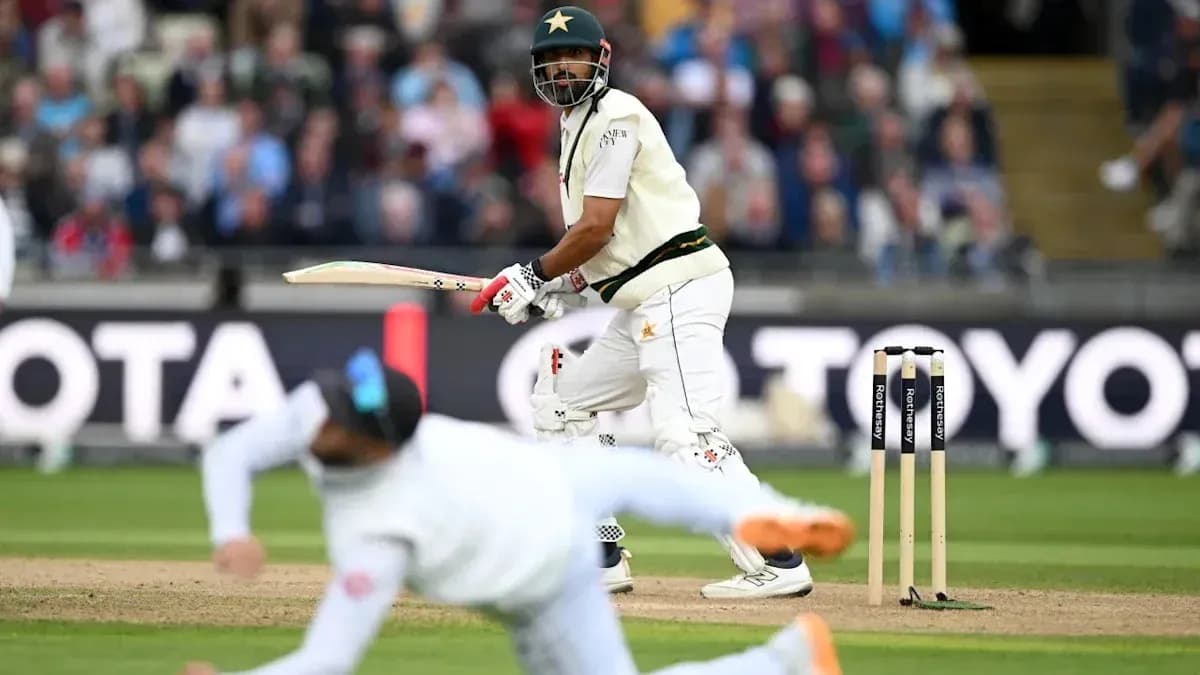
On the field, the rot began early in the match. Pakistan were bowled out for 133 in the first innings, on what Babar himself called the best surface of the series. Soft dismissals, loose strokes, and a total that left their bowlers exposed from the outset.
Babar did not hide from that reality.
“We had a couple of good moments. I think we have bowled well, but I think the first innings cost us. Too many soft dismissals,” he said.
He was right. You don’t win Tests from 133 all out in modern cricket. You barely stay in them.
When the punchline cuts deep
So why did a throwaway tweet from Iceland sting so much?
Because it held up a mirror. A minnow nation, talking about “world cricketing domination by the year 2082,” could point at Pakistan’s fleeting second-innings fight and call it a source of hope. Not inspiration. Hope that one day they might be that competitive.
That is the scale of Pakistan’s slide.
When the standout memory of a tour is a spirited lower-order 81 in a game still lost by eight wickets, the problems run far deeper than form. They seep into structure, planning, and culture.
This isn’t about one bad shot, one missed catch, or one no-ball too many. It’s about a system that has allowed talent to be smothered by instability, selection churn, and muddled decision-making.
England’s 3-0 whitewash is the headline. The real story is what it says about Pakistan’s direction of travel.
They need a long-term plan that survives a bad session, a poor series, or a change in administration. Right now, they don’t have one. And until they do, the loudest, clearest verdict on Pakistan cricket may keep coming not from Lord’s or the MCG, but from a small, ambitious board in Iceland, aiming at 2082 and laughing in the meantime.