Pakistan Cricket Faces Unprecedented Crisis After 3-0 England Defeat
Pakistan cricket has known chaos before. This is different.
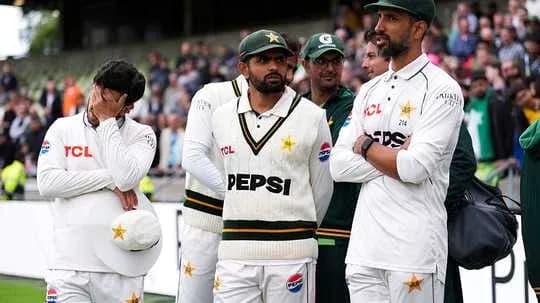
A 3-0 hammering in England – by an innings and 103 runs, 194 runs and eight wickets – has stripped away any remaining illusion that this is just a bad patch or a misfiring generation. England have now swept Pakistan 3-0 twice in four years. It is Pakistan’s 11th 0-3 series defeat, their sixth whitewash in 12 multi-Test series in the last four years, and their ninth 0-3 loss in a three-Test series this century. No team has more.
The numbers don’t hint at a crisis. They scream it.
A team in pieces
The reaction from the Pakistan Cricket Board after Lord’s was brutal and familiar. Head coach Sarfaraz Ahmed sacked. Bowling coach Umar Gul gone. Seven players sent home. Test reins handed to white-ball coach Mike Hesson.
It was the latest in a long line of U-turns that have left Pakistan lurching from one plan to the next. Jason Gillespie, the former Test coach, had already questioned the constant chopping and changing. The data backs him up: this is a side built on flashes of individual brilliance, not on structure, continuity or trust.
Since August 2021, the start of the second World Test Championship cycle, Pakistan have played 37 Tests. They have named an unchanged XI just three times – Dhaka 2021, Colombo 2023, Rawalpindi 2024. They won all three and clinched the series in each case.
Then the revolving door started spinning again.
Pakistan have used 43 players in those 37 Tests. After the original XI, 32 more were introduced in the next 36 matches – almost one new player every Test. Only South Africa have a higher turnover, and they fielded a second-string side in New Zealand because of the SA20.
No specialist bowler has featured in more than 18 of those 37 Tests. Noman Ali tops that list. Shaheen Afridi, the spearhead, has played just 17. Among batters, nobody has been an ever-present. Babar Azam has appeared in 33, Mohammad Rizwan 32, Salman Agha 28. Since the start of that cycle, 23 players have debuted for Pakistan in Tests – 13 of them specialist bowlers. Only South Africa and England have blooded more.
This isn’t evolution. It’s churn.
Revolving doors off the field
The instability runs far deeper than the team sheet.
In five years, Pakistan have made 11 coaching changes across formats, including seven different Test coaches since May 2023. Misbah-ul-Haq and Waqar Younis resigned in September 2021. Saqlain Mushtaq came and went. Grant Bradburn, Mickey Arthur, Mohammad Hafeez – all through the system in quick time.
In 2024, the PCB tried a split model: Jason Gillespie for Tests, Gary Kirsten for white-ball cricket. Both were gone within months. Aqib Javed took interim charge. Mike Hesson arrived as permanent white-ball coach in May 2025.
Sarfaraz Ahmed was then appointed red-ball head coach ahead of the 2026 Bangladesh series. His tenure ended within months, cut short after defeats at Leeds and Lord’s. Back came Hesson, now also in charge of Tests.
This kind of churn is damaging in any format. In Test cricket, where systems, relationships and long-term planning matter most, it is devastating. Selection panels shift, captains change – Shan Masood’s 3-12 record gave way to Babar’s reinstatement – and the team is left trying to build something on moving sand.
Slide down the WTC ladder
The World Test Championship table tells the story in cold, unforgiving detail.
In the 2021-23 cycle, Pakistan finished seventh with a points percentage of 38.1% – four wins in 14 Tests. In 2023-25, they dropped to ninth, at 27.98% – five wins in 14. In the current cycle, they are bottom: two wins in nine Tests, a points percentage of 14.81%.
Among WTC teams since the start of that second cycle, Pakistan’s Test win-loss ratio stands at 0.5. Only West Indies, at 0.4, have fared worse. Their overall Test win-loss ratio has now slipped below 1.0 for the first time since 1987: 153 wins, 155 defeats in 474 matches.
At home, where Pakistan once bullied visiting teams with pace and reverse swing, the decline is even starker. South Africa’s home win-loss ratio in this period is 5.5, Australia’s 5.0, England’s 2.2. India sit at 2.0 with 14 wins and seven defeats. New Zealand and Sri Lanka both sit at 1.43 with 10 wins each.
Pakistan? Four wins, nine defeats in 17 home Tests. A win-loss ratio of 0.444 – the worst among WTC teams, better only than Zimbabwe’s 0.285. It trails Bangladesh (0.727) and West Indies (0.875).
Away from home, the picture barely improves. Since August 2021, Pakistan have played 20 away Tests, winning seven and losing 13 – the third-most defeats in that span, behind England (17) and West Indies (15). Their away win-loss ratio of 0.538 ranks fifth, well behind Australia (2.4), South Africa (1.25), New Zealand (1.125) and India (1.1).
Outside Asia, the drought is glaring. Since the start of the second WTC, Pakistan have not won a Test in SENA countries (South Africa, England, New Zealand, Australia), barring a series in West Indies. They are winless in their last 19 Tests in SENA since 2018, losing 17 and drawing two. Their last such win was at Lord’s in May 2018. Since 2019, every other Asian side has managed at least one SENA victory. Pakistan stand alone.
Batting in freefall
The collapse in results mirrors a collapse in runs.
Since the start of the 2021-23 WTC cycle, Pakistan have been bowled out for under 250 in 32 innings out of 37 Tests. Eighteen of those totals were under 200. On the recent England tour, they were dismissed for less than 200 in five consecutive innings – 171, 135, 110, 194 and 133 – before finally breaching 400 in the third innings at Edgbaston. Those five sub-200 scores, averaging just 41.3 overs per innings, marked the first such sequence in Pakistan’s Test history.
Their combined batting average in this period is 28.46, sixth out of nine WTC teams. Only South Africa, Bangladesh and West Indies have fared worse. Pakistan’s batters have produced the fourth-fewest centuries among WTC sides in this stretch.
Even Babar Azam, the technical and symbolic centre of the batting order, is stuck. He has gone 40 consecutive Test innings without a hundred. His last century came against New Zealand in Karachi in December 2022.
Only seven Pakistan batters have scored 1000 or more Test runs in this period. None averages above 45. Babar leads with 2602 runs at 43.4. Shan Masood has 1548 at 32.25, sixth among those seven, just ahead of Imam-ul-Haq’s 1380 at 39.42. Rizwan has 1862 at 35.8 and only two centuries – the fewest hundreds among the seven.
Across the rest of the WTC field, 51 batters have passed 1000 runs in this window. Eleven of them average over 45. Pakistan simply do not have that class of consistent, heavy scorer right now.
From pace identity to spin dependency
For decades, Pakistan’s Test cricket carried a clear signature: pace. From Imran Khan to Wasim Akram, Waqar Younis and Mohammad Asif, the quicks defined their biggest wins. Spinners were the supporting cast.
That balance has flipped.
Since the 2021-23 WTC cycle began, Pakistan’s best moments at home have been built on spin. Noman Ali, Sajid Khan and Abrar Ahmed have thrived with accuracy, attacking fields and surfaces prepared to grip.
The pace numbers, by contrast, are alarming. Pakistan’s quicks have taken 305 wickets in this period at an average of 32.7 – second worst among WTC teams, ahead of only Bangladesh – and a strike rate of 55.7, again the second worst. Opposition pacers against Pakistan average 27.4 and strike every 48.7 balls.
Those figures expose both sides of the problem: a batting line-up that collapses too often, and a pace attack that no longer intimidates.
Shaheen Afridi remains the leading Pakistan pacer in this era with 68 wickets in 17 Tests at 26.89. Only one other seamer, Mohammad Abbas, has more than 45 wickets – 10 Tests, four five-fors, and a resurgence since his recall last November. In 2026, Abbas has 31 wickets at 21.06, the second-most by any bowler this year behind Josh Tongue’s 33 at 25.67.
Among all Pakistan bowlers since the start of the cycle, only Noman Ali (85 in 18 matches), Sajid Khan (75 in 14) and Shaheen have more wickets than Abbas, and all three have played more Tests.
The spin pivot was laid bare during England’s 2024 visit. In the final two Tests, Noman and Sajid took 39 of England’s 40 wickets – the most by a bowling pair in a two-Test stretch. They claimed all 20 wickets in Multan and all 20 in Rawalpindi, where Pakistan’s specialist pacers did not bowl a single ball. Across the series, spin accounted for 73 wickets, 43 of them by Pakistan’s spinners.
Last year, Pakistan beat West Indies in Multan with their spinners taking all 20 wickets, and South Africa in Lahore with 16. Their spinners also grabbed 13 wickets in a series win in Bangladesh in 2021. Since then, they have lost two Test series to Bangladesh – one at home in 2024, one away in 2026.
The pattern continued against West Indies, where Noman became the first Pakistan spinner to take a Test hat-trick. Their last away series win, in Sri Lanka in July 2023, was again driven by spin. Since the start of the 2021-23 cycle, Pakistan have won 11 of 37 Tests. In nine of those victories, their spinners took 11 or more wickets in the match, including a 14-wicket haul in the Caribbean earlier this year.
That West Indies win remains their only success in their last 12 away Tests.
Where does this end?
Strip away the romance and the nostalgia and this is what remains: a team with no settled XI, no sustained coaching vision, a misfiring batting core and a bowling identity that has drifted from historic strength to short-term necessity.
Pakistan cricket has always lived with volatility. The question now is whether it can still produce greatness from it, or whether this era of whitewashes, revolving doors and statistical freefall becomes the new normal.