Rashid Khan on Afghanistan's Journey and Future in Cricket
Rashid Khan has lived every twist of the India-Afghanistan story. From the days when his team turned up hoping to compete, to now, when they arrive expecting to win. The rivalry has grown. So has Afghanistan. But in Rashid’s mind, the job is far from done.
On the eve of the third and final ODI against India, the legspinner cut through the noise and went straight to the fault lines. Afghanistan, he insisted, must learn to own the powerplay – with bat and ball – if they are serious about standing alongside the game’s elite.
“In Delhi, you always see high-scoring games,” he said, reflecting on the series. The lesson for his young side is clear: you don’t survive those games, you dominate them. “To have that mentality of scoring big is so important.” Afghanistan, he knows, are not there yet. “We still have to do a lot of hard work in our batting department,” he admitted, stressing the need to find a way to pile up big scores under any conditions, against any attack.
The other half of the equation is even more brutal. If Afghanistan keep leaking 70 or 80 in the powerplay, Rashid believes, the rest of the innings becomes almost academic. “It doesn't matter if you are defending 200 or 230,” he said. The early overs are killing them. As he sees it, the bowlers must find answers, not excuses. “As a team, collectively we have to find the solution for this,” he added, treating this India tour as a classroom more than a contest.
A fearless Indian generation
Rashid has seen many versions of India’s T20 side. The current one, led by Shreyas Iyer, impresses him in a different way. It’s young. It’s aggressive. It keeps coming.
“Well, it is a very dangerous side, a destructive side,” he said. One hitter follows another, and they all have the same ambition: not cameos, but hundreds. That, in Rashid’s eyes, is what separates this group. They don’t settle for 20s and 30s. They take games deep, then explode. They play without fear and with skill – a combination he rates as the defining edge of this Indian team.
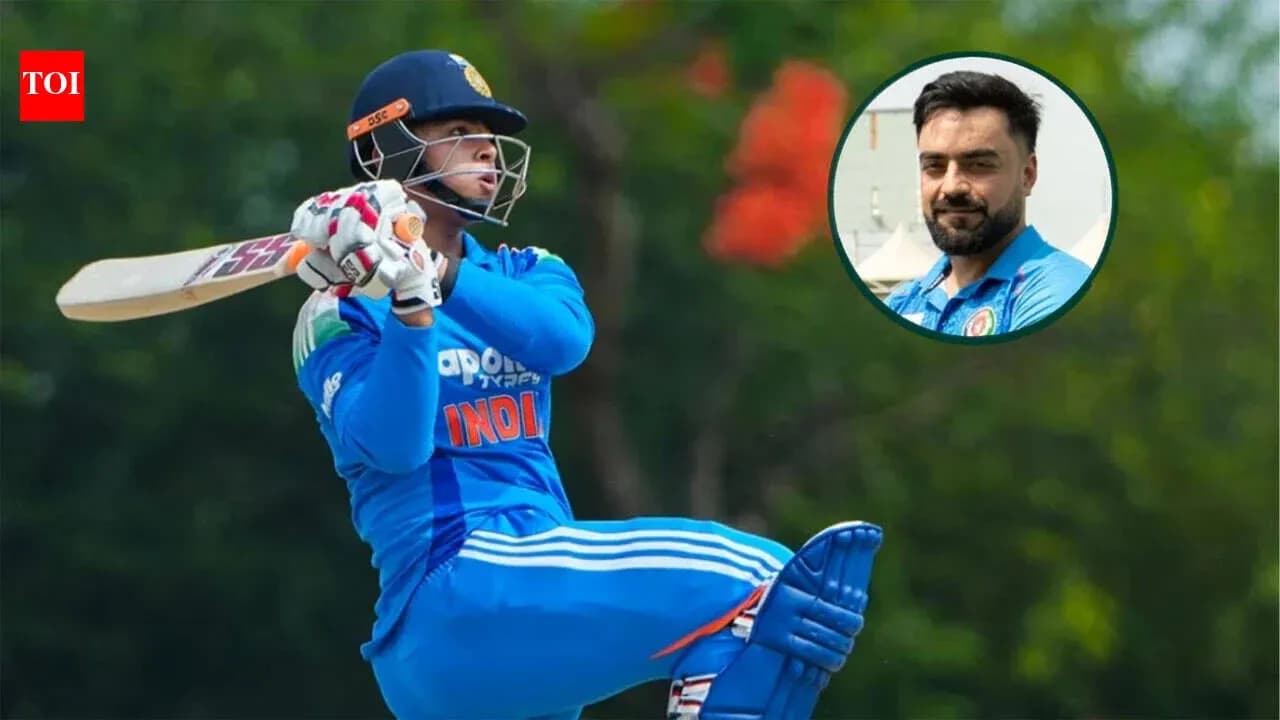
Among that group, one name stands out for him: Abhishek Sharma. Their bond goes back to their days together at Sunrisers Hyderabad, where Rashid saw up close what the left-hander could become.
“I spent so much time with him during SRH; we were very close at that time, and he always had that kind of ability and skill,” Rashid said. The public sees the ball-striking, but he is adamant Abhishek’s value runs deeper. “He is doing so well with the bat, but I think he is a very good bowler as well.” In Rashid’s view, Abhishek is a genuine dual threat, someone who can control overs in the middle and change matches with the bat. “He is the one who is going to be a very big package for Team India in the future.”
Then there is Vaibhav Sooryavanshi, the teenage phenomenon who has already broken into international cricket at 15 and faced Rashid himself.
Here, the admiration sharpens.
Rashid circles back to a word he keeps returning to: fearless. But this isn’t reckless hitting. What grabs him is the clarity. “He backs up his skills and knows his shots,” Rashid said. Shot selection, he believes, is what elevates Sooryavanshi above most prodigies. “He knows his game plan against any side, any bowler, anytime.”
At 15, that is rare. “You hardly see those kinds of things at a very young age; it comes with time, but he already has it,” Rashid said. The power, the hand-eye coordination, the ability to hit big sixes – all of it wrapped in a calm understanding of his game. “He is a god-gifted talent,” Rashid said, without dressing it up.
Does it remind him of himself as a teenager? He doesn’t pretend it does. “I wasn't that talented, to be honest, at that age,” he said, almost amused. The skill was there, yes, but not this kind of raw hitting. “I don't know if I could hit those big sixes at that age, how he has been hitting.” For Rashid, that’s what makes Sooryavanshi “someone very special” – and not just in franchise cricket. The youngster has already shown it “not only in the IPL, but even in the Indian team as well.”
From underdogs to contenders
If India’s next generation looks secure, Afghanistan’s rise has been more hard-earned, more fragile, and far more emotional.
Rashid can pinpoint where the shift in belief began. It wasn’t a slow, vague feeling. It had landmarks. Beating Pakistan in a bilateral T20 series. Toppling England at the 2023 World Cup in India. Then Sri Lanka. Then Pakistan again on the biggest stage. Each result chipped away at the old narrative.
“We did well in Australia & New Zealand at the T20 World Cup [2024], got into the semi-finals,” he said. That run changed everything. “That belief started that we are in that category where we can beat big teams.” The tag of underdogs no longer fits. Now, the question is different: how do they sustain this level, and how do they go higher?
“It’s about us now, how we are going to manage and how we keep this continuing,” Rashid said. The external respect has arrived. The internal standards have to catch up.
Ibrahim Zadran and the next phase
That responsibility now sits heavily on the shoulders of Ibrahim Zadran, the new T20I captain. Rashid, who has carried that weight himself, is clear about why Ibrahim is the right man.
“One thing I like about him is the hard work he puts in,” he said. Ibrahim wants to lead from the front, not from behind a team meeting desk. Consistency, honesty, and a straight-talking approach stand out to Rashid. “He is the kind of person who is always trying his best to set an example for the youngsters and show them this is the way to go.”
Rashid has promised him his full backing as a senior player, but he stresses Ibrahim doesn’t lean on anyone as a crutch. “He himself is someone who is hard-working and very honest in his job,” Rashid said, convinced that the young captain has both the temperament and the ambition to grow with the team and take them with him.
From his own time as captain, Rashid passes on a more personal lesson. Leadership, he admits, can turn inwards and suffocating. “Sometimes you put too much pressure on yourself, which doesn't make it fair,” he said. He knows the feeling of trying to carry everything, every result, on his own shoulders. The correction, he believes, lies in narrowing the focus. “Those are the moments you need to just calm down and focus on your game, focus on your skills, and focus on your game plan.” Think about the process, not the outcome. If the process is right, he tells Ibrahim, “everything will be fine.”
The next Afghan wave
Rashid was the first Afghan cricketer to become a truly global name. Now, a new generation is coming, and he speaks about them with the same excitement he reserves for India’s young stars.
“There is few very good, talented players in Afghanistan coming up,” he said. Noor Ahmad is already known to most followers of the game, and Rashid is convinced he has another gear to find. “He is someone who can get to the next level and who can put up some great performances in the future.”
Fast bowling, though, remains an area Afghanistan must strengthen. That’s why one name keeps coming up in Rashid’s assessment: Abdollah Ahmadzai. The young quick is in the squad now and, crucially, he is fast. “He is bowling quick,” Rashid said. The challenge is not just to use him, but to protect and shape him. “If we manage him properly, he is going to be a very quick bowler and a good future for Afghanistan cricket.”
A body rebuilt, a dream unchanged
Rashid’s own journey has taken him from teenage prodigy to the most in-demand T20 spinner on the planet. With that came a brutal schedule: league to league, country to country, format to format. At first, he embraced it. “It was good for me at that time because I got the experience and I got the knowledge about the condition of different countries,” he said. It made him smarter, tougher, more adaptable.
Then came surgery. Recovery. Struggle. The calendar that once looked like opportunity started to feel like a threat.
“I tried to reduce the cricket as much as possible,” he said. Recently, a stint at the Red Bull Athletic Performance Centre in Austria gave him something he hadn’t really had before – a full, scientific map of his own body. After a battery of tests and consultations with physios and doctors, he left with clarity: which areas needed work, what to avoid, how much cricket he should play, where he should and shouldn’t go.
That knowledge, he believes, will shape the final phase of his career. Not to slow him down, but to keep him on the field when it matters most.
Because one target still burns brighter than anything else.
“One unfinished thing is to win the World Cup for team Afghanistan,” he said, without softening the ambition. The 2024 T20 World Cup, where Afghanistan reached the semi-finals but fell short of the final, has only sharpened that hunger. He wants an ICC trophy – T20 or 50-over – in Afghanistan’s hands before he walks away.
He wants that line in his story: that Afghanistan did not just arrive, they conquered.