Roger Federer Reflects on His Legacy Ahead of Hall of Fame Induction
Roger Federer spent most of his career sprinting forward, chasing titles, records and history. In Newport this weekend, as he enters the International Tennis Hall of Fame, he finally allowed himself to stop and look over his shoulder.
The 20-time Grand Slam champion will be inducted on Saturday alongside broadcaster and journalist Mary Carillo, a moment he described not as another trophy on the shelf, but as something altogether different.
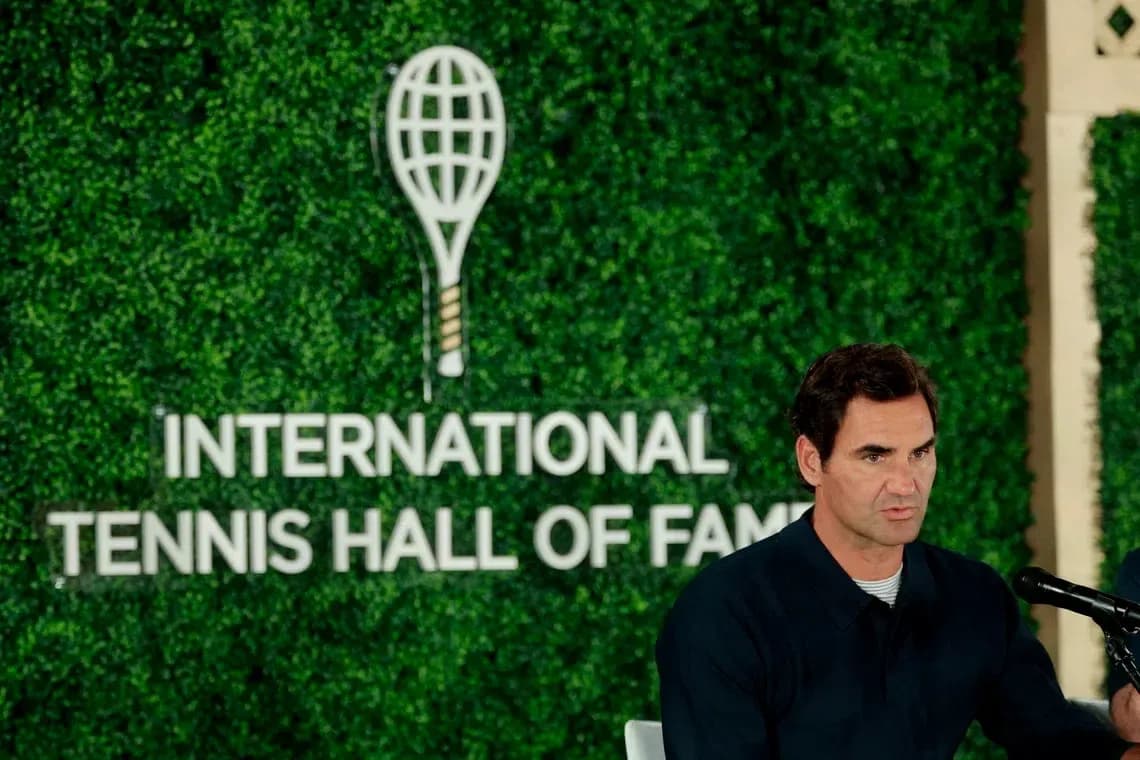
"It's a huge, huge honour, one of the greatest we can achieve in this sport," Federer said on Friday at a news conference moderated by Hall of Fame president Patrick McEnroe.
This one is not about rankings or seedings. Not about whether he held off a rival in five sets. At 45, with eight Wimbledon titles, six Australian Opens, five U.S. Opens and that landmark 2009 French Open completing his career Grand Slam, Federer stood in front of the game and wondered what, beyond the numbers, he is leaving behind.
He also owns Olympic doubles gold from Beijing 2008 with Stan Wawrinka and a Davis Cup crown with Switzerland from 2014. Across 103 ATP Tour titles and 310 weeks as world number one, the statistical résumé is almost absurd.
But Federer pushed the spotlight away from the silverware.
"I hope I represented the sport well," he said. "But more so that maybe I helped drive the sport in the right direction through all the conversations we had together with the leaders of the sport — on the ATP side, with the Slams, the players and councils where I donated my time."
He pointed to changes that don’t show up on highlight reels. The steady rise in prize money, not just for champions but for those grinding through first and second rounds. Better conditions for players. Improved facilities for media and medical staff. Modernised stadiums that make life easier for everyone who travels the circuit.
"I feel like way more players can make a living. And I hope that I have helped with that as well," he added.
That sense of responsibility did not arrive late. It grew alongside the teenager from Basel who quickly realised he was built for the biggest stage.
"I felt like I was a winner early," Federer said. "I liked being on Centre Court. I preferred Centre Court to Court Five or Court 18. I wanted to be that person, so I think I embraced the pressure."
He did more than embrace it; he turned it into an art form. Yet he did not pretend the glare came without a cost. As his profile exploded and he became one of global sport’s defining figures, the scrutiny followed, relentless and often unforgiving.
"You get affected by so many outside comments that it's like one big storm sometimes in your brain," he admitted. "Sometimes you lose the fun in it. But I feel like, for the most part, I've really done a good job of staying really happy on the road."
That balance — between the storm and the joy — may be the part of his legacy he values most. The one-handed backhand will live forever on clips and compilations. The way he carried himself in hotel lobbies, locker rooms and boardrooms is harder to measure, but it is clearly what he wants remembered.
Federer retired in 2022, his last competitive swings coming in a tearful farewell at the Laver Cup. Yet he keeps drifting back toward the sport. On Tuesday he stepped out at Arthur Ashe Stadium for an exhibition ahead of the U.S. Open, rolling back the years in front of a crowd that still treats his presence as an event.
The question now is not whether he will compete again. It is what role he chooses next.
He did not close any doors. A future as a Laver Cup captain? Mentoring the next generation? A turn in the commentary box? All sit on the table.
"I would like to give back to the sport," he said. "I try to attend three, four or five events during the year, so I stay connected.
"It rejuvenates me mentally to see what I could be doing in the sport that would be meaningful down the road."
The Hall of Fame will etch his name in bronze. Federer, typically, is already thinking about the living part of his legacy — where he can still move the game, not just where the game has already immortalised him.