Behind the Scenes of the Singapore Grand Prix
By 1am on Monday, the music has stopped at the Padang and the last echo of V6 engines has slipped between the skyscrapers. The Singapore Grand Prix is over.
On paper, at least.
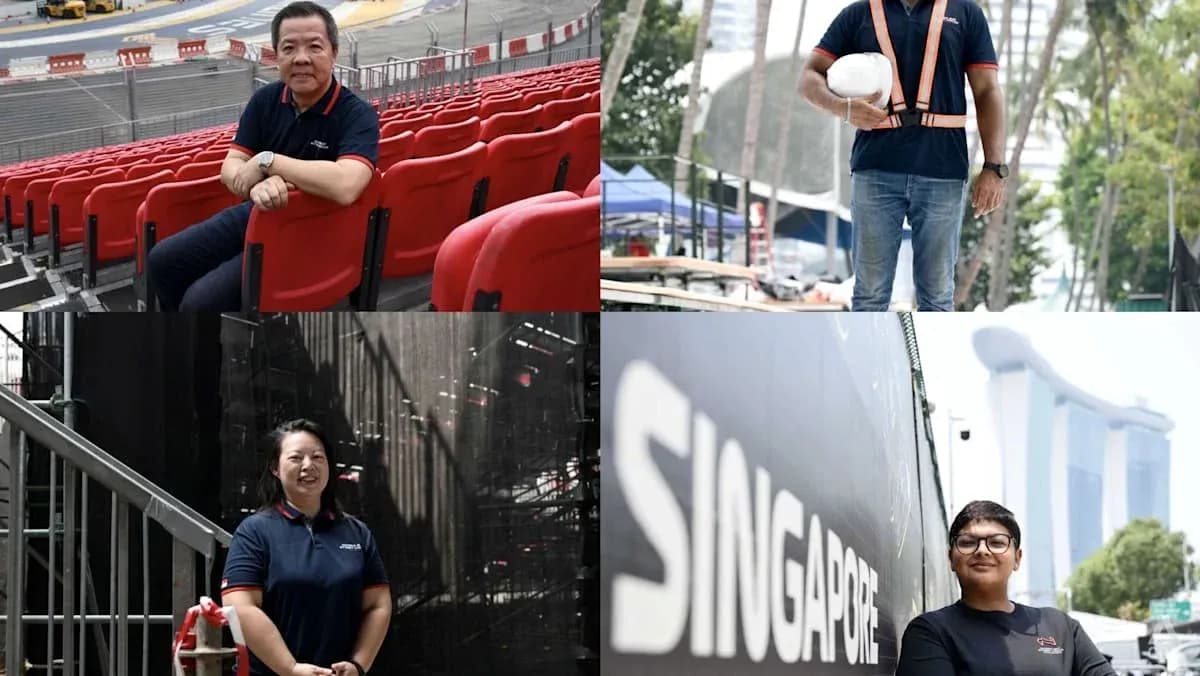
Out on the Marina Bay Street Circuit, the real sprint has just started. Senior manager Shiv Raj Panday and his technical crew have four and a half hours to pull apart sections of a world‑class racetrack and hand the city back to its commuters. By 5.30am, taxis and buses will be rolling over the same tarmac where cars were touching 300 km/h a few hours earlier.
This is the side of Formula 1 Singapore rarely sees: the 362 days when there are no chequered flags, but the work never stops.
The race that never ends
For most fans, Singapore GP is a three‑day blur of night racing and big‑name concerts. For the 70 full‑time staff at race promoter Singapore GP, it is a year-round grind that begins almost as soon as the fireworks die.
Raj’s technical team spends months on feasibility studies and layout tweaks before a single barrier goes up.
"We will take at least about two, three months to plan, before commencing set-up and build of the circuit,” he said.
Space is their most precious commodity. The Marina Bay circuit park is hemmed in by offices, hotels, roads and water. Every year, the team asks the same question: how do you squeeze more experience into the same footprint?
Raj knows the site as well as anyone. He worked for one of the race’s contractors from 2010 to 2023 before joining Singapore GP itself. The post‑race dash to reopen roads has been his ritual almost every year since the inaugural night race in 2008, broken only by the pandemic cancellations in 2020 and 2021.
This year’s edition, from Oct 9 to 11, will be the latest the race has ever run in the calendar. It is also part of a longer play. In January 2022, Singapore secured a seven‑year extension to keep F1 in Marina Bay until 2028.
The long-term commitment comes with a simple reality: every September or October is just one chapter in an operation that resets almost immediately.
Tickets that never sleep
Inside Singapore GP’s offices, another clock runs just as relentlessly.
“The amount of time spent preparing for the event is enormous,” said ticketing and accreditation director Clarence Lai. To most people, the race is a weekend. To his team, ticketing is “endless”.
Sales for one race start in the week of the previous one, with “super early bird” offers that roll straight into the next cycle. His department controls who gets in and where they sit: public ticket holders, corporate guests, vendors, contractors, media.
They constantly rework seating capacity and grandstand configuration. Do they need new stands? Better sightlines? Different price points?
They also fight a quieter opponent: fraud.
Last year, Singapore GP introduced mobile ticketing, a move Lai says has helped curb scams. Previously, fans risked buying duplicated PDF tickets from third-party sellers. Now, access is tied more tightly to mobile passes.
On the other side of the building, senior director for marketing and partnerships Sasha Rafi is already thinking a race ahead.
“Even before the race takes place, we are already planning for next year,” said Rafi, who joined in October 2007, before a single car had raced under the floodlights.
Her team pulls apart every edition in forensic detail — what worked, what didn’t — across marketing, sustainability, and engagement with government agencies and private partners. Then comes the harder part: making a familiar event feel new.
They scan global trends in tech and entertainment, and track how and where people are spending. They also keep one eye on the wider world. Wars, economic shocks, travel restrictions — all can hit demand for what is, ultimately, a discretionary trip.
This year, one of their headline ideas is built around F1’s evolving format. Singapore is hosting one of six sprint races on the calendar, with sprint qualifying on Friday and the sprint itself on Saturday.
The sprint is short and sharp: 100 km, about a third of a full race distance, roughly 30 minutes, no pit stops.
To tap into that, Singapore GP has launched a two‑day sprint bundle — a rarity in a market that has traditionally sold either three‑day passes or single‑day tickets.
“We have looked at bundling and packages of different kinds over the years,” said Rafi. The sprint, new to Singapore, offers a fresh hook for fans who might not want the full weekend but still want to see competitive wheel‑to‑wheel action.
Super early bird tickets for the 2027 race will also go on sale this year. The cycle never pauses.
Building a racetrack around a living city
Turning a business district into a racetrack is one thing. Doing it without stopping the city is another.
Some grandstands at Marina Bay go up one and a half months before the race. That early start can still throw up late headaches. Even if a stand returns to the same spot year after year, rebuilding can introduce tiny variations — a missing row here, a slightly altered layout there.
Lai’s team walks through each stand, checking that every seat exists, is correctly labelled, and is safe. The structures sit out in Singapore’s weather — heat, wind, rain — long before fans arrive.
Time is their constant enemy.
“Sometimes when there're events going on for certain stakeholders, we have to work out the timing as to when is the earliest they can hand over the space to us,” said Raj.
He points to the Connaught Grandstand at the end of Esplanade Bridge, perched along a live road still open to traffic. His crew moves in during the small hours of Wednesday in race week. They close the road, race the clock to build, then clear out before the morning rush.
The same choreography plays out in reverse on Sunday night. Once the podium is done, the priority is clear: reopen critical arteries such as Esplanade Drive by 5.30am so the city can breathe again.
Operations director Melissa Phua, with Singapore GP since 2008, sits at the junction where logistics meets people.
Her remit stretches into the classroom. Each year, Singapore GP works with the Institute of Technical Education and Republic Polytechnic to train and employ nearly 1,000 students across the circuit park. They serve as grandstand and gate officials, and look after the welfare of spectators.
Her team also plans how hundreds of thousands of people move in and out of a temporary venue woven through real streets.
“I think part of our KPI is also in making sure that they leave safely,” she said. “We would hate to see complaints from patrons who were not happy after the event or we didn’t meet their satisfaction.”
The toughest test comes after the nightly concerts at the Padang, when the crowd surges towards MRT stations to catch the last trains. Phua’s staff fan out across the park, opening and closing gates, funnelling people along pre‑planned routes.
Not everyone appreciates being diverted away from the path they used to enter. The team’s job is to keep tempers — and bodies — from colliding.
“It's about making sure that ushers are there and we are there on the ground, making sure that nobody gets yelled at or gets crushed,” she said.
From elitist spectacle to national habit
When Rafi started in 2007, Formula 1 was an abstract concept for many Singaporeans.
“When I first started, Formula 1 wasn't something that was known to most Singaporeans. It was seen in the first few years by some as an elitist sport,” she said.
The response was to widen the tent.
Singapore GP built a range of products aimed at very different audiences: hardcore motorsport fans, corporate visitors using the race for networking, and locals who might care more about the headline acts on stage than the tyre compounds on track.
“We were the first circuit in Formula 1 to actually inject entertainment into the racing experience that you get over the weekend,” Rafi said.
The formula worked. The Marina Bay night race is now a fixture on the global calendar, broadcast worldwide and firmly lodged in F1’s identity. The challenge has evolved.
Today, the task is to keep Singapore relevant in a 24‑race season, and to convince fans to come back — and to choose Marina Bay over newer, flashier stops.
The city itself keeps changing too. In 2023, the track layout shifted behind the Floating Platform, as one of F1’s largest grandstands made way for the development of NS Square. The circuit team had to rethink sightlines, capacity and flow almost from scratch.
Lai feels that instability more than most. His ticketing puzzles are multiplied by the nature of a temporary street circuit.
“It's unlike a fixed venue, let's say, the National Stadium. The seats are always there, so most of the time you won't go wrong, it will not disappear,” he said.
At Marina Bay, everything disappears. Then it has to be summoned back.
Chasing lost seats, finding new views
One of Lai’s biggest headaches since the Bay Grandstand was removed has been simple arithmetic. The race lost a huge block of seats, and the team has yet to fully replace that capacity.
Every year, they look for ways to squeeze more fans into the map without compromising comfort or safety.
This season, the grandstand at Turn 2 — just after the cars rocket out of the pit straight — will be merged from two structures into one larger stand. Additional viewing platforms will sit alongside, carving out new vantage points in a tight urban space.
The city setting does offer one advantage: dispersal. Fans can spill out in multiple directions once the night is done. But the familiar skyline hides a very unfamiliar ground level when the circuit is closed off.
“When we close up the track, it can be unfamiliar at times as the path isn't as straightforward,” Phua admitted. That goes double for foreign visitors trying to navigate fenced‑off streets and redirected walkways.
She still remembers 2022, when a heavy downpour delayed the start by an hour. The schedule shifted, the night stretched, and every carefully drawn movement plan had to flex in real time.
The lights will go out again at Marina Bay this October. The cars will vanish into the night, the concerts will fade, and the grandstands will start to come down.
For the people who build and rebuild this race, the question is already looming larger than any chequered flag: in a sport that never stops expanding, how long can Singapore keep setting the standard for what a city race should be?