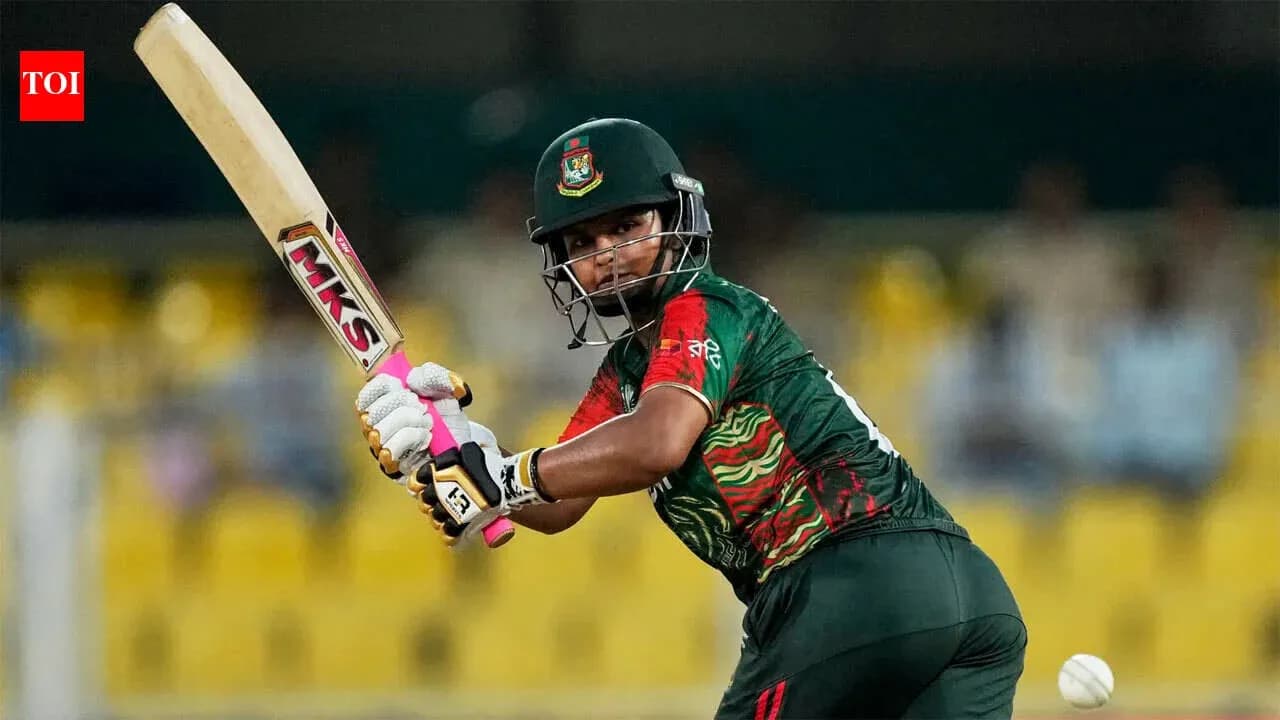
Sobhana Mostary: The Legacy of Bangladesh Women's Cricket Since 2018
The 2026 Women’s Asia Cup is only just underway, but for Sobhana Mostary it already feels like a return to the scene of a revolution.
Not in venue, not in format. In meaning.
Six years on from Bangladesh’s stunning 2018 title run, the tournament remains stitched into her understanding of what women’s cricket can be in her country — and what it demands of her now.
The night everything changed
Mention 2018 and her voice, even now, carries the weight of that final in Kuala Lumpur. Bangladesh, chasing India’s 112/9. A last-ball finish. Jahanara Alam scrambling back for the second run that sealed a three-wicket win and a first Women’s Asia Cup title.
That single moment detonated years of neglect.
“After 2018, we beat India and won the Asia Cup, so it was a huge change in Bangladesh women's cricket. Everything changed. They started giving us lots of facilities, money, everything. There was a lot of change,” Mostary told TimesofIndia.com ahead of the 2026 edition.
The reaction back home underlined it. The Bangladesh Cricket Board announced a reward of 2 crore Bangladeshi Taka for the squad. For a women’s team that had lived on the margins, it felt like the sport had been dragged into the national conversation overnight.
For Mostary, the legacy has never faded. It shapes the way she looks at this year’s campaign.
“We think this Asia Cup, we fight for the title, because if we beat India, so maybe we own the Asia Cup,” she said.
That is the bar now. Beat India, and everything else follows.
A different path to the same dream
Mostary’s own story does not begin under bright lights or TV cameras. It starts in a village, on makeshift grounds, with a girl who simply wanted to play.
Football. Badminton. Cricket. Anything with a ball and space to move.
At 10, her father took her to a local cricket academy. Six months later, she turned up at a trial for the Bangladesh Krira Shiksha Pratisthan (BKSP), the country’s premier sports institute. She made it.
That selection tore up the script for her life.
Still a child, she left her village and moved alone to Dhaka to chase a game that, at the time, could not promise her much. No guarantees of a contract. No certainty of a future. Just nets, early mornings, and the hope that someone would notice.
They did. Her international debut came at 16.
The fairytale, though, did not immediately follow.
Years on the fringes
Mostary joined the national squad, travelled with them, warmed up with them. Then watched others walk out to play.
“It was very difficult. I always travelled with the team, but couldn't play. I just waited and thought that someday the opportunity would come and I could show my strength,” she said.
Three to three-and-a-half years of this. Training hard, boarding planes, sitting out games.
No highlight reels. No headlines. Just quiet persistence.
The patience has started to turn. By 2023, the ICC had tagged her as a “bright future prospect”. The label sits lightly on her shoulders.
“I don't think I have fulfilled my dream and that bright future yet, but day by day, I improve,” she said.
That line could be her career motto. It could also be a neat description of Bangladesh women’s cricket since 2018.
Drawn to a rival’s star
For all her national pride, one of Mostary’s biggest influences wears blue, not green.
Her childhood idol is Harmanpreet Kaur.
Mostary still remembers sitting and watching that 2017 Women’s World Cup semi-final, when Harmanpreet smashed an unbeaten 171 against Australia. The power, the control, the way she dragged India to a total the Australians could not chase — it all stuck.
“That match inspired me a lot, I followed her batting, everything how she controls the match, and now the time how she captains. I just followed everything,” Mostary admitted.
So when Bangladesh face India, there is no fear in her voice. Only anticipation.
“For Bangladeshi fans, playing India is a very good match. They are crazy fans and lots of supporters come to watch. It is a normal match, but normally playing India is very interesting and always very exciting for us,” she said.
The rivalry runs deep, but it also fuels the dream. India remain the benchmark, the team Bangladesh had to beat in 2018 and might have to beat again if they want another title.
This time, they are in separate groups. Bangladesh share Group B with Sri Lanka, Indonesia and the UAE. India lead Group A with Pakistan, Thailand and Hong Kong. Any clash will have to wait for the knockouts.
If it comes, Mostary knows exactly who she would most like to face.
A batter who loves bowlers
Asked to pick one Indian bowler she would want to take on, she does not hesitate.
“Deepti Sharma is always the top bowler in the Indian side, she has played consistently for so many years and improved day by day. I love her bowling,” Mostary said.
It is an intriguing choice. Deepti, the canny off-spinner and all-rounder, thrives on discipline and variation. Mostary, the ambitious batter, wants to measure herself against that kind of quality.
It says something about where her mind is. She is not looking for the easy runs. She is hunting the toughest questions.
Learning from the world
Harmanpreet might be the childhood hero, but Mostary’s eye has widened as the women’s game has gone global.
One name in particular stands out: Laura Wolvaardt.
“I want to practise with Laura Wolvaardt, I really like her batting, and she's also a good human being,” she said.
You can see why. Wolvaardt’s classical technique, her calm presence at the crease, the way she builds an innings — it is a template for any young top-order batter trying to construct a long career.
Mostary is still building. Still borrowing, still learning.
Cricket over medicine
The alternative life was already mapped out for her.
“Maybe a doctor, because my mother wanted me to be a doctor,” she said.
That path would have meant classrooms, clinics, a white coat. Instead, at 16, she packed a bag and chose nets, flights, scoreboards.
“I struggled for three or four years, but now I have improved,” she said.
The sentence is understated, almost casual. The reality behind it is anything but. Those years away from home, the long spells out of the XI, the uncertainty about whether the game would ever fully open its doors to her — all of it has fed into the player now preparing for another Asia Cup.
Bangladesh arrive at this tournament with history on their side and expectation on their shoulders. Group B offers its own challenges, but the shadow of India still looms in the distance, as it did in 2018.
If the draw allows it, and if Bangladesh do their part, the two teams will meet again when it matters most.
And if that happens, Sobhana Mostary already knows what another win over India could spark — not just for a team chasing a trophy, but for a generation that grew up believing 2018 was only the beginning.