Steve Smith's Return to South Africa: The Legacy of Sandpapergate
Steve Smith is back in South Africa, and the ghosts have travelled with him.
Six years on from the scandal that rebranded a tour as “sandpapergate”, Australia’s modern batting great walks into another Test series still framed by a single act of cheating. On that 2018 trip, as captain, Smith oversaw a plan to use sandpaper on the ball, a crude, desperate violation of cricket’s laws that detonated his career, shook Australian cricket, and rewrote the public’s relationship with its team.
Now we are told Smith was “traumatised” by the reaction.
The word lands heavily. Not because he didn’t suffer, but because the suffering has so often been presented as the central story, as though the real tragedy of Cape Town was what it did to Steve Smith rather than to his team, his sport, and the trust that underpins both.
Two returns, two verdicts
The narrative since the bans has split along a sharp line. Smith and his then vice-captain David Warner were both exiled. Their comebacks could hardly have been more different.
When Smith returned to Test cricket at Edgbaston in the 2019 Ashes, he walked into a wall of sound. Booing, chanting, ridicule – hour after hour. England’s crowd did not forgive and they certainly did not forget. Smith responded with 144 and 142, twin epics of concentration and bloody-mindedness. He finished that series with 774 runs, a number that belongs in the game’s folklore.
It was a performance of astonishing resilience. A tale of guts and gumption. The kind of story that invites talk of redemption.
But whose redemption was it? His own? Or the game’s?
Warner’s script was harsher. In that same Ashes, he scraped together just 95 runs in 10 innings, dismissed seven times by Stuart Broad, who seemed to own him. The boos sounded the same, but the runs did not come. Warner looked exposed, diminished.
Then came the correction: an unbeaten 335 against Pakistan, the highest score by an Australian against them, a reminder of his brutal talent. Yet the public judgment did not swing back in step with the numbers. As writer Geoff Lemon, who chronicled the scandal in book form, observed, “Public opinion firmly settled on Warner being the criminal and Smith the innocent bystander.”
The record tells a different story. Smith, with the best average among players who have crossed 10,000 Test runs and for years sitting above 60, second only to Don Bradman, is a modern giant of the game. But greatness with the bat has often been accompanied by a narrower lens on consequence – a focus on what the scandal did to him, not what his choices did to others.
That is where the gap opens between self-obsession and self-awareness.
Oblivious in the spotlight
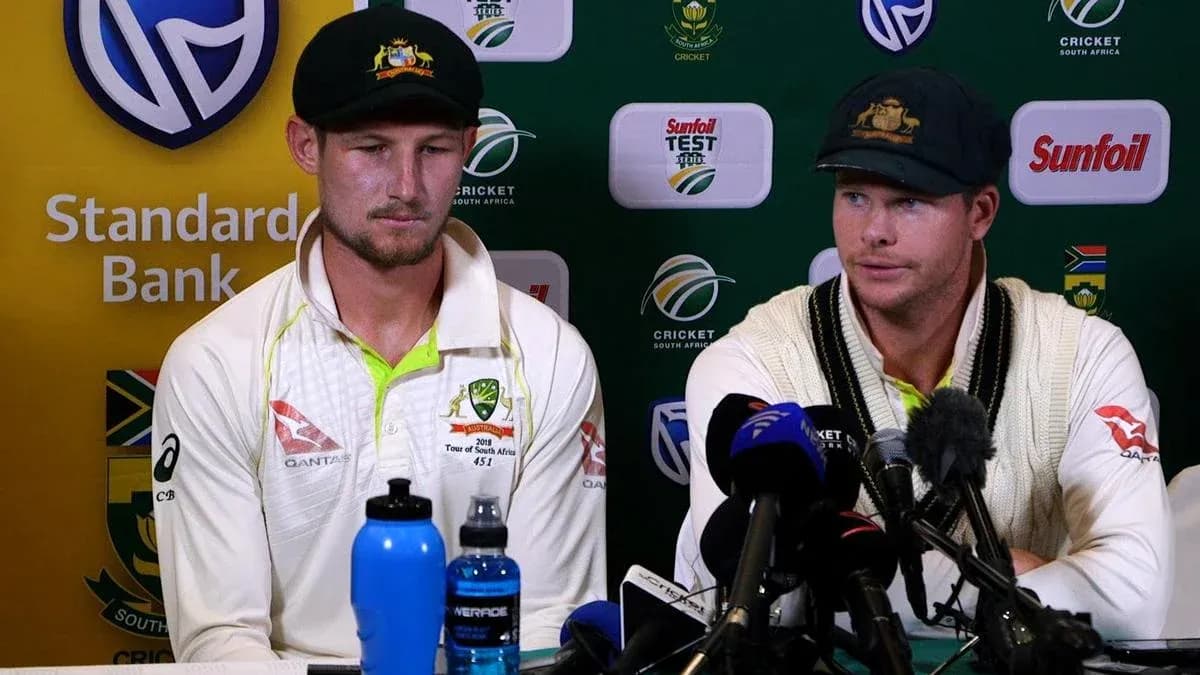
Cricket writer Gideon Haigh captured the unease neatly in a television interview, reflecting on the original sin and the surreal press conference that followed it. “What is extraordinary,” he said, “is how it was done and how easily it was agreed to by the team and how, not unapologetic, but sort of oblivious to the consequences Smith and Cameron Bancroft seemed to be at the press conference.”
Oblivious is the word that lingers. The mindset that allowed such a scheme to be hatched – the entitlement, the “win-at-all-costs” doctrine – was not created in an afternoon. It had been nurtured.
Cricket Australia had long sold a simple equation: more wins meant more public interest, which meant more sponsorship, more money, more power. The “Australian way” became a brand as much as a style: hard, aggressive, unapologetic. Lines were pushed, then blurred, then ignored.
Everything was forgiven. Until it wasn’t.
Cape Town was the moment the bill came due. The act was so brazen, so visible, that it could not be swept away by spin or nostalgia. The board that had indulged the culture suddenly had to punish it.
“Thrown to the wolves”
At one of his most vulnerable moments, Smith said he had been “thrown to the wolves”. It was a revealing line. He was appealing for sympathy, for understanding of the personal trauma, for recognition that he, too, had paid a price.
Yet there is something jarring in that complaint from the man who had allowed – or asked – a younger teammate, Bancroft, to carry out the dirty work in the first place. Responsibility was outsourced to the least powerful figure in the plot. When it blew up, the hierarchy flipped. Smith felt sacrificed by the very system he had led.
The irony is inescapable.
And still, the human dimension matters. A cricketer as consumed by batting and winning as Smith is almost bound to be reshaped by suffering. Stripped of the captaincy, banned from the game he had built his life around, he had to confront himself without the armour of runs and records.
Every person deserves a second chance once a debt is paid, even when that debt comes from an illicit act. There was a time when some voices, including this one, argued for a life ban. The instinct was to protect the game by making an example.
Then another thought intruded: cricket is only a game.
The game, the myth, and the “spirit”
For all the virtues we project onto it – fairness, honour, restraint – cricket remains an artificial construct. We load it with meaning, but it is still a game. That artificiality allows us to demand a standard of behaviour we rarely achieve in the real world. We can insist on ideals that would be dismissed as naïve anywhere else.
Sport itself is morally neutral. It is a stage. The acts of athletes on that stage are not.
Cricket’s own discomfort with this truth is written into its laws. The “spirit of cricket” sits as a preamble, a plea and a warning. It exists because the unwritten rules, once the pride and essence of the sport, were being bent and exploited too often. Players had learned to game the grey areas. The spirit had to be codified because it was no longer trusted to exist on its own.
That says less about the game than about the players and the times they inhabit.
Many international cricketers felt the bans on Smith, Warner and Bancroft were cruel, that the punishment went beyond the crime. They pointed to the culture, the so-called “Australian way”, as an accomplice. Trevor Chappell knows something about being branded a villain by a nation that encouraged a ruthless edge and then recoiled from the image in the mirror.
Chappell, condemned for bowling under-arm to a New Zealand batter to deny a last-ball six and prevent defeat, lives with that moment decades on. “(Smith and the others) will struggle for the rest of their lives,” he said. “I haven’t been able to shake off what happened to me in 37 years. I come up on Google as the man who took the lead role in Australian cricket’s darkest day. It’s a relief I can finally drop that title.”
The baton, in his eyes, has passed. Smith and Warner now carry it.
The real punishment
When Smith returned to South Africa on a white-ball tour, the reception was almost polite by modern standards. A few jeers, a few reminders, but nothing like the venom of Edgbaston. The storm had passed, or at least moved offshore.
Yet the stain travels easily. Every ground offers a fresh chorus, a new chant, another reminder. For some, that will always be the story that comes first: not the runs, not the average, not the centuries, but the sandpaper.
That is the punishment that doesn’t end. Not the ban, not the fine, not the tears at a press conference, but the knowledge that, for all the greatness, the first line of the obituary might already be written.