Tiffany Teo Wins Gold at 20th Asian Games
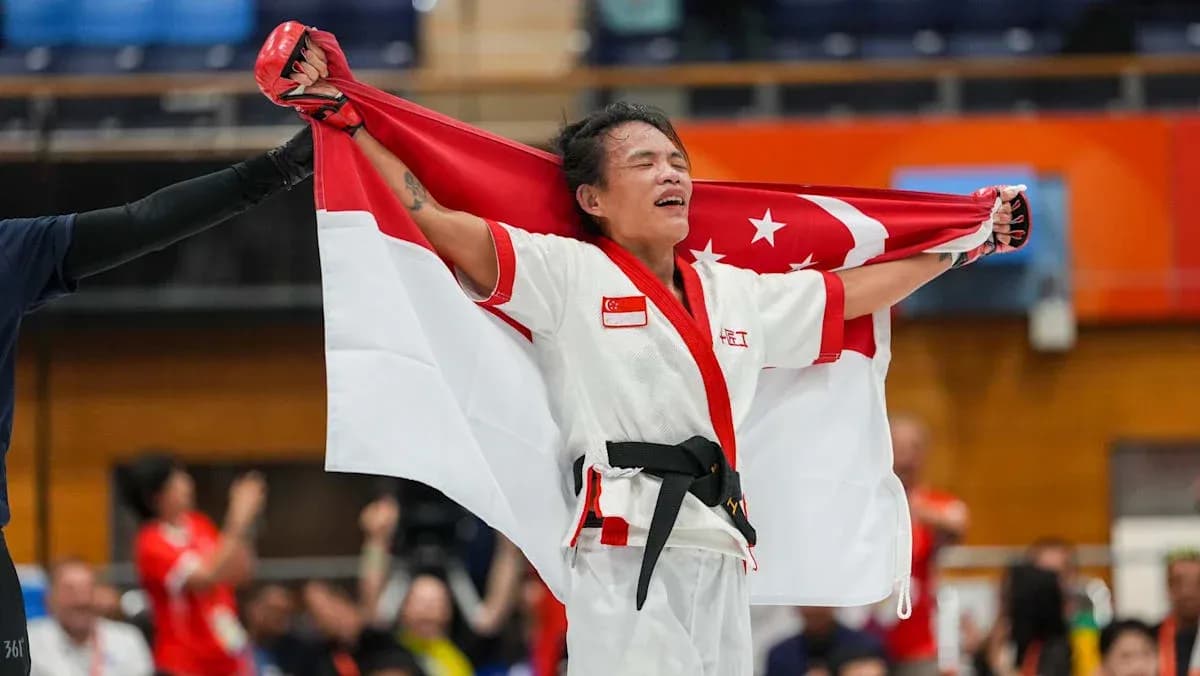
TOKYO – In Tiffany Teo’s hands, the gold medal looked small. The journey behind it did not.
The 265g disc hanging from her neck on Tuesday night was more than Singapore’s first gold of the 20th Asian Games. For Teo, it was the full stop at the end of a decade-long sentence written in sweat, doubt and lonely hours in empty gyms.
“I feel like this entire journey kind of led up to this moment,” she told reporters, still flushed from the fight. “It’s not just the past couple of months of fight camp, it was the hours people didn’t see when I started, when I was a total beginner.”
She arrived in Nagoya believing she belonged. Not as a plucky outsider, but as a favourite.
“Coming into this Asian Games, I felt like I deserved to be here and I definitely deserved the gold medal,” she said, the conviction in her voice matching the belt around her waist.
Overtime, and a champion emerges
At the Nagoya City Inae Sports Center, Teo stepped into the women’s traditional 60kg final against a familiar problem: Uzbekistan’s Khilola Sobirova, the woman who had denied her gold at the Asian Mixed Martial Arts Championship in May.
This time, Teo refused to leave with regrets.
The bout see-sawed through two tense rounds. Judges split them, one apiece. No separation. No safety net. The title would be decided in an extra overtime round, the kind of narrow corridor where champions either freeze or kick down the door.
Teo kicked it down.
When her hand was finally raised, the façade broke. “I was so overwhelmed when I won the fight,” she admitted. “I just started crying; it was just tears of joy.”
The victory carried a personal edge. Just months earlier, Sobirova had been the better fighter. That loss, Teo insisted, became a turning point.
“In retrospect, I’m glad that I lost to her,” she said. “I feel like with losses it makes you reflect more. When you win, you reflect a little bit because it doesn’t hurt that much.”
Pain had done its work. The rematch showed it.
Drama, doubt and a weigh-in tiebreak
Teo’s march to the final was anything but straightforward. Her semi-final against India’s Suchika Tariyal on Monday descended into confusion and technicality, the kind of chaos that can derail even the steadiest athlete.
The pair went toe-to-toe for two rounds. Deadlocked. An overtime round followed, and Teo was initially declared the winner. Job done, or so it seemed.
Then came the challenge.
Tariyal’s corner protested, forcing a review under Asian Mixed Martial Arts Association rules. The decision was overturned. The bout was ruled a draw. No one had done enough to win it outright.
So the fight went to the smallest of margins: the morning weigh-in.
Teo advanced because she was lighter, 58.8kg to Tariyal’s 59.85kg. A gold-medal path decided by a fraction on the scales.
Behind the cold numbers, there was frustration. Teo knew she had made life harder than it needed to be.
“We realised that in retrospect, I was hesitating a lot in yesterday’s fight and honestly, I was pretty disappointed with my performance yesterday,” she said.
“I felt like I could have dominated a lot more and a big part was my fault. My cornerman gave me the game plan, and I was overly eager to grapple and I kind of didn’t follow the game plan in the first round, which led the match to a very close call.”
The scare sharpened her. Against Sobirova, there was no hesitation.
A pioneer chasing more than medals
This Asian Games carries a quiet slice of history. For the first time, mixed martial arts sits on the programme, one of six sports making their debut at Aichi-Nagoya 2026, alongside freestyle BMX, padel, surfing, teqball and virtual taekwondo.
Teo is not just riding that wave; she helped create it.
“I’ve been doing it for a decade and I see myself as a pioneer in the sport,” she said. The word “pioneer” didn’t sound boastful. It sounded like a burden she’s willing to carry.
Her target this week was clear: win gold. Yet even that, she insisted, was only part of the mission.
A “bigger goal” has been tugging at her – to pull MMA in Singapore out of the margins and back into the spotlight.
“I feel that it’s quite sad to see that it’s kind of not as popular now; I would like more people to take up this sport,” she said.
So the medal is not just for her cabinet, or for Singapore’s tally. It is a calling card, a challenge to the next wave of fighters who watched her overtime round and felt something stir.
Teo has her gold. The real question now is who follows her into the cage.