Vande Mataram Echoes at India-Afghanistan T20I
The roar came a little earlier than usual at the Arun Jaitley Stadium on Sunday night.
Before a ball was bowled in India’s opening T20I against Afghanistan, before Jasprit Bumrah marked out his run-up and before Shreyas Iyer flipped the coin, New Delhi paused for something rarely seen on a cricket field: Vande Mataram ringing out across an international ground.
A new sound before the first ball
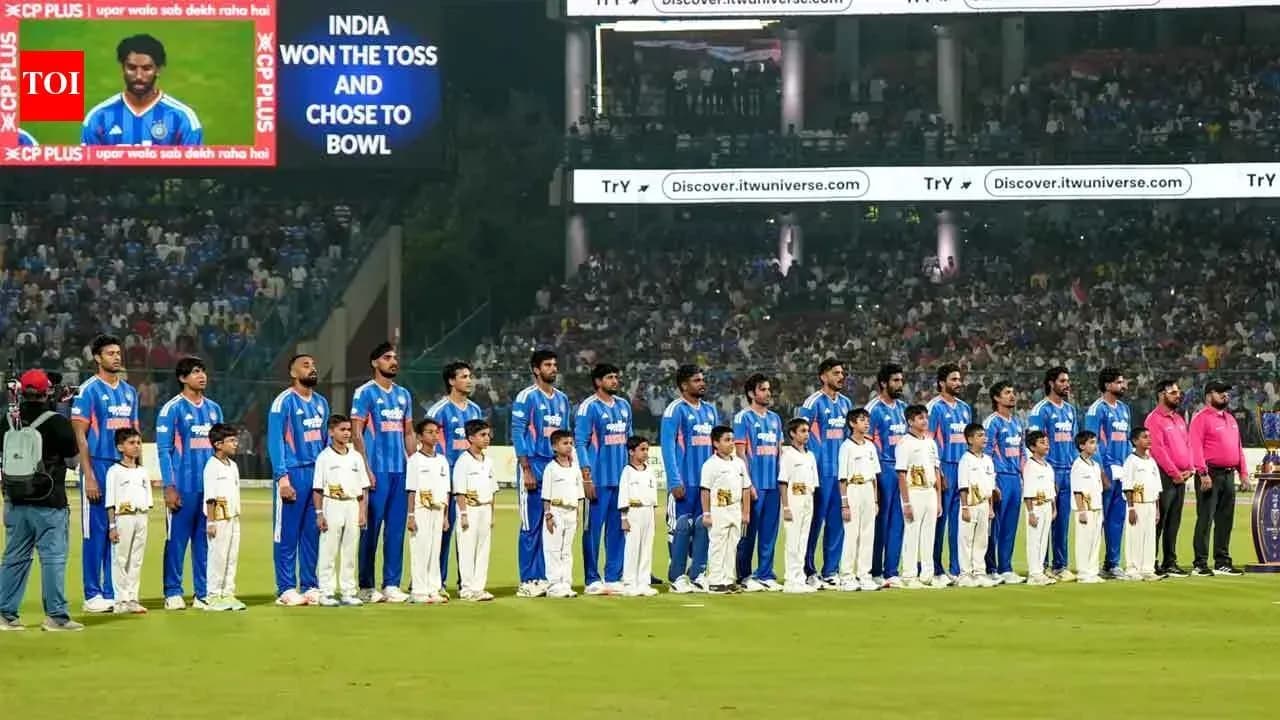
For the first time at an international cricket match, India’s National Song, Vande Mataram, was sung ahead of play. The two teams lined up, shoulder to shoulder, as the familiar strains swept around the stadium. Only after it ended did Jana Gana Mana follow.
The moment owed its roots to a directive issued by the Ministry of Home Affairs earlier this year, which laid down protocols for singing the National Song at official functions. The notification, dated January 28, specified that all six stanzas of Vande Mataram should be sung, a rendition that lasts roughly 3 minutes and 10 seconds.
The ministry also outlined occasions where the National Song must be sung alongside the National Anthem. Sporting events did not figure on that list, which made Sunday’s scene in Delhi all the more striking. It echoed a precedent set on August 15, 2026, when Vande Mataram and Jana Gana Mana were sung in full together for the first time after Prime Minister Narendra Modi’s Independence Day address.
On this night, that ceremonial pairing moved from the Red Fort to a cricket square.
India choose the chase, Bumrah returns
Once the echoes faded and the formalities ended, the cricket took over.
Shreyas Iyer called correctly at the toss and had no hesitation. India would bowl.
“We are going to bowl first. Whenever you come to Delhi, you know what the pitch has got to offer; it usually is a bowl-first wicket,” the India captain said at the toss presentation, laying out his thinking in typically direct fashion. He also nodded to the recent tour. The Zimbabwe series, he said, had given India “a lot of positives” they wanted to carry forward. And then came the line that will comfort Indian fans as much as any anthem: “We know Bumrah is a match-winner.”
Bumrah’s name on the team sheet was a story in itself. This was his first T20I outing since IPL 2026, a long-awaited return to the shortest format in India colours. With his comeback, the attack immediately looked sharper, more seasoned, more dangerous.
India, interestingly, are the designated away side for this three-match series, with Afghanistan listed as the official home team despite all games being staged in Delhi. On paper, India were the visitors. In the stands, it felt anything but.
Selection calls and notable omissions
The XI carried one of the night’s few surprises. Vaibhav Sooryavanshi, so impressive in the Zimbabwe T20I series, missed out. Sanju Samson came in instead, taking the gloves and a middle-order slot.
At the toss, Iyer spelled it out without dressing it up: “Vaibhav is not playing, Washington is not playing, and two more.” No riddles, no hints of niggles, just a clear indication of the churn and experimentation that still shapes India’s T20 plans.
The batting order around Samson had a fresh, almost experimental feel. Abhishek Sharma and Ishan Kishan at the top. Iyer at No. 4. Tilak Varma and Nitish Kumar Reddy in the engine room. Shivam Dube offering power and a few overs if needed. Axar Patel as the all-rounder who so often glues these line-ups together.
With the ball, Arshdeep Singh’s left-arm angle, Bumrah’s craft and Varun Chakaravarthy’s mystery spin formed the core, backed by Axar’s control.
Afghanistan, the “home” side on paper, named a familiar, dangerous group: Ibrahim Zadran leading, Rahmanullah Gurbaz with the gloves and intent, Rashid Khan and Mujeeb Ur Rahman as the twin spin threats, and seasoned hands like Mohammad Nabi and Gulbadin Naib adding depth and experience. Noor Ahmad and Fazalhaq Farooqi rounded off an attack built to test any batting line-up.
The XIs in full
India: Sanju Samson (w), Abhishek Sharma, Ishan Kishan, Shreyas Iyer (c), Tilak Varma, Nitish Kumar Reddy, Shivam Dube, Axar Patel, Arshdeep Singh, Jasprit Bumrah, Varun Chakaravarthy.
Afghanistan: Ibrahim Zadran (c), Rahmanullah Gurbaz (w), Sediqullah Atal, Darwish Rasooli, Azmatullah Omarzai, Gulbadin Naib, Mohammad Nabi, Rashid Khan, Mujeeb Ur Rahman, Noor Ahmad, Fazalhaq Farooqi.
As the players took their positions and Bumrah prepared to steam in for his first T20I spell in years, the evening already felt different. A series billed as a tune-up had opened with a moment of ceremony and symbolism.
Now the question shifts to the pitch: will India’s refreshed, slightly reworked T20 side match the weight of that pre-match occasion with the ball and bat over the next three games?