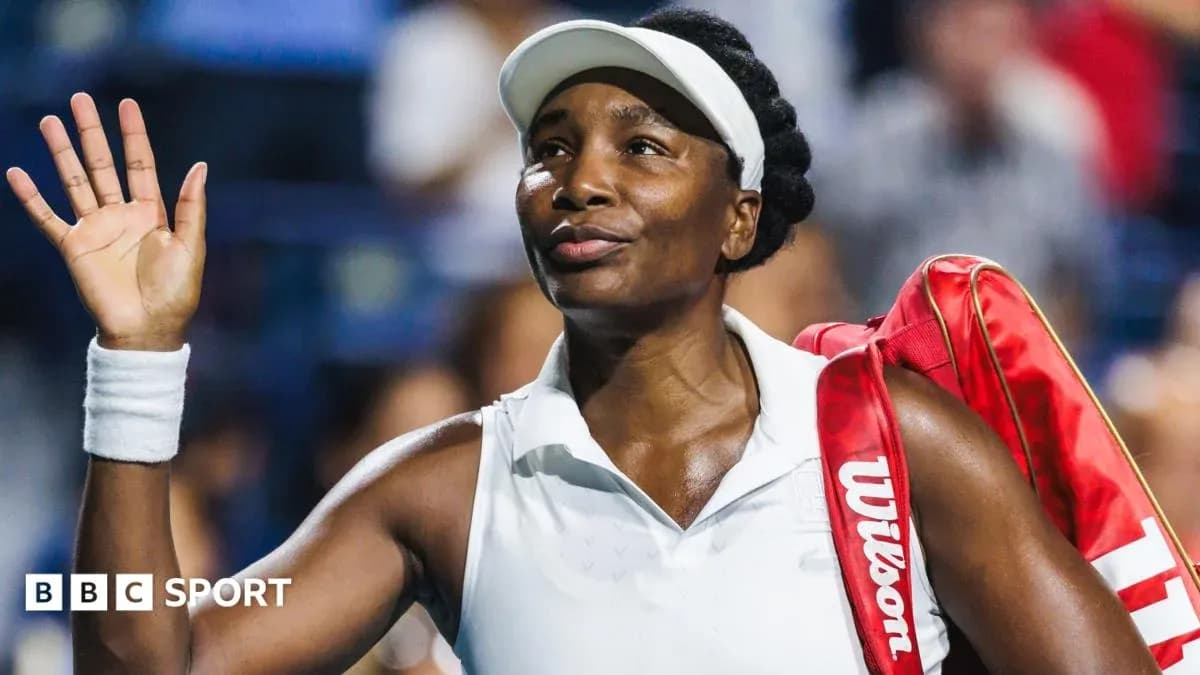
Venus Williams: A Champion's Legacy in Doubt at 46
Venus Williams walks back through the gates of Flushing Meadows this year as both outlier and institution. At 46, ranked 611 in the world and on a 14-match losing streak in singles, she has no business still being here by the cold logic of sport.
But Venus has never lived by that logic.
The United States Tennis Association has handed her a 12th wildcard of the season so she can play the US Open again, this time opening against fellow Grand Slam champion Sofia Kenin. On paper, it is just another wildcard. In reality, it is a collision of legacy, commerce and the uncomfortable question of when a great champion should finally be told “no”.
A legend on borrowed time – and borrowed entries
Williams has not reached a Grand Slam singles draw by right of ranking since Wimbledon 2021. That was also the last time she won a singles match at a major. Her broader record is even starker: 18 defeats in her past 19 singles matches, the lone win coming over Peyton Stearns in Washington last July.
The numbers say the game has moved on. Tournament directors keep insisting she has not.
This year alone, events in New Zealand, Australia, Spain, Germany, Canada and the United States have all found room for her. Eleven wildcards already, the US Open her 12th. There is no rule to stop it. Grand Slam champions face no cap on the number of invitations they can receive, and eight of the 128 spots in a major singles draw are reserved for wildcards anyway.
For many, the calculation is simple. A Williams sister still moves the needle.
Karl Hale, the tournament director in Toronto, offered Venus a wildcard into this month’s WTA 1000 event and saw the effect immediately.
“I think it's good for tennis to have these generational icons,” Hale said. “That they are still allocating wildcards for them says something to their intrinsic value to the tournaments.”
He is not talking about nostalgia. He is talking about tickets, eyeballs, relevance.
Wildcards, trades and the business of nostalgia
Wildcards have always been a blend of merit and marketing. Most tournaments lean first towards their own players, using those spots to promote national talent or reward promising juniors. But the remaining invitations are currency.
They go to names who can sell a session, fill a TV window, give the early days of a tournament a headline.
There are also what Hale calls “trades” – unofficial arrangements between federations or agencies. IMG, which manages players and until recently owned the Miami and Madrid Opens, has long operated in that space. The most visible example is the reciprocal wildcard agreement between the USTA, Tennis Australia and the French Tennis Federation. Each offers a men’s and a women’s wildcard to the others’ players, knowing their turn will come when the tour swings to their own Slam.
Venus sits at the intersection of those forces. She is American. She is a seven-time major singles champion. She is one half of the duo that helped redefine and globalise women’s tennis. If you are a tournament director with a few wildcards to spend, she is still an easy sell.
“The way we looked at Venus is that her legacy is phenomenal,” Hale told BBC Sport. “She's done so much for the sport and is really popular here in Toronto and our markets specifically – so we thought it was really good to announce it early that we have a Williams sister coming.”
The response backed him up. Media interest surged. Opening-day tickets looked more attractive.
“The wildcards always play first-round matches, and with the bigger draw now, it adds more notable names and stars for the beginning of the tournament,” he said. “Venus played opening day. She kicked off our tournament, so it added a lot of value.”
Still competing, just not winning
This is not a farewell tour in name. Venus has not framed it that way, and the results, while brutal on paper, contain just enough resistance to keep the door open.
She pushed 11th seed Karolina Muchova to three sets at last year’s US Open. She went the distance again with Olga Danilovic at the Australian Open in January. She reached the doubles quarter-finals in New York last year. Even in defeat to Kamilla Rakhimova in Toronto – 6-4 6-1 – Hale saw enough to justify his decision.
“The first set was really competitive,” he said. “She's still competitive, but just not winning these matches.”
That distinction matters to the people making the calls. No one in the sport wants to see a legend humiliated. They want the name, the story, the sense of continuity – but not a 6-0 6-0 sideshow.
“You never want to put a player out there that you are unsure about,” Hale said. He does not believe Venus has reached that point.
When is enough, enough?
The question hangs over every wildcard she receives: should there be a limit?
Golf has already wrestled with its own version. Two decades ago, any Open Championship winner under 65 could return whenever they wished. The organisers eventually tightened the rules; champions now play only until 55, freeing up spots for younger, higher-ranked players.
Tennis has never gone that way. There is no age ceiling, no hard stop for former champions. Martina Navratilova returned to singles at 47 with wildcards into the 2004 French Open and Wimbledon, even winning a round on the grass.
So where is the line? Is it ranking? Results? Age? Or something more intangible – the moment when a champion no longer looks like they belong?
Hale believes that decision will not be forced on Venus.
“When the time comes that Venus is not competitive in sets, then I think she will make that call,” he said. In his mind, the responsibility sits with the player first, the tournament second.
“Venus and Serena have done so much for women's tennis and the sport that they should be able to play as long as they want. I'm very happy they are continuing and they make their decision when they are ready, or each tournament makes their decision when they are ready.”
Respect, debt and the last act
Within the locker room, there is little appetite to push her towards the exit. British number one Katie Boulter, who partnered Williams in doubles in Madrid in April, summed up the sentiment.
“Venus has given so much to our sport that she deserves to get what she needs back,” Boulter said. “We have to be grateful that she is still out there, doing the best she can.”
That is the crux of it. Wildcards for Venus Williams are no longer about building a career. They are about honouring one. They are about a sport acknowledging a debt to a player who helped shape its modern era and still wants to compete inside it, even as the results grow harsher.
So she returns to New York again, on an invitation, with a daunting draw and a ranking that belongs to the margins of the tour. The numbers say this cannot last much longer.
The stands, the cameras and the tournament directors keep answering a different question: while she still wants to walk out there, who is really ready to tell Venus Williams her time is up?