Dinusha's Defiance Secures Draw for Sri Lanka in Colombo Test
On a flat, fading Colombo pitch that refused to misbehave, Sonal Dinusha stood between India and a clean sweep – again. By the final session on Day 5, it wasn’t so much a contest as a slow, stubborn negotiation with time. Sri Lanka had followed on, slipped, dug in, and then, through Dinusha’s bat and the lower order’s resolve, hauled themselves to safety.
India walked in on the last morning needing four wickets to open up a chase. They walked off in the evening with the series won, but the Test prised out of their hands by a young all-rounder who has turned this series into his personal coming‑of‑age story.
India Chase the Win, Pitch Says No
The script at the start of Day 5 looked straightforward. Sri Lanka, 242/6 following on, still trailed and had Dinusha and Keshara Nuwantha at the crease. India had the new ball around the corner, a varied attack, and a bright, humid Colombo morning with no clouds in sight. Shubman Gill’s side needed one ruthless burst.
Instead, they ran into resistance.
Ravindra Jadeja and Saransh Jain opened proceedings, probing away at off-stump, looking for any hint of deterioration. The ball turned, but not viciously. It gripped just enough to keep the batters honest, never enough to terrify them. Dinusha and Nuwantha trusted their defence, left well, and picked off anything loose.
The partnership grew, quietly but decisively. The lead nudged past 50, then 100. India kept shuffling the deck: Jadeja from one end, Manav Suthar from the other, then the seamers with the new ball. Nothing broke.
Gill finally turned to Suthar again, and the left-arm spinner delivered the opening India craved. Keshara Nuwantha, who had padded away and blocked with admirable discipline through the morning, finally edged one. It was the kind of ball Suthar had beaten all session without reward; this time Dhruv Jurel snapped up a sharp catch. Sri Lanka 331/7, still only 116 ahead. The door creaked open.
Prabath Jayasuriya came in and did exactly what India didn’t want: he played within the stumps, refused to flirt outside off, and soaked up deliveries. The surface, as it had all game, rewarded anyone willing to be boring. The batters obliged.
Dinusha Turns the Screw
The more India searched, the more Dinusha settled. He had already worn them down once in the first innings with a superb hundred under pressure. Now, in the follow-on, he doubled down.
His method was simple, ruthless, and maddening for the bowlers. He swept – and swept again. Conventional, slog, paddle, hard, soft; the shot became a release valve. Every over, almost like a metronome, he found a sweep for a single, occasionally a boundary. The Indian spinners had seen this movie before with the likes of Ben Duckett and Tom Latham in recent years. They still had no answer.
By the time the first water break arrived on the final day, Sri Lanka were 284/6. Dinusha and Nuwantha had survived, the ball had softened, and the pitch looked asleep. The lead ticked upwards. India’s best hope was that the new ball would shock the game awake.
Gill took it at 257/6, handing it to Mohammed Siraj and Prasidh Krishna. It was a bold choice in conditions that had screamed “spin” for most of the match, but India were chasing impact, not convention. Siraj bent his back, Prasidh hunted for bounce, yet the edges kept falling short or missing altogether. Even when Gill went short with fields set for the pull, the breakthroughs didn’t come.
Sonal Dinusha, meanwhile, just kept batting.
He moved to fifty, then beyond, his third half-century of the series quickly morphing into something larger. His concentration never wavered. The legs were heavy, the back clearly troubling him, but he refused to give India an opening. Every time the pressure rose, he found that sweep or a nudge into the gap.
By lunch, Sri Lanka were 330/6, the entire morning session navigated without loss. India had hammered away for 29 overs and had nothing to show. The lead was 116. The Test was slipping.
Afternoon Grind and a Brief Indian Surge
After the break, India tried to manufacture a spark. Gill rotated his spinners, then brought back pace. The pitch, though, had settled into a stubborn rhythm. The ball turned sharply at times, but always closer to the defensive bat than the edge. The batters, knowing there was no “unplayable” ball lurking, simply trusted technique.
Suthar, to his credit, looked the most likely. He varied his angles, switching over and around the wicket, using whatever rough he could find. Jadeja, as always, hammered away at the stumps. But Sri Lanka had made up their minds: they were playing for time, not runs.
Prabath Jayasuriya absorbed over 20 balls, then 30. He refused to chase width, he wore the ball on the pad, he dead-batted everything in his corridor. India’s frustration rose. A rare release came when Jadeja finally induced a mistake – Jayasuriya driving loosely and gifting a catch. Sri Lanka 355/8. The lead 141. A flicker of hope.
Lahiru Kumara walked in with a simple brief: survive. He had already faced 52 balls in the first innings. If he could repeat that, Sri Lanka would be almost home. India knew it. They crowded him, attacked his stumps, and tested his technique. He survived again.
Gill turned to Saransh Jain, the debutant off-spinner who had removed Kumara and Dinusha in the first innings. This time, the context was different. Sri Lanka had shut up shop. Dinusha, now nursing his back, started farming the strike and, when he couldn’t, trusted Kumara to defend. Over after over, the tailender held firm. India’s fields grew more attacking, then more resigned.
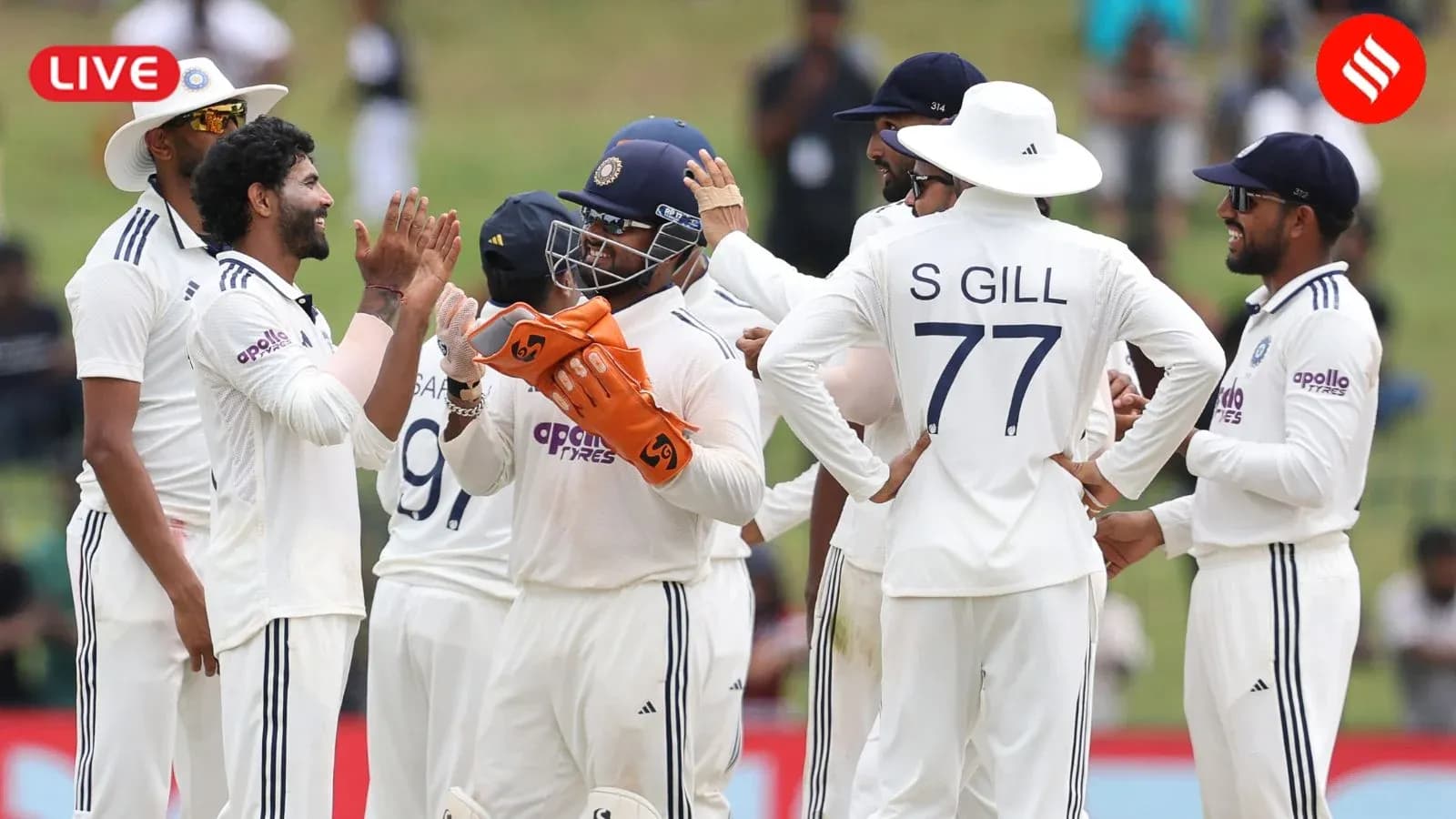
Jadeja, India’s most threatening bowler, then trudged off mid-over with what looked like heel discomfort. The one man who consistently looked like taking wickets was suddenly gone. With him, a large chunk of India’s last push.
Century No. 3 – and the Game Drifts Away
Tea arrived with Sri Lanka 383/8, leading by 170. Dinusha was stranded on 98, the innings stretched across hours, the match hanging by a thread India could no longer grip. When play resumed, he needed only a couple of strokes to reach three figures – his third century of the series, and arguably the most defiant.
This wasn’t a pretty hundred. It was a hard, unyielding, deeply valuable one. He had been Sri Lanka’s difference between humiliation and respect all series, and in Colombo he did it twice in the same Test.
Around him, Lahiru Kumara continued to play the innings of his life. He left well, blocked better, and soaked up over after over. Any time Dinusha felt his back tighten, he simply gave Kumara the strike early in the over and trusted him to see it out. It worked.
India tried everything. Prasidh Krishna returned with attacking fields. Siraj pounded the surface, again targeting Dinusha’s ribs, an area where he had looked uncomfortable earlier in the match. Saransh Jain searched for drift and dip, Suthar for that one ball that would finally bite through bat and pad. Nothing.
As the final session wore on, the tone of the contest shifted. It stopped being about India forcing a result and became about when – not if – the captains would shake hands. The lead moved past 170. Overs melted away. The spinners lost bite. The seamers lost zip. The umpires, as is the ritual, would soon check with both skippers about calling it.
Sri Lanka had done more than just survive. They had dragged the Test out of India’s grasp, one leave, one sweep, one dead bat at a time.
A Young Core, a Hard Lesson
For India, this was a reminder of the flip side of enforcing the follow-on. Their bowlers had already sent down close to 90 overs in the first innings. Asking them to go again immediately on a placid surface carried risk. As the second innings wore on, that risk materialised: tired legs, slightly frayed plans, and a pitch that grew friendlier for batting by the hour.
Yet there were positives. Prasidh Krishna, under the guidance of Morne Morkel, again showed why India see him as a long-term all-format option: heavy bounce, improved fuller length, and the willingness to do the “donkey work” spells. Mohammed Siraj, even on a dead wicket, kept bending his back and banging it in, testing batters with short balls in the rib-cage channel. Suthar, in just his second Test, learned what it feels like when batters attack and then shut you out. Jain, on debut, toiled with discipline, finally collecting his first Test wickets and bowling long, demanding spells.
On the other side, Sri Lanka unearthed something priceless. Sonal Dinusha emerged from this series not just as a handy all-rounder, but as the heartbeat of their resistance. With his third century of the series and a pair of backs-to-the-wall efforts in Colombo, he turned what could have been a procession into a contest.
By the time the draw loomed into view and both teams quietly accepted it, the scoreboard told its own story: Sri Lanka 395/8 in the follow-on, 140.3 overs of grit, defiance, and time stolen from India’s ambitions.
The series belongs to India. The last word in Colombo, though, belonged to a 23-year-old left-hander who refused to leave the stage. The next time these sides meet, how different will the script look with Dinusha at the heart of Sri Lanka’s plans?