Maia Bouchier Leads England to Record ODI Chase Against Ireland
Maia Bouchier’s blistering century powered England to their highest successful ODI chase as they dismantled Ireland’s 281/5 with almost casual authority at Grace Road, Leicester.
Ireland walked off at the break with a spring in their step. They had earned it. A solid 136-run stand for the second wicket between Amy Hunter and Gaby Lewis gave their innings structure and calm after the early loss. Hunter and Lewis, matching each other stroke for stroke, both moved into the 60s and drove England back with 13 fours between them.
When three wickets tumbled in just over seven overs from the 30th, that platform looked in danger of crumbling. The innings hovered on the brink of mediocrity, a sub-250 total suddenly looming. Leah Paul and Rebecca Stokell refused to let it happen. Their 84-run partnership from only 71 balls changed the mood again. Ireland lashed 77 runs from the last 60 deliveries, dragging themselves to 281/5 and, for a moment, planting doubt in English minds. It felt like a score with teeth.
Then Bouchier walked out.
The tone of the chase flipped in one over. In the sixth, the England opener tore into Jane Maguire, the 23-year-old seamer, with four consecutive boundaries. Any early pressure dissolved in that burst. Ireland’s fielders spread, the bowlers searched for answers, and Bouchier simply kept swinging.
At the other end, Sophia Dunkley moved with ruthless efficiency. By the 10-over mark, England were 72/0, the run-rate already ahead of the requirement and climbing. The pair weren’t just ticking along; they were ripping the chase open. Dunkley’s half-century arrived from 40 balls in the 15th over. Bouchier’s came three overs later, off 53 balls, a milestone that felt less like a checkpoint and more like a warning.
Ireland’s 281 began to look thin.
The runs flowed at more than seven an over, the ball racing repeatedly to the rope as gaps opened and shoulders dropped. England’s openers added 143 from 118 balls, a partnership that turned what should have been a contest into an exercise in timing the finish.
Cara Murray finally broke through in the 20th over, removing Dunkley for a vibrant 73 off 61. The leg-spinner struck again almost immediately, dismissing Jodi Grewcock in the next over to inject a flicker of hope. Two wickets in quick succession, a new batter at the crease, and a large chase still on the board — if Ireland were going to find a way back, this was their moment.
England never let it become one.
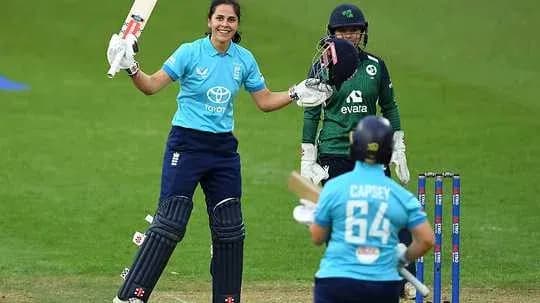
Alice Capsey joined Bouchier and the tempo barely shifted. The pair added a brisk 50, Bouchier steering the chase with the authority of a player in complete control. She reached her century from 91 balls in the 31st over, a knock built on 11 fours and relentless intent. By then, the equation had shrunk to a formality.
Her dismissal in the 32nd over, on 104 from 95 balls, arrived too late to alter the script. Ireland had removed the architect, but the building was already complete.
Freya Kemp arrived and swung like a finisher who didn’t intend to hang around. She cracked two fours in an over off Louise Little, then tore into Arlene Kelly with four more boundaries, as England surged past 250 inside 34 overs. Kemp’s 36 from 22 balls underlined the depth and aggression of this batting unit, even as Murray continued to fight, claiming her third wicket when she dismissed the left-hander.
By that stage, the chase was all but done. Capsey, composed and unflustered, closed it out in the 39th over with a boundary, finishing on 41* from 40 balls. England had cantered home, not merely overhauling Ireland’s 281 but turning it into a footnote in their own record-breaking pursuit.
Ireland had crafted a total that, on many days, would demand a serious response. They found instead a batting line-up in full stride, led by Bouchier’s statement century and backed by a supporting cast intent on making a high target look ordinary.
If this is the standard England set at the start of their season, the real question is who will be able to slow them down, let alone stop them.