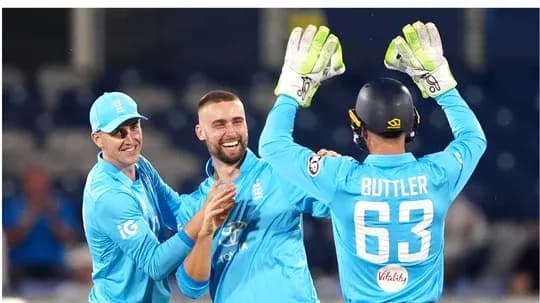
Mark Wood Retires: A Fast Bowling Career of Impact and Resilience
Mark Wood, England’s snarling, smiling speed merchant, has called time on his international career at 36, ending an 11-year ride that burned white-hot when his body allowed it and left two World Cups and four Ashes series in its wake.
He goes as he arrived: at full tilt, no half measures.
A career lived in the fast lane
Wood’s England story began at Lord’s in 2015, a tearaway quick from Ashington hurling himself into a Test debut against New Zealand. From there, he carved out a career that was never about sheer volume, but about impact.
In 38 Tests he took 119 wickets, often as the man asked to do the hardest overs on the flattest days. In white-ball cricket he finished with 80 wickets from 70 ODIs and 54 in 38 T20Is, enough to sit sixth on England’s all-time T20I wicket charts. When captains wanted something different, something hostile, they threw the ball to Wood.
The numbers only tell part of it. The memory is of a whippy action, a late leap, and the speed gun spiking into the mid-90s mph. Of spells that changed atmospheres as much as they changed scorecards.
World champion in both formats
His medal collection is the envy of a generation. Wood stands as a double World Cup winner, with one title in each white-ball format.
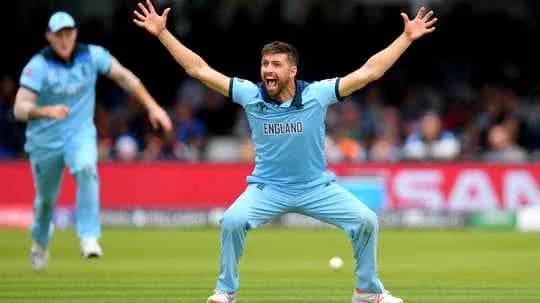
In 2019, on home soil, he was central to England’s ODI World Cup triumph. He took 18 wickets in the tournament, repeatedly bursting through the 95 mph barrier. Even on the biggest day of his career, the final at Lord’s, he bowled through a side strain as England edged New Zealand in that nerve-shredding Super Over finish. The images that linger are of a fast bowler pushing his body past its limit because the trophy was on the line.
Three years later, in Australia, he did it again on the T20 stage. Nine wickets in four matches at the 2022 T20 World Cup underlined his role as England’s shock weapon, the bowler who could rip through top orders and tilt a tournament.
Ashes moments and a body that fought back
Wood’s Test career was shaped by the Ashes, and by a constant duel with his own body.
He featured in four Ashes series, his first in 2015 ending with a defining moment at Trent Bridge, where he took the wicket that sealed the series for England. That ball, that roar, that sprint in celebration – it was Wood at his most vivid.
Injuries kept dragging him away, but he kept coming back. The most stirring return came in 2023. Recalled at Headingley with England 2-0 down, Wood unleashed one of the great modern Ashes spells. Pace, hostility, reverse swing; Australia’s batters suddenly looked hurried, the crowd surged, and the series came alive. England clawed their way to a 2-2 draw, and Wood’s intervention sat at the heart of that resurgence.
Yet the same ferocity that thrilled crowds also took its toll. A succession of injuries increasingly limited his availability. His final England appearance came in the Ashes Test in Perth last November, another comeback that ended with another breakdown.
This time, there would be no more returns.
‘The England dream has slowly been ground out of me’
Wood’s decision comes on medical advice, with specialists ruling out any realistic route back to Test or 50-over cricket. The fast bowler who built a career on resilience admitted this was a battle he could not win.
“I’ve made the decision to retire from international cricket. Although this may not come as a surprise given the past year, it just feels like a natural time at the end of my contract,” he said.
“I've always tried to be resilient and come back from injury to prove people wrong and show everyone what I can do. Unfortunately this time I lost the battle. On medical advice, Test cricket and 50-over cricket are not possible, so the England dream has slowly been ground out of me over the past year.
“Playing for England has been the greatest honour I could have ever wished for and a dream come true. The little lad in me would be so chuffed to have played so much for England. To travel the world, meet incredible people and play against the best, is something I feel incredibly lucky to have done, doing something I have loved.”
It is a raw admission from a bowler whose public image was all laughter and lightning bolts, but behind it lay years of rehab rooms, scans and lonely gym sessions.
A point of difference, a career well spent
Inside the England setup, there is no doubt about the scale of his impact. Rob Key, England men’s managing director, summed it up simply.
“It’s been a privilege to watch the latter part of a great career,” Key said. “To have been a point of difference in Ashes series wins, a World Cup, and to have thrilled crowds every time he got the ball in his hand is something very few players achieve. He can look back with enormous pride on a career very well spent.”
That phrase – “point of difference” – captures Wood neatly. In an era of data and match-ups, he offered something you cannot coach: genuine, unsettling pace. Captains used him in bursts, in short, violent spells designed to rip open games. Fans felt the change immediately; the noise rose as he marked out his run, the anticipation that something – anything – might happen.
Now that run-up ends. The stats will sit quietly on the page, but the legacy lives in the memories of those spells at Headingley, those surging sprints at Lord’s, those World Cup nights when the speed gun flashed and England’s opponents flinched.
England will move on, as teams always do. The search begins for the next quick who can bend a game to their will. But for a decade, when England needed raw pace and a jolt of electricity, they knew exactly whose name to call.