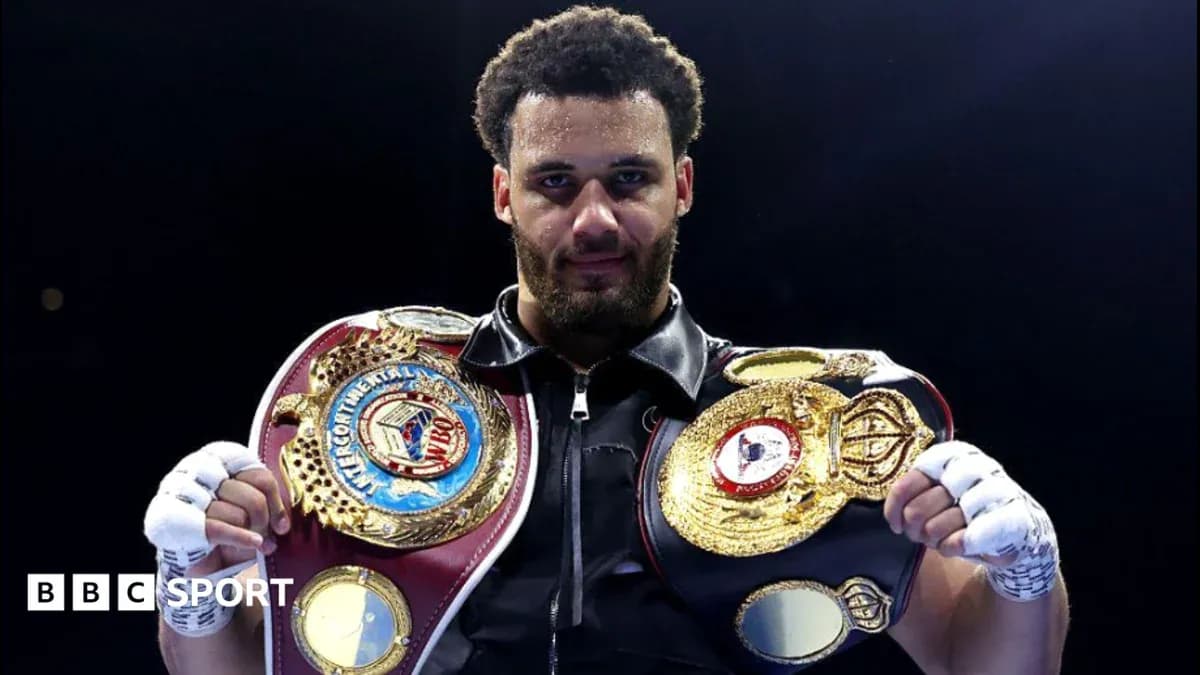
Moses Itauma: Rising Star in Heavyweight Boxing
Moses Itauma scrolls through his phone and bursts out laughing.
On the screen is a meme: former Nigerian president Olusegun Obasanjo in full traditional dress, hands on hips, staring straight through the camera. The caption reads: “This is how an African dad looks at you when you pursue a career that goes against his wishes and you turn out to be successful.”
“That is pretty much my dad,” Itauma says.
From that look to this stage has been a whirlwind.
Born in Slovakia to a Nigerian father and Slovak mother, raised in Kent, Itauma grew up in a house where success meant medicine or law, not heavyweight titles. His parents wanted textbooks, not punchbags. Then his older brother turned professional, the pads started popping a little louder, and it became impossible to ignore the youngest son’s talent.
His mother’s stance changed with one decisive line.
“Don’t worry about school. Just focus on your boxing.”
At 21, that gamble now carries him into the most unforgiving spotlight in the sport. On Saturday, Itauma faces Filip Hrgovic for the vacant IBF heavyweight title, with the chance to become the second-youngest world heavyweight champion in history.
He knows what that represents.
“There’s a lot of expectations on my shoulders to carry the flag of British boxing. I just have to live up to it,” he says.
The timing is striking. Tyson Fury and Anthony Joshua, the twin pillars of a golden era for British heavyweights, are edging towards the final chapters of their careers. The division is searching for its next long-term headliner. Beat Croatia’s Hrgovic and Itauma doesn’t just step into the conversation – he walks straight to the top table.
Yet he is not Fury. There are no Netflix cameras trailing his every move, no carnival of chaos wherever he goes. Itauma is closer in temperament to Joshua: guarded, measured, and happy to keep the media at a distance.
“What irritates me most is when people think you’re public property,” he says. “What people don’t know about me is that I don’t actually want to be in the limelight. The way my career is going, I just have no choice.”
That reluctance shows during fight week. Where others perform, he simply turns up. When Hrgovic tried to needle him by interrupting Thursday’s news conference, Itauma didn’t bite. No shouting match, no chest beating. He just turned to host Adam Smith and asked for the next question.
The comparisons with Joshua run deeper than personality.
Joshua challenged for the IBF belt against Charles Martin in his 16th professional bout, having boxed 34 rounds. Itauma reaches his first world-title shot a fight earlier, with 31 rounds behind him. Joshua had the Olympic gold medal and a rich amateur pedigree. Itauma does not. But if he wins on Saturday, the numbers will scream the same thing: he will have become the fastest British heavyweight to claim a world title.
Ben Davison, the trainer who has worked closely with both Joshua and Fury, believes Itauma is built for this.
“Pressure is a privilege,” Davison says. “Moses has already had that pressure for such a long time and I just think it’s water off a duck’s back.”
Most blue-chip prospects are wrapped in cotton wool. Matchmakers feed them learning fights, step them up gradually, and only throw them in deep when the team is sure the timing is right.
Itauma has been treated differently. He has been fast-tracked.
Francis Warren, son of Queensberry boss Frank, first spotted him as a teenager, trading leather with seasoned professionals in sparring. Long before that, former British heavyweight champion Jeamie ‘TKV’ Tshikeva saw something unusual.
“Moses was a big 11 or 12-year-old, around 75 to 80kg, and sparred an adult of the same weight,” TKV recalls. “He really showed up, put hands on this grown man, and I was shocked.
“The guy he sparred was around 25. Imagine going home and telling your wife you got beat up by a kid.”
Those early warnings have been backed up by the cold reality of the professional ring. Itauma has ripped through opponents with destructive stoppages over Dillian Whyte and Jermaine Franklin. Neither sits at the very top of the division, but the manner of those wins – the composure, the power, the lack of drama – hardened the belief that he is heading for the summit.
Then the door swung open.
When Oleksandr Usyk vacated the IBF title and Frank Sanchez agreed to step aside, Itauma’s meeting with Hrgovic suddenly became a world-title fight. The fast track looked, to some, like a shortcut.
Hrgovic pounced on that narrative long before the belt was attached to the bout. He claimed Itauma had been handed “everything on a plate”. On social media, the reaction echoed that sentiment. Many argued a final eliminator, a harder proving ground, would have been a more natural route.
Itauma doesn’t seem remotely interested in satisfying that crowd.
“It’s a lose-lose situation for me because if I win, I’ve done what people expect, and if I lose, it’s just like, I wasn’t as good as what I thought,” he says. “I don’t find happiness in trying to please other people’s expectations.”
The real questions lie elsewhere. What happens if his power doesn’t blow the door off its hinges early? What happens when the man in front of him is still upright in round eight, still punching back, still dangerous?
TKV, who has shared rounds with Joshua, Daniel Dubois and Fabio Wardley, believes the answers are already there, hidden in the quiet work.
“Moses works hard even though he hasn’t had to face adversity in his fights or training,” he says. “I’ve never seen him slack. He’s fast, sharp, a good learner and I rarely see him get hit.
“I believe he can do the rounds, too. He has the potential to dominate the division for years.”
Inside Itauma’s camp, there is no hint of doubt. They talk about this level as his natural habitat, not a place he is visiting early. Outside, the debate over timing, merit and readiness rumbles on.
All of that noise will dissolve when the first bell rings.
On Saturday night, a 21-year-old who once upset his parents by choosing gloves over grades gets 12 rounds – if he needs them – to turn promise into a place in heavyweight history.