Namibia Cricket Ground Hosts Exciting T20I Tri-Series
Lavender, leather and a little bit of jeopardy. The Namibia Cricket Ground in Windhoek is about to host the biggest fortnight of its short life, and it smells faintly of possibility.
In a city ringed by rock and dust, the outer walls of the NCG are lined with lavender. It’s a soft touch in a hard land, and a curious flourish at a venue where grass is usually the only greenery that counts. Yet it fits. This is one of the world game’s newest, sharpest, most carefully finished grounds, and from Friday it steps onto the main stage.
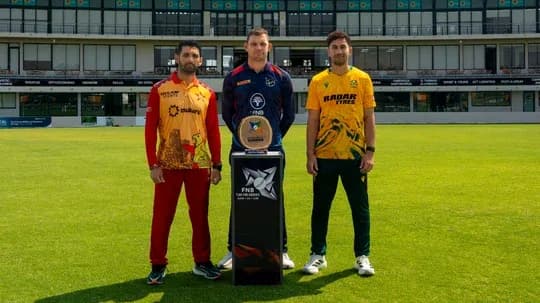
Namibia, South Africa and Zimbabwe arrive for a T20I tri-series that runs until September 6. Seventeen completed men’s white-ball internationals have already been played here, along with as many women’s T20Is and eight men’s under-19 ODIs since March last year. None of those days will feel as loaded as what’s coming now.
A ground grows up
For the first time, the NCG will host two ICC Full Member teams at the same time. One of them already knows how unforgiving this place can be.
South Africa came to Windhoek last October for a T20I, expecting to ease past their neighbours. Namibia had other plans. The Eagles dragged the game to the last ball, then dragged South Africa over the edge, winning by four wickets in their first meeting in any format. The home crowd is still telling that story, and probably will be for years.
No-one who watched that night thought Namibia had snatched anything they didn’t deserve. They were better. They played the big moments with more nerve. They earned it.
Gerhard Erasmus, their captain, knows exactly what that win meant — and what this format offers teams like his. “It’s a question we always get in the associate world: how do you bridge the gap to the next level? By beating teams at the next level. The T20 format gives you the ability to impact the game. If you have two star performers on the day you could swing the result your way.”
He’s not theorising. His team have already done it on this ground.
On the other side of that result stood Bjorn Fortuin, now leading an experimental South Africa squad. The memory still stings. “It wasn’t a fun experience. I don’t think there are scars or underlying issues from that result. The reality was we got beaten by the better team on the day.” That’s as blunt as it gets.
A southern way of playing
The schedule is tight and unforgiving. From Friday to September 6, only three days will go by without a game. Each team must absorb the strain of back-to-back fixtures at least once. Legs will tire. Minds will fray. The ones who cope best will define the series.
There’s a chance here, too, to see something like a southern African signature take shape. These are sides built, at their best, on pace that bites, fielding that cuts off singles like a knife, batting that looks flinty and unyielding rather than flamboyant. They tend not to surrender, even when the scoreboard suggests they should.
The conditions should help that kind of cricket. Afternoon starts, sunshine, temperatures in the mid to upper 20s Celsius. In 13 men’s T20Is at the NCG, totals of 200 or more have been posted only three times. Two centuries and eight fifties hint at batting opportunities, but bowlers have had plenty to say: six four-wicket hauls, four of them by seamers, underline that this isn’t a slogger’s paradise. You earn your runs here.
Namibia: full strength and familiar faces
Namibia come armed with continuity and a couple of intriguing subplots. Justin Kemp, once a hulking presence in South Africa’s middle order, now sits in the home dugout as assistant coach. He knows the mentality of the visitors. He also knows what it means to punch up in international cricket.
Michael van Lingen, who last appeared in a T20I at the 2024 World Cup, has stepped out of retirement to rejoin the fray. That alone tells you how seriously the hosts are treating this window.
A possible XI reads: Jan-Nicol Loftie-Eaton, Junior Taanyanda, Gerhard Erasmus (capt), Alex Busing-Volschenk, Zane Green, JC Balt, Jan Frylinck, Max Heingo, Bernard Scholtz, Waldo Smith, Jack Brassell. There’s enough experience and enough bite there to trouble anyone, especially at home.
South Africa: experiments under pressure
South Africa have gone the other way. This is not their first-choice T20 side; it’s a laboratory in green and gold.
Jason Smith has been ruled out with an inner thigh strain, trimming their options further. Eathan Bosch is uncapped in T20Is, Duan Jansen in any format. For some, this is a doorway; for others, a trap.
Fortuin captains a group heavy on promise and light on international scars. A possible XI: Tony de Zorzi, Lhuan-dré Pretorius, Connor Esterhuizen, Dewald Brevis, Rubin Hermann, Prenelan Subrayen, Duan Jansen, Bjorn Fortuin (capt), Kwena Maphaka, Lutho Sipamla, Nqobani Mokoena.
There is talent everywhere you look — Brevis’ bat, Maphaka’s left arm, De Zorzi’s timing — but not much in the way of shared experience. In a compressed series, that can be thrilling or brutal. Sometimes both in the space of an hour.
Zimbabwe: edge and absence
Zimbabwe arrive with their own mix of return and regret. Graeme Cremer is back from an arm injury that has kept him out for more than 17 months, a welcome boost for their spin stocks and leadership core. At the same time, Richard Ngarava misses out with a lower back problem, a serious blow to their new-ball threat. Brendon Taylor has been dropped, a notable name missing from the team sheet.
A likely XI: Brian Bennett, Ben Curran, Dion Myers, Sikandar Raza (capt), Wessly Madhevere, Tadiwanashe Marumani, Brad Evans, Newman Nyamhuri, Graeme Cremer, Wellington Masakadza, Blessing Muzarabani.
With Raza at the helm and Muzarabani spearheading the pace, Zimbabwe won’t be short of edge. The question is whether they can manage the workload and the pressure without Ngarava’s heavy ball and Taylor’s experience.
The Thirsty Cup that isn’t
All of this will play out in front of supporters who know how to make a day of it. Namibians don’t need much prompting to raise a beer. Neither do South Africans or Zimbabweans. Over 10 days, a small mountain of bottles and cans will disappear, whatever the results.
The series could almost have been christened the Thirsty Cup. The only thing it should avoid is the kind of off-field trouble that has dogged other parts of the cricketing world. Brydon Carse’s recent arrest outside a Derby bar, and the growing list of late-night mishaps in English cricket, offer a cautionary tale.
Down here, the expectation is simpler: enjoy yourself, play hard, go home in one piece and without handcuffs. Southern Africans usually know where that line is.
Stakes in the Windhoek sun
Strip away the lavender and the laughs and there is steel underneath. For Namibia, this is a chance to prove that last October was not a one-off flicker but the start of something more permanent. For Zimbabwe, it’s an opportunity to reassert themselves as the established Full Member in this corner of the map. For South Africa’s second string, every over is an audition.
The format helps the underdogs. Erasmus is right about that. Two star performances on a given afternoon can flip a script, rewrite a hierarchy, redraw a pecking order. And this ground, still new enough to be learning its own personality, has already shown that it’s not afraid of an upset.
From Friday at 2pm in Windhoek — the same time in South Africa and Zimbabwe, early evening in India — the cameras will finally give the NCG its close-up. The sun will be high, the temperatures kind, the totals probably shy of 200 more often than not.
The real question is simpler, and sharper: when the dust settles and the lavender sways in the evening breeze, whose story will this ground be telling next?