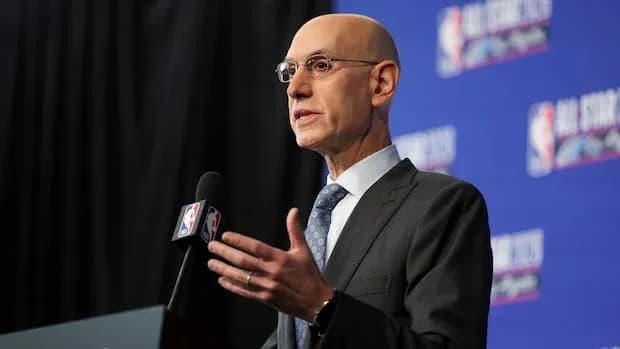
NBA Commissioner Adam Silver Addresses Clippers Punishment and Lakers Sale
NEW YORK — Adam Silver didn’t flinch.
The NBA commissioner sat in midtown Manhattan at the close of a two-day Board of Governors meeting and made it clear: the hammer the league dropped on the Los Angeles Clippers is not up for appeal, not up for debate, and very much designed to scare off anyone else thinking about playing loose with the rules.
The punishment is one of the harshest in league history. Five first-round draft picks stripped. A $30 million fine. Owner Steve Ballmer banned from all league and team activities for a year. All of it tied to what the NBA determined was the franchise “knowingly seeking to help” Kawhi Leonard secure off-court income opportunities that violated salary-cap rules.
Two Clippers executives also received suspensions, and Leonard was fined $700,000 for his role in the scheme. None of them were in the room in New York. Ballmer has already apologized to fans and publicly accepted the penalties, saying he will not contest the league’s findings.
Silver acknowledged the weight of the decision but insisted the league had no choice.
He spoke about “competitive consequences” and the need to protect the integrity of the cap system, while conceding that fans inevitably get caught in the crossfire.
“We still want to be a 30-team league, and we recognize that, in some ways, we're unfortunately punishing the fans of that team as well. And so that's the balance we're trying to seek,” Silver said. “The ultimate goal, in terms of these type of sanctions, are to ensure that other teams don't have to engage in this type of behavior, in the future, so there has to be something beyond suspensions and financial consequences, and that has to be to regulate competition.”
The message was blunt: if you cheat the system, you risk your future.
Clippers pay on and off the floor
The sanctions land in the middle of a major roster reset.
On June 30, Los Angeles completed a trade that sent Leonard back to the Toronto Raptors, the franchise he led to the 2019 NBA title. In return, the Clippers received forward Brandon Ingram, guard Gradey Dick, two unprotected first-round picks, a first-round pick swap, and two second-rounders.
The deal had been frozen at the Clippers’ own request while the league wrapped up its investigation. Once the findings were in and the penalties levied, the trade finally went through.
So the Clippers emerge from the summer without their star, without a stack of future first-rounders, and without their ultra-visible owner for a year. Silver, though, pushed back on the idea that the franchise has been irreparably damaged.
He framed the sanctions as a necessary line in the sand, not a death sentence.
Lakers sale turns messy
While one Los Angeles team absorbed punishment, the other remains stuck in a power struggle.
Silver also addressed the escalating situation around the sale of the Los Angeles Lakers. Current owner Mark Walter — co-owner of the Los Angeles Dodgers and CEO of TWG Global — has agreed to sell the team for a record $12.5 billion to businessman Josh Kushner and former Disney CEO Bob Iger.
That headline number alone would reset franchise valuations across the league. But the deal is far from clean.
Lakers controlling owner Jeanie Buss is challenging the sale. She argues that her five siblings do not have the authority to sell the family’s remaining 17.8% stake. Because she holds more than 15% herself, Buss remains the team’s governor and insists that control stays with her.
The backdrop complicating everything: Walter is under scrutiny from federal prosecutors for potential financial improprieties at two insurance companies he controlled. Silver said the league did not uncover any issues when Walter originally bought into the Lakers in October 2025 and stressed that the current legal questions remain just that — questions.
“Even to this day, as you know, these are allegations,” Silver said. “There are issues that are now being looked into, but independent of Mark Walter choosing to sell this team right now, he was not being investigated by our league.”
The NBA now has to navigate a record-setting sale, a family dispute, and an owner under federal investigation — all while maintaining that its own vetting process holds up.
Expansion on the horizon, pressure in Portland
Beyond discipline and ownership drama, Silver also addressed the league’s long-running expansion drumbeat.
Las Vegas and Seattle remain at the front of the line. The commissioner confirmed that the next round of bids from potential ownership groups is due soon, and he sounded genuinely energized about the possibilities in both markets.
In Vegas, the discussion centers on whether a renovated T-Mobile Arena can be elevated to NBA standards or whether the city should go all-in on a new, state-of-the-art building.
“I think that there is real excitement around either, you know, a renovated T-Mobile Arena,” Silver said. “I think it still needs some significant improvements, but at the same time, there are groups who have presented plans to go, what I would call, you know, a modern entertainment palace in Las Vegas, and it's a unique market.”
Seattle, still scarred from the loss of the SuperSonics, waits with familiar anticipation. The league has no formal timetable, and Silver reminded everyone that no expansion team has been added since the Charlotte Bobcats joined in 2004. That franchise eventually reclaimed the Hornets name a decade later, bringing the league to its current total of 30 teams.
While Vegas and Seattle circle, Portland sits in a more precarious spot.
The Trail Blazers’ future in the city hinges on solving a very different problem: their arena. The Moda Center, opened in 1995, now ranks among the league’s least favored venues. Owner Thomas Dundon remains locked in a drawn-out fight over plans for a new building.
Silver didn’t mince words. The Blazers, he said, need a new arena. He also stressed that the league is not discussing relocation — and that if it ever came to that, it would represent a failure.
“It is important, at the same time, that Tom Dundon reaches a deal with the city officials and the state elected officials that makes operating important and viable for the long term. So that's what we're focused on.”
No deadline. No ultimatum. But the clock is ticking all the same.
As the Knicks prepare to open the league’s 81st season on Oct. 20 by defending their championship against the Philadelphia 76ers, the NBA steps into a year defined not just by what happens on the floor, but by who owns, where they play, and how far Silver is willing to go to keep everyone inside the lines.