Percy Fender’s 35-Minute Century: Cricket's Unmatched Record
More than a century has passed since Percy Fender walked out at Northampton and tore into Northamptonshire’s bowling. The world has changed. Cricket has changed. Scoreboards now flash up strike-rates and wagon wheels in real time. Yet one number refuses to move: 35 minutes.
On 26 August 1920, four days after his 28th birthday, Fender produced an innings that still sits in the game’s record books as the fastest authentic first-class century by time at the crease. Others have come quicker on paper. None have survived the scrutiny of how they were made.
A county match turns into carnage
The setting was unremarkable enough: Surrey against Northamptonshire in the County Championship at Northampton. The match began in traditional fashion. Northamptonshire put up 306 in their first innings, anchored by Fanny Walden’s 128. Fender’s role at that stage was with the ball, where he chipped in with three wickets.
Surrey’s reply started solidly, then wobbled. Andy Sandham, so often the bedrock, fell for 92 and the visitors slumped to 160 for four. Northamptonshire had a foothold. The game looked set for the familiar grind of a three-day county fixture.
Andy Ducat and Alan Peach had other ideas. The pair ripped the script to shreds, adding 288 in just 135 minutes. Ducat’s 149 shifted the pressure, but when he finally departed, the innings still needed a finishing touch. That was Fender’s cue.
What followed was mayhem.
Nineteen minutes to fifty, thirty-five to history
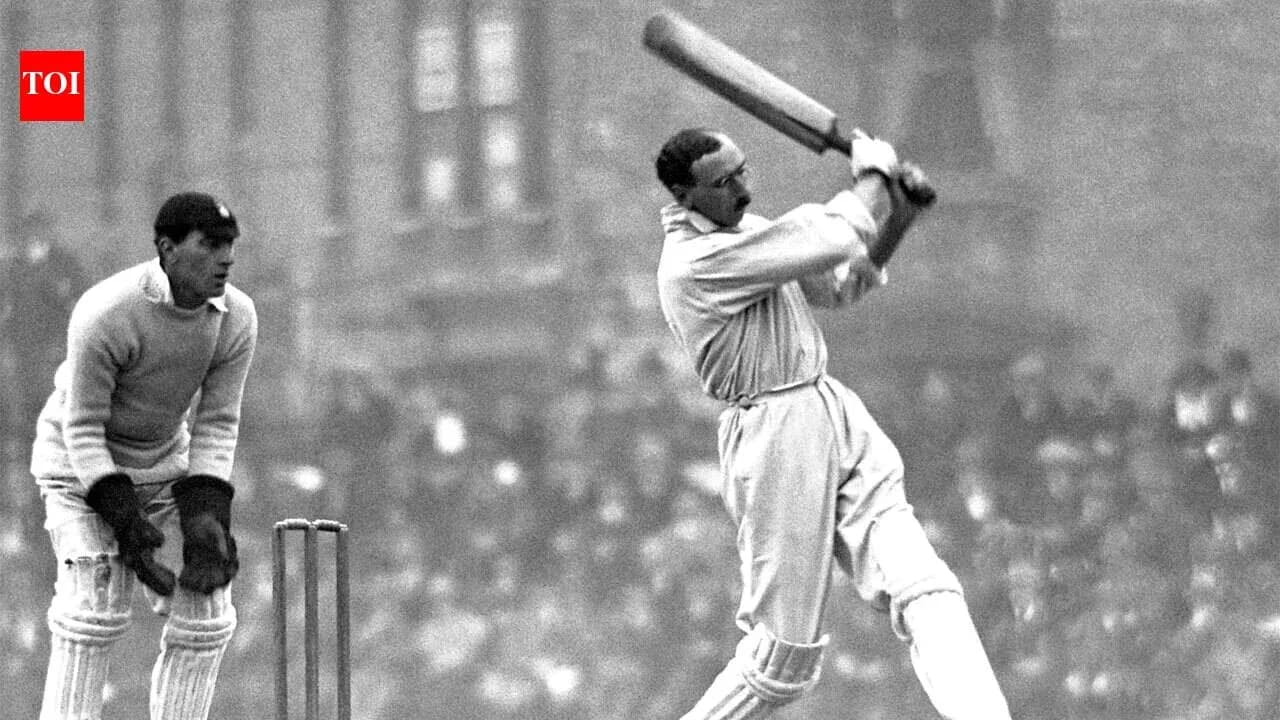
Fender strode in and attacked from virtually his first swing. He drove long and hard, carved through point, pulled anything short, and threw in the slashing strokes that became his trademark. Northamptonshire’s bowlers searched for control and found only the boundary rope.
He raced to fifty in 19 minutes. Nineteen. In an era of uncovered pitches and orthodox fields, that alone was staggering. Gilbert Jessop’s famed 40-minute hundred against Yorkshire at Harrogate in 1897 had long been the touchstone for rapid scoring in first-class cricket. Fender was about to leave Jessop behind.
The assault did not relent. Fielders scattered, bowlers rotated, the clock kept ticking. Fender reached three figures in 35 minutes, slicing five minutes off Jessop’s record and etching his name into cricket folklore.
Boundaries, and little else
The milestone did not slow him. Fender continued to hit as if chasing a storm, finishing unbeaten on 113 in just 42 minutes at the crease. The raw numbers still jolt the modern eye: 16 fours, five sixes. Ninety-four of his 113 runs came in boundaries, more than 83 per cent of his total.
At the other end, Peach quietly compiled a monumental double-century. Surrey declared when Peach reached 203 not out, leaving the sixth-wicket partnership at 171 runs in only 42 minutes. It was a blur of scoring that would look outrageous even in today’s T20 leagues.
Crucially, the record Fender set that day is not about balls faced. No one was counting in that way. The measure was time: the simple, unforgiving tick of the watch from the moment he arrived at the crease to the moment he reached his hundred. That distinction still matters.
The day someone “matched” Fender – and why it didn’t stick
For 63 years, no one touched Fender’s 35-minute mark. Then, in 1983, the name Steve O’Shaughnessy suddenly appeared alongside his in the record columns.
The Lancashire all-rounder blasted a century in 35 minutes against Leicestershire, and at first glance it looked like history had been equalled. The story behind it tells you why the statisticians and historians drew a firm line.
The match had been battered by bad weather, with play starting late and time leaking away. By the final day, both sides needed to force a result. Once Leicestershire declared, O’Shaughnessy and Graeme Fowler walked out to face an attack that included David Gower and James Whitaker, but not in the roles you would expect.
What followed was described at the time as farcical. Gower and Whitaker turned their arms over with a diet of full tosses and long hops. A short boundary beckoned. Fielders stood back. Fowler cashed in, hammering 100 with 10 sixes. O’Shaughnessy joined the fun, racing to his own hundred in 35 minutes.
The scoring was spectacular. The intent was transparent. This was manufactured cricket, a contrivance designed to set up a finish, not a genuine contest between bat and ball. The runs counted in the match. The “record” did not.
Quicker on the clock, slower in credibility
O’Shaughnessy was only the start. The county game’s habit of stage-managing declarations and contrived chases produced a clutch of even faster hundreds by time.
Glen Chapple smashed a century in 21 minutes for Lancashire against Glamorgan in 1993. Mark Pettini rattled up one in 24 minutes for Essex against Leicestershire in 2006. Michael Goodwin and Tom Moody joined the list with whirlwind efforts in 25 and 26 minutes respectively.
On paper, they obliterate Fender’s 35-minute benchmark. On the field, they were products of a very particular culture. With three-day matches often strangled by rain or slow over-rates, captains resorted to extreme tactics to engineer a result: part-time bowlers lobbing hittable deliveries, ring fields abandoned, boundaries invited.
The scorebooks recorded the numbers. The game’s collective memory applied its own filter. Performances built on deliberately friendly bowling and pre-arranged acceleration have been placed in a separate category – entertaining, useful to the match situation, but not legitimate yardsticks for all-time records.
That separation is what leaves Fender alone at the top.
What “fastest” really means
There is another layer to the debate. Talk about the “fastest century” today and most fans think in terms of balls faced, not minutes spent at the crease.
Measured that way, the first-class record belongs to David Hookes, who blasted 102 from just 34 balls for South Australia against Victoria in 1982. In Test cricket, Brendon McCullum set the standard in Christchurch in 2016, reaching his hundred from 54 balls against Australia in a furious farewell statement.
Those feats sit in their own category: pure ball-by-ball destruction.
Fender’s record comes from a different age and a different metric. No one timed his backlift or tracked his strike-rate. They looked at their watches. From his first step onto the field to his hundredth run, 35 minutes elapsed under what are still recognised as genuine first-class conditions, with the opposition trying, and failing, to stop him.
More than 100 years on, no authentic innings by time has gone past him. The game has added formats, floodlights and franchise leagues, but that old County Championship afternoon at Northampton still holds its ground.
Until someone can marry Fender’s pace with an uncontrived contest, the 35-minute hundred of 1920 remains what it has long been: the gold standard.