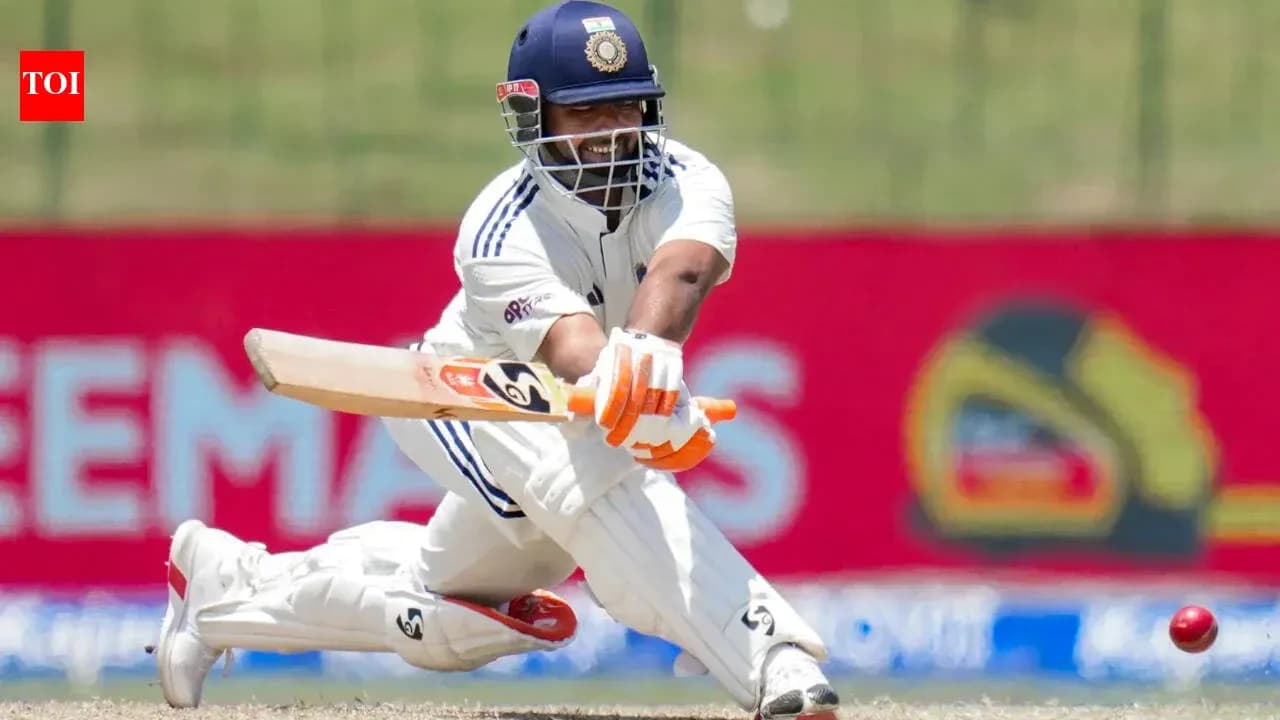
Ravichandran Ashwin's Tough Love for Rishabh Pant
Ravichandran Ashwin has never been one for soft cushions or easy excuses. Not for himself, and certainly not for those he believes can give India more.
So when he looked at Rishabh Pant’s latest Test returns – 168 runs, two half-centuries in a two-match series against Sri Lanka – he didn’t see a reassuring set of numbers. He saw a gap. Between talent and responsibility. Between what Pant is, and what Ashwin believes he must become.
On his show ‘Ash Ki Baat’, the former off-spinner cut through the noise around India’s wicketkeeper-batter with a blunt assessment: the time for indulgence is over.
Numbers on the board, questions in the air
Pant’s series against Sri Lanka was, on paper, solid enough. Runs, impact, momentum shifts – the usual markers that keep a player’s place safe. But Ashwin refused to be seduced by the scorecard.
“My expectation from Rishabh Pant hasn't been fulfilled till now. I am very sorry,” he said, making it clear that the critique was not about averages or aggregates. It was about judgement.
The concern is not new. Pant’s high-octane style has been dissected for years, celebrated when it comes off, questioned when it doesn’t. The debate flared again as Ashwin revisited one particular dismissal: Guwahati, last year, against South Africa. Pant, captaining India in Shubman Gill’s absence, charged down at Marco Jansen and edged to the keeper.
A risk, yes. But for Ashwin, it was more than that. It was a symbol of a larger problem.
When “that’s how Rishabh plays” becomes a shield for poor decisions, Ashwin argued, the team pays the price.
No free passes for “once-in-a-generation” tags
The host on the show pushed a familiar line: Pant is unique, a match-winner, a player who has already shaped famous victories. Shouldn’t such a player be allowed to play on instinct?
Ashwin’s response was sharp.
He acknowledged those landmark knocks in Sydney and Brisbane, but refused to let them become a permanent exemption from scrutiny. “Rishabh played a class knock in Sydney and Brisbane, but you couldn't have won that match without Washington Sundar and Shardul Thakur,” he reminded. Test wins, he stressed, are collective constructions.
“It takes 11 cricketers to build a Test and win it in the last session of the game, but it takes only 1 moment of foolishness to lose a Test,” Ashwin said.
The target of his frustration was not aggression itself. It was timing. Game awareness. Reading the moment and adjusting, even if it means shelving the ego for an hour.
“I am just talking about the times when these chances are being taken when the game is on the line. I love Rishabh the player. It is about playing situations in this format,” he said.
To drive the point home, Ashwin reached for two of the most explosive names in modern cricket history: Virender Sehwag and Adam Gilchrist. Both attacked, both changed the tempo of Tests. But, Ashwin argued, “these two don't get edged out while dancing down to Marco Jansen when your team is trailing by 500 runs.”
That, for him, is the line. Not between attacking and defensive cricket, but between bravery and recklessness.
“Don't place these marketing lines in front of me ever again,” he snapped, dismissing the “once-in-a-generation” label as a convenient slogan that can cloud honest evaluation.
A 50-Test player, not a kid learning the game
Pant is no longer the raw, wide-eyed youngster thrown into a cauldron. He has played 50 Tests. He has toured, failed, succeeded, and returned. He has the scars and the stories.
Ashwin believes that experience must now translate into accountability.
“Don't give one player special treatment. This once-in-a-generation player backing, then give it to everyone. Jaiswal is also such a player,” he said, making it clear that special talent is not a Pant-only currency in this Indian setup.
“All I'm saying, Rishabh, is that he is experienced; he has played 50 Tests. He needs to take responsibility. Don't come up with this ‘once-in-a-generation’ argument.”
The criticism cut deeper because it came attached to a stark reminder: Pant is currently a Test-only cricketer for India. His decision-making, Ashwin said, is a key reason he has slipped out of favour in ODIs and T20Is.
“It is because of his decision-making that he's not playing the other two formats. The day you tell him the truth, he will be an all-format player for India,” Ashwin declared.
That line hung in the air. Less a rebuke, more a challenge.
A crossroads for Pant – and for India
Pant remains central to India’s Test plans. His ability to turn sessions, to rip up a bowling plan in an hour, still makes him invaluable in red-ball cricket. But Ashwin’s words frame the next phase of his career in stark terms.
This is no longer about whether Rishabh Pant can thrill. Everyone knows he can. The question, laid out by one of India’s sharpest cricketing minds, is whether he can consistently choose the right moment to attack, the right moment to rein himself in, and the right way to serve the game situation rather than his own instincts.
If he gets that balance right, Ashwin is convinced, India don’t just regain a white-ball option. They regain an all-format force.
For Pant, the message could not be clearer: the shots are already in the locker. The next leap is in the mind.