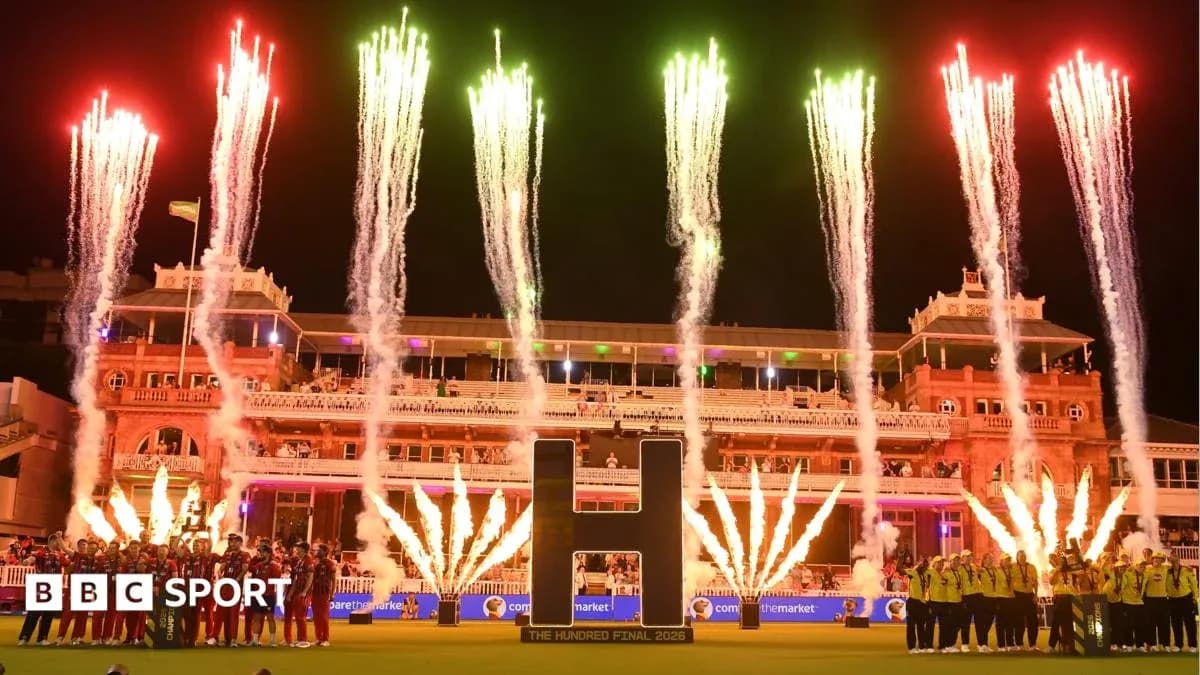
Richard Thompson on The Hundred's Impact on England's Cricket Calendar
Richard Thompson is under no illusions about the chaos The Hundred has injected into England’s cricket calendar. He just thinks it is worth it.
The England and Wales Cricket Board chair has watched the domestic schedule buckle under the strain of another competition, seen a Test squeezed in two days after a Hundred final, and heard players call the turnaround “crazy scheduling”. He accepts all of it – as the necessary cost of reshaping the game’s finances.
‘A price worth paying’
“The sacrifices have got to be made,” Thompson told Sky Sports, as he doubled down on the ECB’s backing of The Hundred.
“If we can take all of the debt out of the game, which we have, make a generation [of counties] which can reinvent themselves, that is a price worth paying.”
The numbers explain his conviction. More than £500m was raised when stakes in the eight Hundred franchises were sold last year, a windfall spread across the professional and domestic structure. For some counties, it has meant clearing historic debts. For others, long-delayed investment in grounds and facilities.
The trade-off sits in plain sight every July and August. A dedicated window has been carved out for The Hundred, stripping away international cricket so England’s best can line up for their franchises. The ECB has given up the power to pull those players out early to prepare for Test duty. When the final ends, the next ball they face might be in a different format, in a different arena, for their country.
That is how England ended up playing a Test against Pakistan at Headingley just two days after the Hundred final this summer.
“We were criticised that The Hundred finished and two days later we were playing a Test match at Headingley,” Thompson said. “Imagine if that becomes one day – that can’t happen.”
The warning is clear. The window is fixed. The number of days The Hundred occupies will not grow, Thompson insists, but the squeeze around it is already brutal.
A calendar at breaking point
The Hundred did not arrive in a vacuum. It landed on top of a domestic structure already carrying the County Championship, the T20 Blast and the One-Day Cup. Something had to give.
The One-Day Cup has slipped down the ladder, often resembling a second-team competition as top players disappear into The Hundred. The Championship fights for space around white-ball windows. Coaches and administrators talk of “jigsaw” scheduling; Thompson reaches for a blunter image.
“We are having to crowbar so much cricket in,” he said.
Yet the ECB chair sees England in a small, powerful club. Only four boards, he points out – England, South Africa, India and Australia – have carved out dedicated franchise windows that, in his words, can “pretty much guarantee the financial success of their game”.
In that context, the discomfort is framed as strategic. A short, intense block of domestic franchise cricket, international stars available, broadcast slots locked in, investors satisfied, debts reduced. The cricket may creak around it, but the financial foundations harden.
The question is how much more the players and the schedule can absorb.
Standards under scrutiny
Thompson’s week has not been dominated solely by spreadsheets and scheduling. He has also had to address fresh scrutiny of the England men’s team off the field.
The conduct of players has come under the microscope again after bowler Brydon Carse was left out of England’s side for the second Test against Pakistan. Carse was briefly arrested on suspicion of being drunk and disorderly while on duty with Durham, before being de-arrested. Investigations by both the police and the Cricket Regulator are ongoing, with images circulating on social media showing him in handcuffs and surrounded by officers.
For Thompson, the episode cuts deep.
He described the continued questions around the professionalism of the men’s side as “enormously” disappointing and moved quickly to restate what he believes the shirt should represent.
“When you play for your country you are judged by far higher standards,” he said. “What comes with wearing those three lions comes with respect, responsibility and pride.
“Unless you live and breathe those qualities there is a problem. Every player has to understand the responsibility that comes with playing for England.”
The ECB chair is trying to pull English cricket in two directions at once: towards a leaner, more secure financial future, and back towards traditional values of conduct and pride in the badge. The Hundred sits at the heart of both battles – the tournament that pays the bills, and the competition that demands England’s stars stay on the field and in the spotlight.
The money is in. The window is locked. The standards, Thompson insists, cannot slip.