Sanju Samson and Sooryavanshi: A Respectful Rivalry in Indian Cricket
The story began with an injury and a punt.
Rajasthan Royals lost their captain deep into IPL 2025. In walked a 14-year-old opener, Sooryavanshi, thrown into the glare of top-flight cricket long before convention would have allowed it. He didn’t just survive. He detonated the stage.
A century in his third game. A teenager dictating tempo to seasoned professionals. By the time Sanju Samson returned from injury, the decision almost made itself. The kid stayed at the top. The captain slid to No. 3.
From there, the dynamic shifted. Mentor and protege, yes. But also, inevitably, rivals.
From RR’s Dressing Room to India’s Top Order
The following season, India fast-tracked Sooryavanshi into the T20I setup. The same role, the same slot, the same conversation: who opens?
In India colours, Samson and Sooryavanshi suddenly stood on opposite sides of the same door.
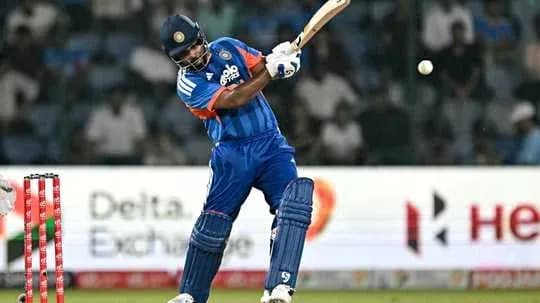
At the Arun Jaitley Stadium against Afghanistan, that door opened for Samson. The teenager watched from the dugout again, benched for the second game in a row despite walking into the series as Player of the Series from Zimbabwe.
Samson knew the stakes. He had failed in the series opener. This time, he tore into Afghanistan with a 22-ball 57, batting with the urgency of a man who understands how quickly the landscape can change.
He didn’t just protect his place. He reignited the debate.
Yet when he spoke after India sealed the T20I series 2-0 with a game to spare, there was no edge in his voice.
“We may be competitors to the outside world, but we are a team and we are playing for a country and we want to win the game first,” he said. No theatrics, no coded barbs. Just a clear line in the sand.
Living With the Musical Chairs
Samson has lived this life long enough to know how ruthless it can be.
“We just have to be ready for our own opportunity. We can't sulk that ‘oh, I didn't get [the chance] or why did they give it to him’. Those kind of mindsets don't work here.”
He understands the other side too. The one the public rarely sees.
“It is a very challenging place to be in. For the whole team management and everyone, from the captain, from the coach, from the selectors, it is a very tough choice. I totally understand, myself [having] led an IPL franchise. I know how hard these decisions are when everyone has been performing really well.”
This is not the language of a man looking for excuses. It’s the perspective of someone who has sat in selection meetings and felt the weight of the names on the whiteboard.
From World Cup Highs to Franchise Whiplash
Earlier this year, Samson stood at the summit of the format. Player of the Tournament at a home T20 World Cup. Benched to start, he forced his way into the XI and then into the narrative of the tournament: 97* off 50 in the semifinal, 89 in the final, and India became the first side to defend their T20 crown.
He had his defining stretch. His signature on a global trophy.
Then the season turned. While Sooryavanshi shredded attacks with a scarcely believable 776-run IPL campaign at 48.5 and a strike-rate of 237.3, Samson’s year with Chennai Super Kings swung wildly between feast and famine. One rode a wave. The other wrestled with inconsistency.
The inevitable followed.
Samson failed in three games in a row: twice in Ireland as India lost the series 0-2, and again in the first T20I in England. Suddenly, the Sooryavanshi question was no longer a whisper. It was the only question.
The teenager got three games, a harsh introduction against high-quality opposition, before Samson returned for the final match of a series India lost 0-4. Then came another turn: Samson rested for the Zimbabwe tour, Sooryavanshi unleashed. Player of the Series. Another statement. Another nudge in this quiet, compelling race.
By the time the teams reached Delhi for the Afghanistan series, the selection debate had become public property. Every XI was a referendum.
Turning Off the Wi-Fi, Not the Fire
Samson’s response to all the noise is disarmingly simple.
“I try to turn off the Wi-Fi,” he said, drawing laughter in the room.
The line was light, but the sentiment behind it was not.
“At first, it feels bad. I am not a machine. We are not robots that it wouldn’t affect us at all. It definitely matters, and you kind of get a bit affected,” he admitted.
This is the reality of modern Indian cricket: every failure is magnified, every omission dissected. A missed lofted shot becomes a talking point. A single series becomes a verdict.
Maturity has taught Samson not to fight the chaos, but to live with it. He has embraced the volatility that comes with being a high-risk T20 opener. He knows his method will not always produce neat scorecards.
So he has shifted his definition of consistency.
“I think consistency in my process. I think consistency in my preparation, consistency in how I am practicing, how I am putting my hard yards in. That's where I try to focus on. You can't control the consistency in the result in this format… Consistency has to be in the frame of mind, and then whatever happens, happens. I think that's what fearless mindset is.”
The runs may fluctuate. The mindset cannot.
Two Openers, One Slot, Shared Space
Samson’s acceptance of the contest, and his refusal to see it as a zero-sum game, is what keeps this rivalry from curdling.
“You see, a 15-year-old boy has scored 700-800 runs. My Man of the Tournament award [at the 2026 World Cup] was before that. After that he’s performed so well. He had to come in [to the Indian set-up] sooner than later. I didn't perform in 2-3 games and he was in-form and we wanted to win games in that [England] series.”
There is no bitterness in that assessment. Just logic.
He also pulled back the curtain on the conversations that shape these calls.
“There was a lot of communication in the middle of the England series. He spoke to me a lot before this series as well… It’s very easy to take very popular decisions. But, as a leadership group, we have been taking some really tough calls keeping the team at the front. That’s where we have to give the credit to the leadership group of our team.”
It’s a rare admission from a current player: popular decisions are not always the right ones. Dropping a World Cup Player of the Tournament for a teenager on a hot streak is not easy. Doing it twice is even harder.
Yet Samson seems at peace with that churn. He has chosen a simple lens: Sooryavanshi’s rise does not automatically mean his fall. His failure does not need to be the only door through which the teenager walks.
On Tuesday in Delhi, Samson made his case again with the bat. The crowd saw the swagger, the clean hitting, the urgency. The selectors saw a man who refuses to step aside quietly.
The next toss, though, might still bring Sooryavanshi’s name to the top of the team sheet.
That is the reality both men live with now. One slot. Two compelling stories. And a leadership group that has shown it is not afraid to pick the harder road if it believes that’s the one that leads to wins.