Varun Aaron's Journey from Fast Bowler to Cricket Coach
Daniel Vettori’s phone call found Varun Aaron in a very different life.
Aaron had walked away from professional cricket earlier in 2025, 35 years old, content with the headset and the commentary box. Coaching wasn’t a project, let alone a plan. It was something he slipped into without naming it – a tip here for a Jharkhand teammate, a tweak there for a friend’s run-up, long chats about wrist position and follow-through. Years of injuries had already turned him into his own personal bowling coach.
“I think I've coached myself quite a bit because of the amount of injuries I've had,” he says. The breaks, the scans, the rehab – they forced him to understand his body, his action, his limits. That knowledge, he discovered, was useful to others. And he liked the feeling of making a difference.
So even before a job title arrived, the work had started. The new MRF Pace Foundation High Performance Center was effectively his blueprint come to life. Aaron helped design and execute the facility, the protocols, the programme, even the redevelopment of the ground and gym – a very literal way of giving back to the academy where he had spent so many formative years. He then moved into a formal role with the Jharkhand State Cricket Association as a bowling consultant.
But there was no grand career map. No five-year plan.
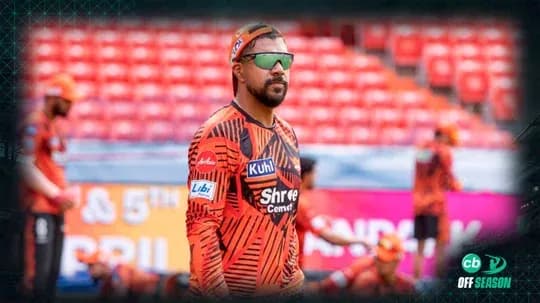
“After retiring, I really was not setting out any targets. I was not thinking, 'I want to coach, I want to commentate.' After having a journey which was hampered by injuries throughout, all I wanted to do was enjoy myself after retiring, and whatever came about after that just happened on its own. And then one day, Dan rang me up and asked me if I was interested to coach Sunrisers."
That call changed everything.
Building a bowling unit from scratch
In his first season with Sunrisers, Aaron’s brief was clear and demanding: help assemble a bowling group and get young quicks ready for the IPL. Not just to fill nets. To compete.
He had a voice in the auction room. He used it. Two names in particular stood out for him: Praful Hinge and Sakib Hussain.
“What I saw was not what they were doing, but what they could do,” Aaron says. He wasn’t seduced by current numbers; he was chasing ceilings. “I had a feeling that we could achieve what I could envision they could do, which they weren't doing. I'm glad it just worked out."
It worked out quickly.
Hinge and Sakib exploded onto the scene against Rajasthan Royals, each taking four-wicket hauls in their first IPL game. That kind of debut doesn’t happen by accident. By then, Aaron had already put in hours with them – hours that had to be squeezed into a schedule most coaches wouldn’t recognise.
Because while he was shaping Sunrisers’ next crop of quicks, he was also on T20 World Cup broadcasting duty. Some days he’d bring Sakib to Mumbai, rush to the studio in the morning, then coach in the evening. Other days, the order flipped. As the World Cup schedule tightened and travel spiked, Aaron made a call: he sent Hinge and Sakib to Rao Cricket Academy.
The decision was based on trust.
"Me and SS Rao have a brotherly relationship,” Aaron says. “He was captain when I played for Jharkhand and I wanted them to go to somebody who I trust, and basically if I tell that person what has to be done, he does exactly that and nothing different. So I sent them there with a set of instructions that they have to do this, this, this, and he absolutely abided by it. Obviously, him being so experienced, his presence and his energy did so much good to them, also his coaching.”
Hinge and Sakib may have grabbed the headlines, but they weren’t the only ones who caught Aaron’s eye.
"I think Shivang [Kumar] was unbelievable as well. And then you had Onkar [Tarmale] who hadn't played. He just got injured at the right time, so people didn't see him, but he's somebody who can move 145. We had some really good, interesting picks."
The pattern is obvious: he targets potential, not polish.
Freedom to create
Coaches often talk about “alignment” with management. Aaron goes further. He talks about being empowered.
"When you're empowered by the head coach and the team owner in that fashion, I really feel your job becomes all that much easier,” he says. “I think I was really lucky to be a part of a brilliant team, because it's not very common that in your first year you get an almost free hand to do what you want to. Through that, I just felt I could express myself creatively in whatever I did and it was a lot of fun."
That creative space matters when your subject is fast bowling – a craft that looks violent but, in Aaron’s mind, is rooted in clarity.
"Fast bowling is really simple, but I think as a player you complicate it a lot,” he explains. “You try different things. But at the end of the day, it just boils down to a few very basic principles. If you can simplify it or if you have somebody who can simplify it, then it just makes your journey a whole lot more enjoyable and easy."
Simple doesn’t mean one-size-fits-all. His philosophy is the opposite.
"There's no set method to coaching. It completely depends on the individual. I think every individual comes with certain skill sets. Number one, you've got to identify what's unique about the bowler. And amplify it. And if there are any shortcomings, you just have to make the bowler more efficient.
"Some bowlers just present with a beautiful action and they're able to execute whatever they want. And some bowlers just have injury history, have different actions which don't make it easy for them. So, that's when you have to do some work. Everybody's different. Every bowler presents differently. And I feel that's where coaching has to head, where you see every bowler as an individual because everybody has different musculature, everybody's got different minds, everybody's got different coordination, everybody's got different biomechanics."
For Aaron, coaching is less about judgment and more about investigation.
"I genuinely think that you can't look at somebody's performance and be like, 'Oh, that was a bad performance' or 'that was a good performance'. As a coach, I really feel you've got to find the reason behind a bad performance or a good performance. If it's a good performance, you should make sure that the bowler remembers why he or she performed well. And if it's a bad performance, it's something to take away from. You can learn from it. But if you just meander along day after day, just bowl, go home, bowl, go home, then it doesn't really add up to anything."
Beyond the speed gun
In Indian cricket, Aaron’s own story is inseparable from the number on the speed gun.
His name burst into wider consciousness when he clocked 153 kph in the 2010/11 Vijay Hazare Trophy final, at a time when genuine pace in India was still a rarity. Young fast bowlers still come to him talking about speed first, everything else later.
He sees it differently.
"Fast bowling is all about timing,” he says. “When you're batting, you want to time your initial movement correctly so you're in a balanced position, your head is stable and you have time to access the ball. In bowling, your timing has to be spot-on before you release the ball. If you boil it down to one thing, if your timing and the sequencing of your action is right, I think you've won the battle. You will bowl as fast as you can, you won't be injured and you bowl the ball where you want to. And you can only bowl as fast as you can. You can't bowl faster than your body is going to allow."
Few are better placed to talk about that battle between ambition and anatomy.
After his Ranji Trophy debut in 2008/09, Aaron endured three stress fractures of the back. His Test career tells the same story in harsher numbers: a debut in 2011, then a gap of almost three years before his second Test in 2014 because of more back trouble. Every comeback required compromise, recalibration, and a fresh understanding of what his body could handle.
Now, as a coach, he is trying to help others manage that same tension.
Off the field, another balancing act plays out.
"How do I balance that? That's a question you have to ask my girlfriend because she's not the happiest customer - I'm hardly at home. But, yeah, I'm trying to give her and my family more time. It is quite hectic, but it is very enjoyable," he says.
Coaching the mind, sharpening the mic
Aaron’s dual life – part coach, part broadcaster – has created a feedback loop he didn’t anticipate.
"It gives me a lot more insight. Obviously, you know a lot of players from before, but when you coach them, you know the inner depths of their mind. It helps you be a lot more predictive in your commentary because you know what the player does when he's under pressure. You know what the player's go-to ball is. You know what the player's field set is when he bowls a particular delivery. So, from that angle, coaching definitely helps broadcasters because you have a lot more recency and first-hand information about players. And like coaching helps broadcasting, sometimes broadcasting also helps coaching because I'm almost seeing all these players throughout different competitions."
For someone who never set out to be a coach, the shift has been revealing.
"What it has taught me about myself is that coaching gives me immense happiness. There is no greater joy than talking to a bowler after a session and he has achieved every single thing he wanted to from that session."
The fast bowler who once chased 153 kph now chases something quieter but no less intense: the moment a young quick walks off a training ground knowing exactly why the ball finally came out right.