Zuffa Boxing: Dana White's Strategic Moves to Dominate the Boxing Landscape
Dana White hasn’t just walked into boxing. He’s walked in with a playbook.
Conor Benn and Jai Opetaia were rolled out as the shiny new faces of Zuffa Boxing. Big money, big push, big noise. But they are not the endgame. They’re leverage. They’re bait. They’re the opening moves in a much bigger campaign aimed squarely at two names: Ryan Garcia and David Benavidez.
Both are one fight away from free agency. Both are restless. And Zuffa has already started promoting them without technically owning them.
Ryan Garcia: One Foot Out the Golden Boy Door
The fracture between Ryan Garcia and Oscar De La Hoya isn’t new. It’s years deep. The lawsuits, the public sniping, the passive-aggressive social media posts — all symptoms of the same problem: Garcia doesn’t feel like Golden Boy treats him like the star he believes he is.
He got a glimpse of another world in April 2023.
That night against Gervonta “Tank” Davis, under the PBC and Showtime banner, changed him. The numbers told the story: 1.2 million pay-per-view buys, a $22.8 million gate, the kind of crossover event that swallows a whole sports weekend. Garcia walked through that promotion, saw the machine working at full power, and realized what he’d been missing.
He went home and sued Golden Boy.
He couldn’t get out then. The contract held. But time has done what lawyers couldn’t. He’s down to one fight left with Golden Boy, and the landscape around him looks very different now.
Zuffa and TKO dropped more than $30 million on Conor Benn across two fights. That wasn’t just a statement. It was an investment in access to Garcia. The Benn fight gave Garcia the same hit of big-time promotion he’d felt in the Tank build-up — major event, wall-to-wall coverage, the full superstar treatment. This time, it came with Dana White in the promoter’s chair.
Garcia has been open about how happy he is with Zuffa. He said it again on Monday, speaking to Uncrowned. The timing couldn’t be better for White. With Garcia’s Golden Boy deal running down, Zuffa has stepped in and shown him exactly what life could look like on the other side.
The Garcia-Benn show was technically a Ring Magazine-funded event. On paper, it wasn’t a Zuffa card. In reality? It looked and felt like a Zuffa production from start to finish. Paramount+ carried it. TKO and Zuffa branding framed it. White fronted it like a classic fight promoter. Garcia was presented to the public as if he already belonged to that world.
Oscar De La Hoya? Invisible. No presence in the build-up. No presence on fight night. No photo ops, no post-fight podium, nothing. That wasn’t an accident. It was strategy.
To the paying public, Garcia is now tied to Zuffa and Paramount+, not Golden Boy. The rebranding has started before the contract has even expired. Zuffa is selling him on what they can do for him, while simultaneously selling the audience on the idea that he’s already one of theirs.
Breaking Eddie Hearn’s Heart
Conor Benn’s role in this goes beyond Garcia.
Signing Benn was a direct shot at Eddie Hearn and Matchroom. A personal one. Benn, along with Katie Taylor and Anthony Joshua, was one of the fighters Hearn built from the ground up, one of the names he emotionally and publicly attached himself to. When Benn failed multiple drug tests for clomiphene, Hearn went to war for him. He fought for Benn’s reputation, fought for his right to fight, and fought regulators and critics for two years.
Those are the fighters you convince yourself will never walk away.
Benn walked. And he walked to Zuffa.
That move didn’t just hurt Hearn’s business. It cut into his identity as a promoter. It sent a message that no one is untouchable. If Benn can leave Matchroom, anyone can. Every fighter under every promoter just became a potential target.
Bob Arum once warned: “Don’t fall in love with your fighters because they will break your heart.” De La Hoya learned it. Arum lived it. Now Hearn has joined the club.
For Zuffa, Benn is a star in his own right in the UK. He helps deliver something else vital: a major television deal with Sky Sports and a serious foothold in the British market. But in the bigger game, he’s also a symbol — proof that Zuffa can walk into established boxing territory and walk out with one of its prized assets.
Opetaia, Benavidez and the Power Play at Cruiserweight
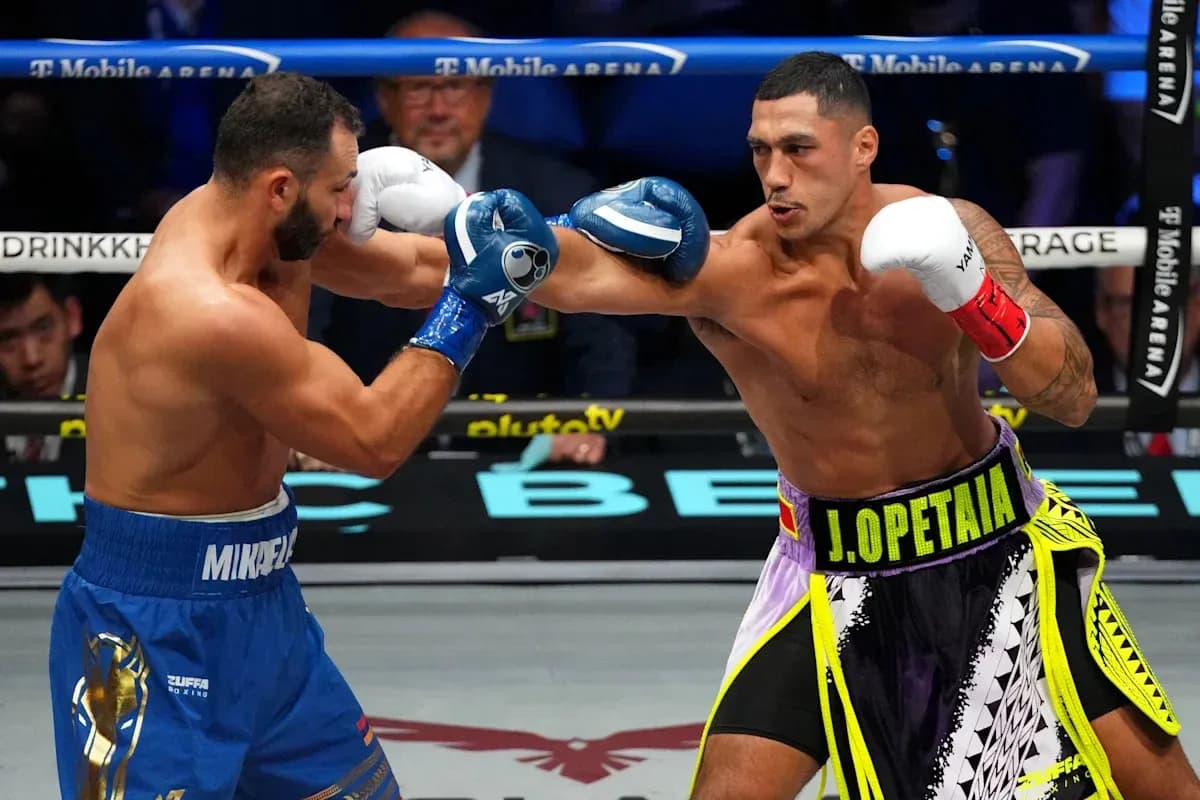
On the Garcia-Benn undercard, Jai Opetaia did exactly what Zuffa needed him to do.
He stopped Noel Mikaelian in nine rounds, then immediately called out David Benavidez. Benavidez, sat ringside, climbed into the ring for the face-off. That image wasn’t just a tease. It was a roadmap.
Benavidez has one fight left with PBC and Sampson Lewkowicz. Dana White hasn’t hidden his intentions. “The Mexican Monster” is on his list.
Benavidez’s career has been defined by near-misses with the biggest names. At 168 pounds, he was the most credible threat to Saul “Canelo” Alvarez yet never got the fight. He moved to 175, tried to land Dmitry Bivol or Artur Beterbiev, and again, those doors stayed closed. Now he’s at cruiserweight, staring at a chance to fight the consensus No. 1 in the division.
Opetaia offers him something he’s been chasing for years: a clear path to a defining legacy win and a genuine claim to being the best pound-for-pound fighter in the sport.
Benavidez has always behaved like a legacy fighter. He hunts the toughest opponents. He chases the fights people doubt he can win. If you offered him Oleksandr Usyk at heavyweight, you get the sense he’d say yes before you finished the sentence.
Zuffa knows this. So it has built a scenario he’ll find hard to ignore: Opetaia under their banner, a pile of money on the table, and a ready-made fight that crowns the true king at cruiserweight.
It goes deeper. Garcia and Benavidez have already talked about sharing a card next May. If Zuffa lands Garcia, it gains more than a star. It gains a magnet. Put both men on the same stage, give Benavidez a taste of that promotional machine, and one fight might be enough to show him what his career could look like outside the traditional boxing ecosystem.
The Garcia experiment is already the template.
Zuffa vs. the Sanctioning Bodies
Opetaia isn’t just a route to Benavidez. He’s a weapon in Zuffa’s long-running war with the sanctioning bodies.
White’s hostility toward boxing’s alphabet organizations has been a recurring theme. Recently, the noise around it has quietened as Zuffa has done more business with the WBC, WBA, IBF and WBO. The long-term aim, though, hasn’t shifted: challenge their power, question their authority, and reshape how titles work in the sport.
Opetaia’s story hands Zuffa a powerful case study.
He was stripped of his IBF cruiserweight title in March. On Saturday, he beat WBC champion Noel Mikaelian, only to see that belt declared vacant less than 48 hours later. In the eyes of most observers, Opetaia is the best cruiserweight on the planet. Yet he holds no major sanctioning body title.
To the public, that looks absurd. To Zuffa, it looks like ammunition.
Opetaia has already taken legal action, filing a lawsuit accusing the IBF of unlawfully stripping him of his title in retaliation for signing with Zuffa. He’s not just a victim of the system in Zuffa’s narrative. He’s the vehicle through which they can challenge it in court and in the court of public opinion.
Benn and Opetaia were huge signings. But they were also stepping stones. Benn got Zuffa into Garcia’s orbit and twisted the knife on Hearn. Opetaia opened a lane to Benavidez and gave Zuffa a living, breathing argument against the sanctioning bodies.
The Post-Canelo Chessboard
Ryan Garcia and David Benavidez are perfectly placed to become the two defining American stars of the post-Canelo era. Both are young enough, loud enough, and good enough. Both stand on the edge of free agency. Both have now had a taste of Zuffa’s world.
Zuffa hasn’t signed either man. Not yet. But Dana White has done something arguably more important at this stage: he has set the board.
The TV partners are in place. The UK foothold is established. The sanctioning bodies have been put on notice. The rivals — De La Hoya and Hearn — have been publicly wounded. The fighters Zuffa really wants have been brought into its orbit without a single official long-term deal.
TKO’s assault on boxing is still in its opening phase. The punches that matter most — Garcia’s signature, Benavidez’s signature — haven’t landed yet.
But the ring is closing in. And if those two finally step across the line, the balance of power in boxing won’t just shift. It will lurch.