Babar Azam's Struggles and Razaullah's Promising Debut
The lights were on before lunch at Edgbaston, and so was the sense of inevitability.
Forty-five minutes into the Test, Pakistan were three down, the ball jagging, the clouds hanging low and mean over Birmingham. Ollie Robinson bustled in with the keeper standing up and five slips fanned out like a picket fence. From the other end, Jofra Archer was only four overs into his work, loosening the shoulders, gathering pace. It was a grim time to be a batter.
So of course, it was Babar Azam’s turn.
A giant, diminished
Not long ago, mornings like this belonged to him. In 2022 he stood among the best in the world, and not as a polite inclusion either. He bullied Australia for 196 in Karachi, chiselled 119 against Sri Lanka in Galle, crafted 136 against England on that dead Rawalpindi strip, and then 161 against New Zealand back in Karachi. He ended that year averaging 49 in Tests, ranked third in the world, crowned ICC Men’s Cricketer of the Year.
That version of Babar feels distant now. Since then, no Test hundred. Across his last 20 matches, a top score of 88, an average of 29. The numbers read like a slow fade.
Still, for a moment, you could close your eyes and picture him dragging this broken team out of the storm again, as he once did almost by habit.
Then you opened them.
Robinson’s first ball drew a half-commitment, Babar yanking the bat inside the line at the last heartbeat. The next went past the outside edge. The third he clipped through square leg, a couple of runs that felt more like a stay of execution than a statement.
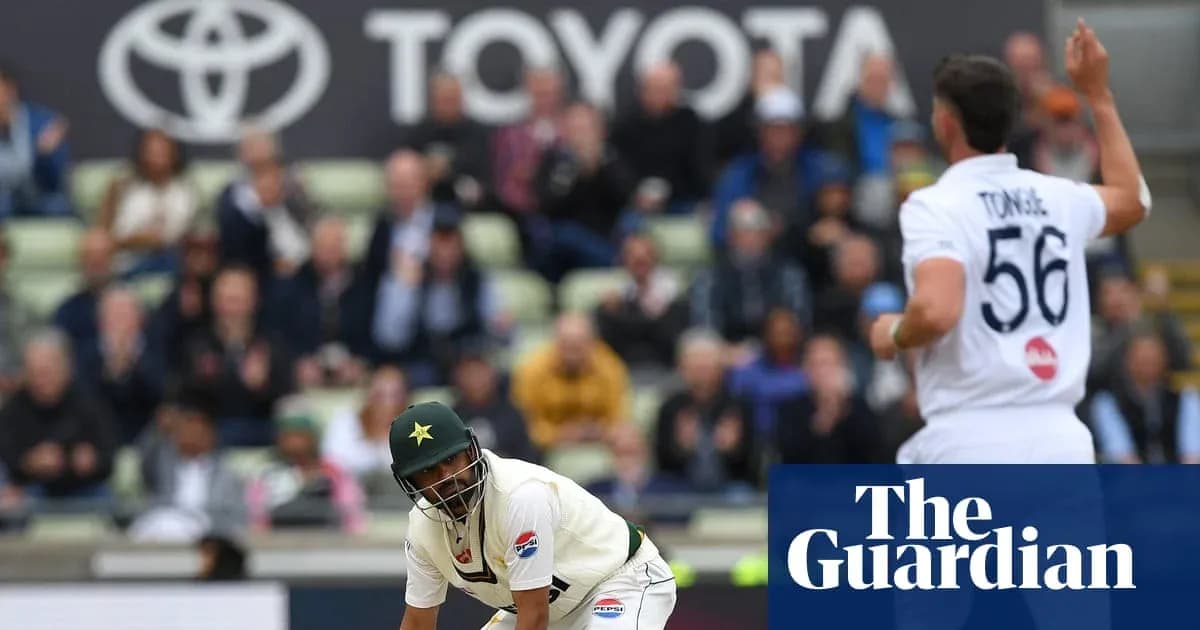
Archer tested him with a short ball; Babar flailed, missed. Gus Atkinson came on and beat him twice before an ugly edge leaked away for four. In the fourth over of his innings, Josh Tongue flattened his stumps. Seven runs. Eighteen balls. One more entry in a ledger that has started to look alarmingly ordinary.
Pakistan’s scores in the series tell their own story: 171, 135, 110, 194, now 133. One more collapse in the second innings here and they will become the first team since the 19th century to be bowled out for under 200 in every innings of a three-Test series in England. That isn’t a blip. It’s a system failure.
They look like a side hollowed out from the inside. Leading them feels less like a job and more like a sentence. Babar, notionally part of the selection panel, admitted he didn’t even know seven new players were being sent for this Test.
“It was news to me,” he said. “I found out after.”
For a national captain, those eight words are as damning as any scorecard.
A new name in an old story
One of those seven late arrivals changed the mood of the day, if not the direction of the series.
Razaullah. Twenty-one years old. A name that, until now, belonged mostly to domestic diehards and squad lists. He played his first major match only last November, debuting for Peshawar in the Quaid-e-Azam Trophy. Seven first-class games. Nine List A matches. Seven T20s. That’s the entire footprint of his professional life before he was flown in for this one Test.
He came on first change from the City End and within four balls had everyone sitting up.
The first three hurried Joe Root, forcing him into cramped, uneasy movements. The fourth screamed in, quicker, straighter, sharper. Root dropped the bat late in defence and missed. The ball thudded into the front pad, dead in front of middle.
Root, disoriented, called for a review. The replay only confirmed what the naked eye already knew. Plumb. LBW. Again.
Razaullah had his first international wicket. Edgbaston had its first real jolt of the day. For a few overs, the match stopped being about Pakistan’s disarray and became something else entirely: a reminder of what their cricket can still produce when the chaos briefly clears.
He bowled with pace, with snarl, with that unmistakable Pakistani fast-bowling flair. Later, he came back and knocked over Emilio Gay with a 90mph ball that took the inside edge and cannoned into the stumps. Brutal. Thrilling. Familiar.
The hair immaculate, the run-up smooth, the arm whippy and fast. It was all there: speed, audacity, vivacity. A new name, an old feeling.
Talent without a map
Pakistan never run out of fast bowlers. Even in the bleakest stretches, another one appears, charging in from some far-flung ground, armed with raw pace and a loose bag of tricks. The problem has never been the supply line.
The question is what happens next.
If your memory stretches back even a little, you’ll remember Naseem Shah and Shaheen Shah Afridi on their first tour of England in 2020, both of them tearing in, both of them looking like the next decade belonged to them. Now look at this series and ask why neither is here.
Ask what the system has done with all the fast-bowling riches it has unearthed over the last ten years. Ask how a batter as gifted as Babar could go from the heights of 2022 to the uncertainty of this morning, dragging his bat inside the line, eyes clouded with doubt.
Razaullah’s spell felt like a promise. It also felt like a warning.
Because you can already see the path stretching out in front of him: the bursts of brilliance, the adoration, the expectation, the confusion, the mismanagement. The cycle that has swallowed so many before him.
What lies ahead for him should be the most exciting question in Pakistani cricket.
The trouble is, deep down, everyone suspects they already know the answer.