India’s Spinners Dominate Bangladesh to Reach Sixth Women’s Asia Cup Final
In a tournament built on slow turners and suffocating spin, India did exactly what this side now does on autopilot. It strangled, it squeezed, and when the moment came, it slammed the door shut.
A 40‑run win over Bangladesh in Dubai sent Harmanpreet Kaur’s team into a sixth consecutive Women’s Asia Cup final, their 149 for six proving far beyond a chase that never truly left the runway. Bangladesh finished on 109 for eight, outplayed, out-thought and, at times, simply overwhelmed.
India will now face the winner of Pakistan vs Sri Lanka on September 11. Whoever comes through knows what awaits: 20 overs of hard labour against the most ruthless spin unit in the women’s game right now.
Shafali rides her luck, then makes Bangladesh pay
On a surface where timing had to be earned, Shafali Verma walked out and tried to bend the game to her will anyway. She survived three chances — on 6, 11 and 56 — as Bangladesh’s fielders turned routine catches into moments they will replay in their heads for weeks.
They paid for every miss.
After Smriti Mandhana fell early for 2, miscuing Sultana Khatun to Shorna Akter at mid-on with the score on nine, Shafali took control. She flicked Marufa Akter for her first four, then tore into Sultana’s second over, charging down the pitch to launch back‑to‑back sixes — one straight, one over mid-off — as India surged to 34 for one in the fourth.
The intent never dimmed. A thumping pull over mid-wicket, crisp drives, and the audacity of a reverse sweep behind point off Nahida Akter pushed the fielders back and the bowlers into survival mode. When she finally raised her 50 — her 20th in T20Is at just 22 — it felt inevitable, not explosive. This was a player dictating the tempo of a semifinal, not chasing it.
Her luck held deep into the innings. A mis-hit to deep mid-wicket was shelled again, then she added two more fours off Sultana Khatun. Only on 64 from 40 balls, looking for one big blow too many, did she finally hole out to deep mid-wicket. Bangladesh, at last, held a catch. The damage, by then, was baked into the scoreboard.
Shafali’s 64, with seven fours and three sixes, formed the spine of India’s 149. It was not a flawless innings. It didn’t need to be. It was brutal, relentless, and perfectly tuned to a pitch where 140 already felt like a mountain.
Middle order scrapes, then Deepti finishes with a late burst
Around Shafali, India’s middle order again looked scratchy, but this time it did just enough.
Pratika Rawal, promoted to No. 3 in Jemimah Rodrigues’ continued absence, flashed one glorious cover drive for four off Marufa and stepped down to Rabeya Khan to lift a six over mid-wicket. Yet she never quite broke free, and the innings lost some of its early rhythm once she departed later in the innings.
The real concern came with Harmanpreet. The captain walked in at 53 for one in the eighth over and promptly got stuck. Dot balls piled up, timing deserted her, and by the 13th over she sat on 2 off 10 deliveries. Even when she did find the middle, the ball kept finding fielders.
India’s scoring rate sagged. Boundaries dried up between the ninth and 11th overs as Bangladesh’s spinners tightened their lines and lengths. Rabeya, Fahima Khatun and Nahida Akter bowled to smart fields, forcing India to work in ones and twos. For a spell, the semifinal felt like it might drift Bangladesh’s way.
Shafali’s sustained aggression and those dropped catches kept India afloat. Once she fell, the innings threatened to stall again.
Then Richa Ghosh and Harman finally nudged it back to life. Richa, ever the disruptor, improvised a switch hit, then launched Shorna Akter over long-off for six. Harman, still fighting her timing, eventually broke the shackles with a straight six off Fahima. It wasn’t fluent, but it mattered.
In the 19th over, Nahida outfoxed Richa, drawing her down the track for a sharp stumping on 21 off 16 (two sixes). India sat on 137 for four with one over to go, needing a final push to turn a good total into a winning one.
Deepti Sharma provided it. Marufa started the 20th with a dot, then watched Deepti carve a four behind square, pick the slower ball early to clear long-on for six, and drive straight for two. A mistimed loft to mid-off ended her cameo on 13 from six balls, but the job was done. A last-ball run-out of Bharti Fulmali left India on 149 for six — not spectacular, but on this pitch, imposing.
Charani’s record, India’s stranglehold
If any team thought 149 was chaseable in Dubai, they had not been watching India’s spinners all tournament.
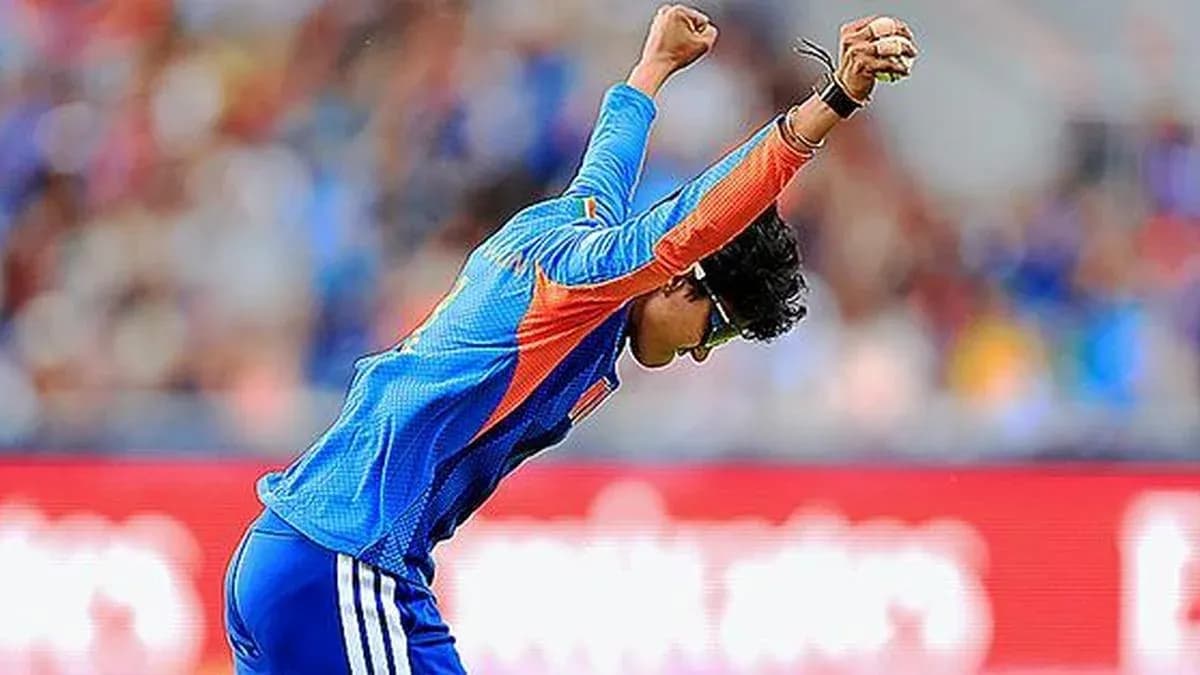
Kranti Gaud and Nandani Sharma took the new ball, but the real buzz came when N. Shree Charani was thrown the ball in the fourth over. One wicket away from 50 T20I wickets in the calendar year and level with Poonam Yadav’s Indian record of 35 in women’s T20Is, she walked in with an air of inevitability.
Her first over teased, her second over delivered. Juairiya Ferdous, who had earlier cracked Kranti for a four over mid-wicket, miscued a top edge off Charani. Richa Ghosh settled under it. Safe hands, landmark wicket.
Ferdous gone for 14 off 18. Charani into the history books with her 50th T20I wicket of the year and a wicket-maiden in a semifinal. The record she had been chasing for weeks finally belonged to her, shared with Poonam but no less significant.
From there, Bangladesh never truly threatened.
Dilara Akter tried to break free with a crisp four through cover off Deepti, but paid for her aggression the very next ball, holing out to Kranti at mid-wicket for 21 off 26. At 35 for two in the eighth over, with the required rate climbing past eight an over, the chase began to fray.
Deepti and Prema close the door
If Charani lit the fuse, Deepti and Prema Rawat applied the choke.
Deepti’s second over brought a flash of tension — a sweep from Nigar Sultana Joty for four, followed by a fiery throw back at the striker’s end and a few sharp words. Bangladesh’s captain tried to inject some fight, but the scoreboard kept dragging her team down.
Sobhana Mostary briefly offered resistance, using her feet and finding the gaps, but India’s spinners simply waited her out. Deepti returned, hit the top of off with a straight ball, and sent Sobhana back for 18 off 24. Bangladesh slipped to 73 for three after 14, going at exactly five an over while needing far more.
Prema then struck the hammer blow. Nigar, who had finally launched a massive six across the line, tried to go again and only managed a leading edge to short third. She fell for 19 off 17, and with her went Bangladesh’s last realistic hope of a late charge.
At 76 for four in the 15th, the chase became a formality.
Deepti wasn’t done. She cleaned up Sharmin Akhter for 1, finishing with another crucial strike as the innings slid further into trouble. Her control, her ability to attack the stumps, and her temperament in the middle overs underlined why she remains the heartbeat of India’s bowling unit.
Late hitting, late drama, no miracle
Shorna Akter tried to fight the inevitable. She clubbed Deepti over long-on for six, then took on Shafali with a clean hit down the ground. For a brief moment, the ball flew, the crowd stirred, and the scoreboard flickered with possibility.
It didn’t last.
India’s fielding, briefly shaken when Richa and Kranti collided going for a catch off Shorna, held its nerve. Both players got back to their feet, the scare passed, and the bowlers went back to their work.
By the time the final two overs arrived, Bangladesh needed a miracle. They got a few flourishes instead.
Fahima Khatun produced the shot of the night, a perfectly executed dilscoop for four off Nandani Sharma in the 20th over, then a cheeky reverse sweep earlier in the 19th. For a few deliveries, the contest felt like a free hit at pride rather than the result.
Nandani had the last word. Fahima, on 14 off 14, picked out short backward point. One ball later, Rabeya Khan trod on her stumps, hit wicket for a duck. Bangladesh closed on 109 for eight. India’s margin — 40 runs — reflected the gulf in quality, especially with ball in hand.
India came into this tournament with questions over its middle order and the lingering memory of that 2018 final upset. It now stands one match away from another Asia Cup crown, armed with a spin attack that looks almost unfair in these conditions and an opener in Shafali who can break games open on her own.
Pakistan or Sri Lanka will emerge from the other semifinal. The real question is whether either can find a way through the web India’s spinners have spun across Dubai — or whether this is the year the Asia Cup simply bends to the inevitable.