Japan's Bold Asian Games Cricket Squad Emphasizes Pathway Players
Japan have made a clear statement with their Asian Games build-up: this campaign belongs to the pathway players.
In a deliberate move, selectors have left out cricketers who qualify for T20Is under ICC regulations but fall foul of Asian Games eligibility rules. The result is a squad built firmly around domestically developed talent and long-term project players, rather than short-term firepower.
It opens the door for names that have been bubbling under the surface.
Emerging spin-bowling all-rounder Jake Kusuda-Nairn is rewarded with a call-up after eye-catching performances in domestic competition, a nod to his rapid rise and Japan’s growing depth in slow bowling. Alongside him, there is a familiar face: Tsuyoshi Takada, back in national colours a decade after first representing Japan at the ICC East Asia-Pacific Twenty20 Championship in 2013. His recall underlines how experience still matters in a squad otherwise skewed towards the future.
There is a strong schools and Bukatsu flavour to this group. Wataru Miyauchi and Makoto Taniyama both come through Japanese school systems that run cricket Bukatsu programs, a pathway that has quietly become one of the national setup’s biggest assets.
Taniyama’s story, in particular, speaks to the sport’s reach. A leg-spinner who honed his craft by studying Shane Warne on YouTube, he wears shirt number 23 in tribute to the Australian legend and has turned that inspiration into production. He stands as Japan’s leading wicket-taker across all pathway and international competitions, the statistical backbone of a spin unit that will carry heavy responsibility at the Games.
Youth continues to push through. Charlie Hara-Hinze, part of the Japan U19 side that famously beat Tanzania at the U19 Cricket World Cup, also makes the cut. His presence links that breakthrough age-group result to the senior project now taking shape.
There is also a welcome return for spinner Benjamin Ito-Davis. His East-Asia Pacific T20 World Cup 2028 Sub-Regional Qualifier campaign ended abruptly with a hand injury, but his comeback gives Japan another frontline option with unfinished business at international level.
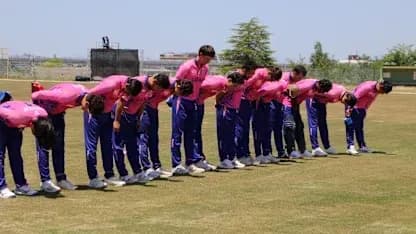
That qualifier still looms large over this squad. Japan finished second in the tournament, level on points with Papua New Guinea and edged out only on net run rate, despite beating the Barramundis on the final day. The numbers hurt, but they also tell a story: this is a team close enough to feel the next step.
The Asian Games will not feature every eligible T20I name Japan could field. Instead, it will showcase a core built in schools, on domestic pitches, and in long, patient pathway work. The question now is whether that investment can carry them from promising nearly-men in regional qualifiers to a side that finishes the job on the global stage.